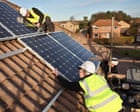
 Solar panels are installed on a house in Washington, Tyne and Wear. Photograph: Washington Imaging/AlamySolar panels are installed on a house in Washington, Tyne and Wear. Photograph: Washington Imaging/AlamySolar cuts ‘at least £400 from bills in even the cloudiest British areas’
Savings grow as energy prices in Great Britain rise and cost of panel installation falls, analysis finds
Households in Great Britain’s cloudiest regions could still save more than £400 a year on their energy bills by installing rooftop solar panels, research has found.
Rising wholesale energy prices mean the potential savings from a home solar panel system have climbed in recent years, as the cost of installation has continued to fall, leading to increased demand.
An analysis carried out for the Guardian has found that in areas with the fewest sunny days, solar panels could bring annual savings of about £450 a year on the average household electricity bill. In areas with the brightest skies, this figure could climb to more than £600.
The findings, provided by the UK solar firm Recharge Renewable, show that households in southern Scotland could save on average £440 a year, based on the estimated solar generation in Glasgow over a year, while homes in the north-west of England could save £463, based on the generation likely in Manchester.
A graphic comparing the average generated power and annual value for solar energy generated by each region in Great BritainIn southern England, where brighter weather means more solar generation, savings on bills could climb to between £571 and £618 a year for households in Brighton and Southampton, respectively, according to the figures.
The potential savings have increased in recent years as conflict in Ukraine and the Middle East have compounded Britain’s rising electricity prices, leading to a boom in rooftop solar installations. Large-scale installations have also climbed under the Labour government, which has set a target to triple the UK’s solar farms by 2030.
A Guardian analysis of the government’s official figures revealed there were more new solar power installations in the first half of this year than in any six-month period since 2011, the year the UK built its first large-scale solar farm, in Cornwall.
Record number of homes in Great Britain turn to green energy as fuel prices soarRead moreMost of the new solar panels recorded are on household rooftops, with these smaller solar installations making up slightly less than a third of the country’s total solar power capacity.
The increase in capacity allowed solar power to supply 14.4% of Great Britain’s electricity in July, more than in any previous month, after some parts of the UK recorded almost twice the average sunshine hours for the time of year. The rise was due to the summer heatwaves, made more severe by the climate crisis, which has triggered drought and record temperatures across Europe.
Recharge Renewable, a Somerset-based solar provider, warned that households hoping to save on their energy bills from solar panels need to pay attention to the set-up of each rooftop system as well as the regional potential.
“Even in cloudier parts of Britain, a typical 4kW system can still be worth around £450 a year in electricity used at home under the current price cap,” a spokesperson said.
“The catch is that this is the value of the units displaced, not a finished bill, and a north-facing or shaded roof will not match a modelled south-facing array. Households should compare any regional headline with their own annual use, then look at whether a battery or more daytime demand would keep more of that generation on site.”
Plug-in solar: could a low-cost panel cut your bills?Read moreThe company’s analysis used the typical electricity output from a standard, south-facing 4kW rooftop solar system, and data for the average energy use of the typical household. These figures were then adjusted for each of Great Britain’s 14 regions, using satellite imagery to measure the different levels of annual sunshine across big cities and accounting for varying electricity rates.
The calculations do not include the use of a battery and assume that each household uses only 50% of the electricity generated over a year. This means that bill payers who use more solar power while working from home, for example, or by timing appliances to run during daylight hours, could make even greater savings.
However, a typical 4kW solar system costs about £7,000 after the government removed VAT for solar upgrades. This puts the upfront cost out of reach of many families and has prompted calls for the government to step in to help make rooftop solar more affordable for people on lower incomes.
Plug-in solar panels went on sale in the UK for the first time last week, allowing households unable to use rooftop set-ups to generate power from their balconies.
Explore more on these topicsShareReuse this content