
 ‘We all work in an AI-hybrid world now,’ said a professor of information science. Illustration: style-photography/Getty Images‘We all work in an AI-hybrid world now,’ said a professor of information science. Illustration: style-photography/Getty Images‘Soon publishers won’t stand a chance’: literary world in struggle to detect AI-written books
US release of horror novel Shy Girl cancelled and UK book discontinued after suspected AI use, as publishers feel ‘cold shiver’
Recently, the literary agent Kate Nash started noticing that the submission letters she was receiving from authors were becoming more thorough – albeit also more formulaic.
“I took it as a rise in diligence,” she said. “I thought it was a good thing.”
But then she had what she described as her eureka moment: the letter with the AI prompt right at the top. “It read: ‘Rewrite my query letter for Kate Nash including a comp to a writer she represents,’” she said.
Once Nash had seen the prompt, she “couldn’t unsee AI-assisted or AI-written queries again”.
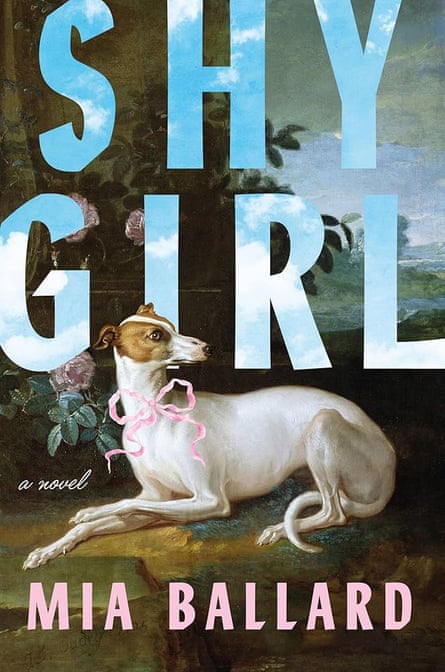 Hachette’s Orbit imprint confirmed it had halted US publication of Shy Girl, by Mia Ballard, after an internal review. The title has also been removed from online retailers and will no longer be distributed in the UK. Photograph: PR
The news last week that Mia Ballard’s “femgore” horror novel Shy Girl could be up to 78% AI-generated, however, has forced literary agents and publishers alike to consider whether sharp eyes alone can detect AI-generated work.
“The question of how Shy Girl slipped through Hachette’s net is something the publisher has to answer themselves, but in reality, it was only a matter of time before this happened,” said Anna Ganley, the chief executive of the Society of Authors.
Wildfire, a UK imprint of Hachette, had published Shy Girl in November 2025. It was due for US publication in April, but the controversy led to its UK discontinuation and US cancellation earlier this month. Ballard has denied using AI to write Shy Girl, telling the New York Times, which first reported the story, that an acquaintance she hired to edit a self-published version of the novel had used it.
An editor at one of the “big five” publishing houses said a “cold shiver went down my spine” when the Shy Girl story broke. “It really is a case of ‘there but for the grace of God go I,’” they said.
“It’s an issue publishers are keenly aware of. We make it very clear to authors what we expect, we get them to sign contracts and we run their work through multiple AI detection tools, but we know all this is fallible.
“Hence the cold shiver: if an author is determined to use AI, then cover their tracks, there’s very little we can do.”
Prof Patrick Juola, a US computer scientist known for his work on authorship attribution, agreed. “I don’t want to call AI detection tools a scam, but it’s a technology that simply doesn’t work.”
He likened the failure to antibiotic resistance: “AI is a learning system continually upgraded by its manufacturers. If there was a detection technology that worked, then people would simply build better AI tools to fool it.”
More than half of UK novelists believe AI will replace their workRead moreMor Naaman, a professor of information science at Cornell Tech and head of its social technologies research group, agreed. “AI learns very quickly how to avoid AI detection. We’re not quite there yet, but soon publishers won’t stand a chance,” he said.
Already, the sophistication of the technology threw up an interesting point, said Nikhil Garg, an assistant professor at Cornell Tech’s Jacobs Institute. “Sophisticated authors who want to evade the detection tools know how to edit their text, test it against these tools and revise again,” he said. “At some point, you have to ask: has it become their own work anyway, despite the AI?”
Naaman agreed that while Shy Girl appeared to be an “egregious” example, there were increasingly grey areas. “We all work in an AI-hybrid world now. When does something become an AI-generated book, rather than just using AI like I use a spellchecker, to fix my grammar or maybe spark ideas?” he asked.
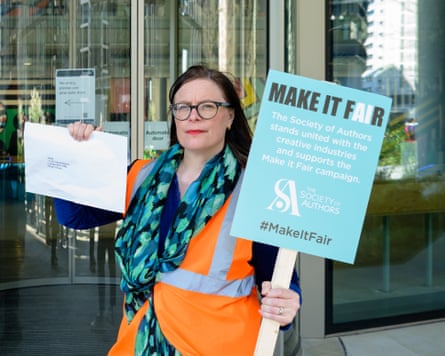 Anna Ganley, of the Society of Authors (pictured at a protest last year against Meta’s use of authors’ content to train its AI), said ‘it was only a matter of time’ before AI-generated books slipped through the net. Photograph: Adrian Pope
If all this is true, the obvious question is: why does it matter if AI writes our books? After all, at one end of the spectrum, generic, formulaic books have always represented a sizeable proportion of any bookshop shelf. Why would it matter whether they were generated by humans or AI?
And if AI did become sophisticated enough to write genuinely engaging books, does that matter, as long the literature is good?
For Naamen, the reason it matters is cultural: AI may flood the page, but it cannot replace the messy, difficult work of being human – the very work that literature exists to reflect back at its readers.
Thousands of authors publish ‘empty’ book in protest over AI using their workRead more“AI nudges users into a bland monoculture. It could never generate the truly diverse creativity of the human mind,” he said. The debate wasn’t about originality alone, he added, it was also about who gets to write, who gets to be read, and who ultimately shapes our culture.
“AI subtly inserts specific viewpoints into its work that are driven by algorithms of all-too-powerful corporations,” Naamen said. “And if AI sucks up all the minor writing jobs and opportunities, then emerging authors are deskilled before they get the chance to create their really significant works.”
Earlier this month, Ganley launched the Human Authored scheme to identify works written by humans. It is, however, a system based on trust – that singularly human and inherently vulnerable value.
But, as Nash says, in this era of deception, trust is more valuable than ever. “Readers trust writers. Writers need to continue to trust themselves over machines,” she said. “The bond between reader and writer is likewise based on trust; the engagement can operate on many levels, but most of all, it must be meaningful.”
Explore more on these topicsShareReuse this content