SpaceX is shooting for new heights with its upcoming Starship test flight, and the booster tapped for the mission is in its final stretch of preparations before the mission.
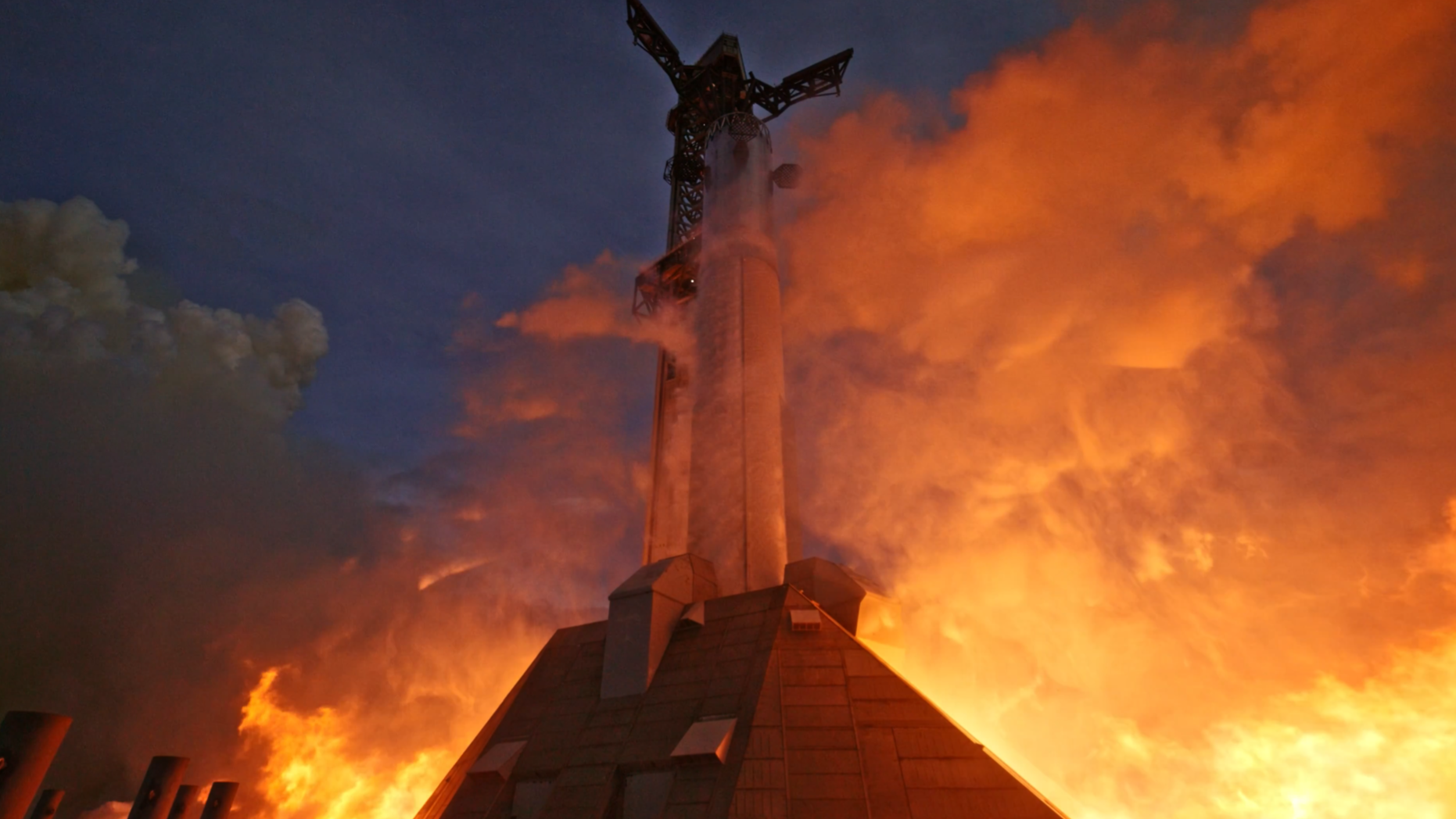
The Super Heavy booster for Flight Test 15, Booster 22, underwent a static test fire on Sunday (Oct. 25), igniting all of its Raptor 3 engines for about 15 seconds. "Full duration 33-engine static fire for the Super Heavy booster preparing for Flight 15," SpaceX said in a post on X.
The test is a beginning of final checks on the first-stage vehicle, which will be mated with the Flight 15 upper stage, Ship 42, ahead of launch, but not before the spacecraft completes some tests of its own.
Ship 42 will also complete a series of tests as the next Starship launch approaches, including a static engine fire and final systems checks. SpaceX CEO Elon Musk has stated that SpaceX will attempt the first launch tower catch of a ship upper stage on Flight 15, which, if successful, would be a significant step forward for the company's goal to mature Starship to full reusability.
SpaceX's confidence in its ability to catch both the Super Heavy and Ship stages has been building this year, following three launches so far in 2026. Its most recent (Sept. 28) mission, Flight 14, reached orbit for the first time and performed the successful deployment of 26 next-generation Starlink V3 satellites, marking the first operational payloads delivered to orbit by the spacecraft. Starlink V3 satellites are too big to fit aboard the company's workhorse Falcon 9 rocket.
Flight 14 wasn't without setbacks, however. An upper-stage Raptor engine shut down prematurely during ascent, prompting SpaceX to cut the planned 10-hour mission short. Ship, nevertheless, completed a controlled reentry and splashed down in the Pacific Ocean about three hours after liftoff.
Flight 15 could carry another batch of V3 Starlinks, though SpaceX has not officially confirmed a payload. Beginning to upgrade its global network with the fast V3 satellites, however, is a major reason SpaceX is pushing to bring Starship into regular service.
Full duration 33-engine static fire for the Super Heavy booster preparing for Flight 15 https://t.co/7eqbC4h0FhOctober 25, 2026
Starship's development also has implications for NASA's Artemis program, which has contracted SpaceX to develop a modified Ship upper stage capable of landing astronauts on the surface of the moon.
NASA recently updated the timeline of milestones SpaceX needs to accomplish with Starship before a lunar lander version will qualify to carry crews, with a significant demonstration mission coming up next summer on Artemis III.
The next Artemis mission will launch astronauts to Earth orbit aboard NASA's Orion spacecraft, which will dock with both lunar lander vehicles over the course of about two weeks (in addition to Starship, NASA contracted Blue Origin's Blue Moon spacecraft as a another lunar lander for the program).
SpaceX is also working toward an uncrewed lunar landing demonstration ahead of NASA's planned return of astronauts to the moon on Artemis IV, targeted for 2028. Which lander will be chosen for that mission is still undetermined, and SpaceX and Blue Origin are both still vying for the first crewed Artemis landing.
Beyond Flight 15, SpaceX hopes to demonstrate additional milestones before the end of 2026, including Starship's first launch from Florida and potentially the first re-flight of an upgraded V3 Super Heavy booster.
Booster 22's engine test marks the beginning in a series of tests leading up Flight 15, which, if recent Starship campaigns are any example, could lift off sometime in mid-to-late November.