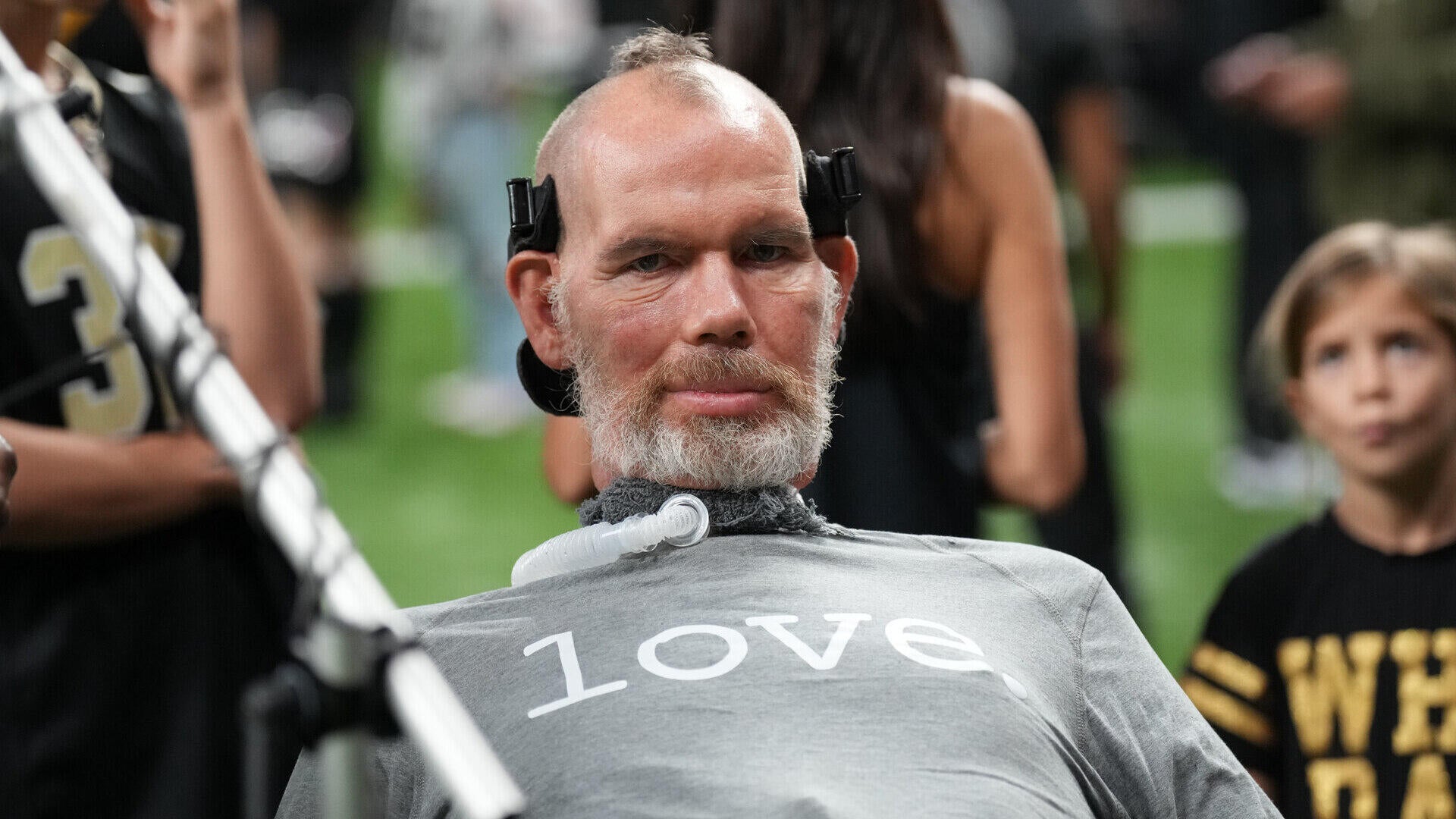
The parallels between Steve Gleason's legendary blocked punt, what it meant for the city of New Orleans and how it resembles his own personal struggle are chilling. A play on the football field that will forever be known as the "rebirth" of New Orleans was, in many ways, a "rebirth" for Gleason. He just did not know it at the time.
Almost exactly 20 years ago, the New Orleans Saints returned to the Superdome for the first time since Hurricane Katrina devastated the city. The venue that served as a shelter for thousands during and after the storm became, once again, the home of a proud football team. A minute and a half after the opening kickoff of the Sept. 25, 2006, game against the rival Atlanta Falcons, Gleason made the most memorable play in franchise history, blocking a punt that was scooped up in the end zone. It was a play that gave the Saints and the city of New Orleans hope once again.
20 years ago, the @Saints player their first game back in The Superdome after Hurricane Katrina. The Steve Gleason blocked punt will live on forever. 💛 ATLvsNO – 8:15pm ET on ESPN Stream on @NFLPlus pic.twitter.com/BUyftIq5D3
— NFL (@NFL) October 5, 2026
On Monday, the Falcons return to the Superdome to face the Saints in Week 4 of the 2026 season. The team will honor Gleason and that 2006 squad in a 20th anniversary celebration.
It will undoubtedly be a meaningful return to the Superdome for Gleason.
"When I roll back into that stadium, I will not only be revisiting a monument of 2006, but I will be walking into a mirror — a place that had to learn how to rise," Gleason said on "Good Morning America" on Monday. "I had to learn the same thing."
Steve Gleason's battle with ALS after football career
Five years after he made an indelible mark on New Orleans with his blocked punt, in 2011, Gleason revealed that he was diagnosed with ALS. The average life expectancy after diagnosis is about three to five years, yet Gleason is among the 10-20% of those who survive for 10 years or more.
"I'm still here," Gleason said on GMA. "That still surprises some people. It does not surprise me as much as it used to."
Gleason uses speech synthesis technology to communicate and requires assistance to move and breathe. Still, he relishes in a "miraculous, wonderful life" and remains an active contributor to the ALS awareness movement. He became the first NFL player to win a Congressional Gold Medal in 2019 for his activism.
NFL players represent one of the populations that is at higher risk of developing ALS than the general public, Gleason said. He found community with other football players who battled or are currently battling the disease, including Chris Johnson, Tim Shaw, O.J. Brigance, Eric Stevens, and Steve Smith.
What "Rebirth" means to Gleason
That game 20 years ago did not just revive the city of New Orleans. In hindsight, it was a pivotal moment in Gleason's life. It just took a few years for him to fully realize what it would mean to be a central figure in a defining moment in the city's and the football team's history.
"If I do not block that punt, I am another former special teams player, a has-been football guy," Gleason said. "When ALS came, I probably fade away quietly and die anonymously. That play made me visible at the exact moment this city needed a symbol. Years later, that visibility became a lifeline. So many people have told us our foundation's work saved their lives."
Last week, Gleason announced that he will release a musical album. The project combines his poetry with the instrumental talent of local musicians in New Orleans. He has already released two tracks and will continue to unveil more throughout the month of October. The songs are largely influenced by Gleason's life since his ALS diagnosis.
Fittingly, the album is titled "Rebirth."
"The truth I have to live with is this: The same play that helped New Orleans breathe again," Gleason said, "is a big reason I'm still breathing now."
How Gleason remembers his blocked punt
Gleason, a special teams stalwart, ran unblocked to deflect the Falcons' punt into the end zone, where Curtis Deloatch recovered the loose ball for a touchdown. The crowd popped when Gleason made contact with the ball, rivaling that of any big play in football history. It was a cathartic moment for a city that, over the previous year, had been through misery.
For the first time in a year, New Orleans had something to cheer about.
"During the Falcons' first two games of the year, we noticed a lot of confusion and errors on their punt team, so we wanted to exploit that," Gleason said, recounting the preparation for that contest. "The scheme is an interior stunt where I cross from the right A gap to the left A gap. Sure enough, the Falcons had some confusion on their assignments. Because they used the slide technique, I ended up unblocked and the B gap opened up for me.
"At that point, there wasn't much thinking. All the film study, repetition and technique took over. The gap opened, and I knew I had a real chance. Then the ball hit my hands."
The Saints had spent the past year bouncing from stadium to stadium because of the damage Hurricane Katrina had done to the Superdome. They went 3-13 in that adversity-filled campaign. Questions arose about whether the franchise would return to the Superdome or to New Orleans in general.
But after a year of repairs to the facility, the Saints made their way back to the Superdome and dominated their division rival. The blocked punt helped the Saints down the Falcons 23-3 in a game that was symbolic of New Orleans' revival as a city.
In turn, a statue of that blocked punt stands outside the Superdome.
Add CBS Sports on Google Join the Conversation comments