
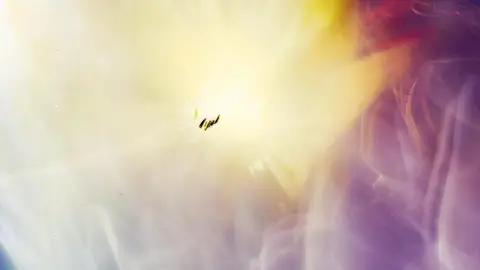
 Tom LiggettA negative film which Tom Liggett developed after it returned from space captured some images believed to be created by cosmic radiation
A photography student at a university has created unique works of art using cosmic rays high above the earth.
Tom Liggett, who is studying BA (Hons) Photography at Arts University Bournemouth sends blank negative photographic film sealed in a bag to the edge of space using a helium balloon.
High above the planet's atmosphere, cosmic radiation rather than light creates remarkable patterns in a technique believed to be a world first.
The balloon rises to three times as high as a commercial aircraft flies, before it explodes, sending the bag of film back down to earth which Liggett then develops.
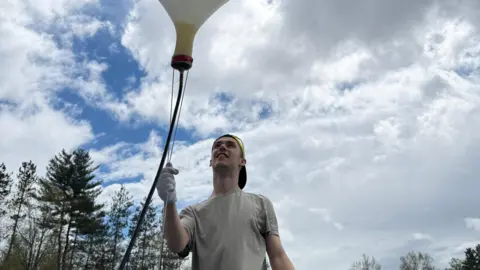 Tom LiggettTom Liggett was able to travel to New York State to take part in the most recent launch of a balloon carrying his photographic film
"It came at the beginning from the question of what would happen if I sent a negative of film in to space", says Liggett.
"It was a really wild question. The chances of this not working is very high, because as far as I know no one's ever achieved it before".
The effect of radiation on undeveloped film can often be a concern for photographers, with X-ray scanners at airports known to pose a risk of causing damage.
But Liggett's interest was in exploring the impact that different radiation could have and after experimenting using dental and hospital X-rays, he turned his attention to space.
He approached a US-based company which sends objects into space using helium balloons and it agreed to work with him.
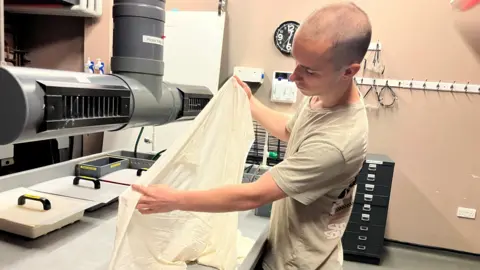 He was able to bring the remains of one of the balloons used to carry his film in to space back to the dark room at Arts University Bournemouth
"A lot of people think when I say these things that there's a camera involved taking the image", says Liggett.
"There is nothing. It's literally just a plastic bag and a sheet of film inside it and it's duct-taped down, that's it".
Liggett travelled to New York State for the most recent launch of balloon carrying his film.
The balloon rises to as high as 121-thousand feet, three times as high as a commercial aircraft flies, before it explodes, sending the bag of film back down to earth.
A tracking-device attached to the package allows the company to locate the film, which he can then develop.
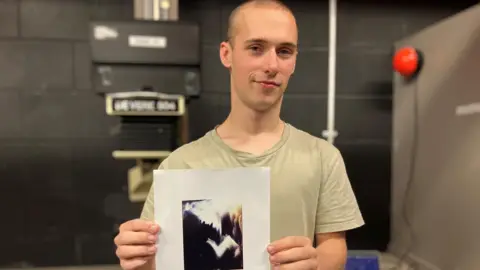 The photography art student thinks the image is a more accurate representation of space than a photograph
Liggett admits he had very low expectations of what the experiment could produce.
"Going back to the first launch, when it came down the film was then sent back and I opened the dark bag and developed it at Arts University Bournemouth", he says.
"There was something on the negative, this kind of like pattern. I knew at that point that I'd achieved something literally unimaginable".
After carrying out extensive research in to the balloon launches that he's been involved in, Liggett says he's confident there's an understanding of how the images have been formed on his film.
"We've kind of deduced it to be UVC radiation, the radiation that exists above the ozone layer because obviously there's no filter up there", he says.
"Then cosmic radiation and muons from black holes, like billions of light-years away".
"I actually think it's a more accurate representation of space than a photograph is", he says.
"It's capturing the actual molecular formula of space".
More stories like this