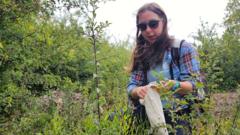

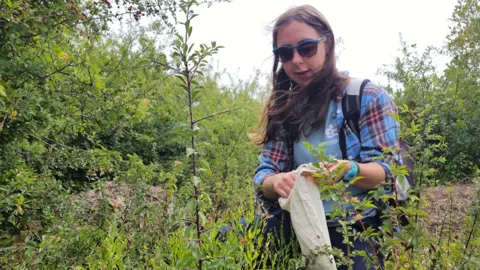
 The National Botanical Garden of WalesEllyn Baker says almost 160 different species of seed have been banked
Should the apocalypse arrive, Wales as we know it may depend on conservationists Ellyn Baker and Kevin McGinn and their cotton bags full of seeds.
The duo are in charge of carefully collecting and storing native wild seeds to create a living genetic library that could restore the country's ecosystem after a disaster.
Ellyn, 25, and Kevin, 38, meticulously plan their summer so they can be in the right place at the right time when plants release their seed - a window of just days in some cases - that, if missed, can take several years to happen again.
But these seeds are not just being saved for some global catastrophe - they have already been used to restore species that have been wiped out.
Inside a small lab tucked away in the National Botanical Gardens of Wales in Carmarthenshire, humming freezers full of labelled silver packets are the last line of defence to save wild species from extinction.
Wales has about 60 species of plant that are not found anywhere else and, if they are wiped out, then that species ceases to exist on the planet, said Kevin, the curator of the seed bank and herbarium.
One-sixth of all plants in Wales are threatened with extinction and if they are lost there would be far reaching consequences for humanity.
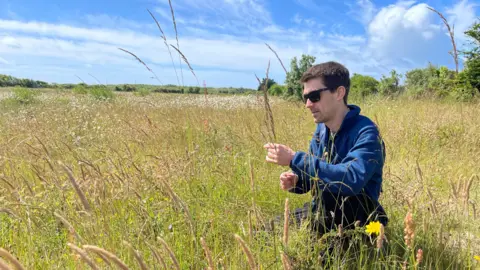 The National Botanical Garden of WalesKevin McGinn helped set up Wales' seed bank in 2018
If a flood or a drought wiped out all of Wales' wild species of plants, it would be this seed bank that could restore the country and save the ecosystem, said Kevin.
"That would be the worst-case scenario," Ellyn added. "As long as the conditions after the apocalypse were still OK for the plants to grow, because obviously they would have been through a lot."
Kevin said it was much more likely for extinctions to happen in localised areas, something that has already happened.
Kevin said people often suffered from "plant blindness" where the benefits to the environment, and society itself, are overlooked.
"When plant species are lost, ecosystems become less resilient to pressures such as climate change, disease and extreme weather," he added.
"This can trigger knock-on effects, for example, insects that rely on specific plants may decline or disappear too.
"Changes like this can affect people. Floral diversity supports pollinators and fewer pollinators can reduce crop yields, impacting food production and local economies.
"Plant diversity also helps maintain soil health, which is vital for farmland, flood mitigation and communities."
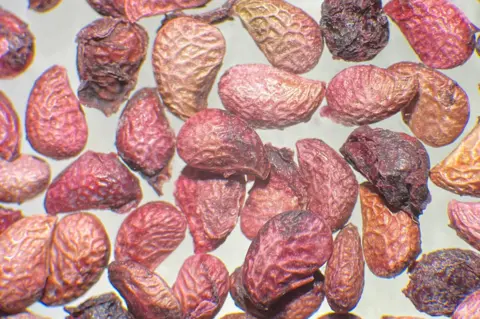 The National Botanical Garden of WalesRubus Caesius, a species of dewberry, seeds are sorted and dried before being sealed in airtight bags
With fewer plant populations, genetic diversity - the range of different genes within a species, some of which could help it adapt to new environments - are lost.
"Genetic diversity is a resource for us too as humans, especially the wild relatives of crops. We've got quite a few in Wales, like sea radish, sea carrot, sea cabbage," said Kevin.
These wild species often have useful genes that make them resistant to pests and pathogens that the agriculturally bred species have lost.
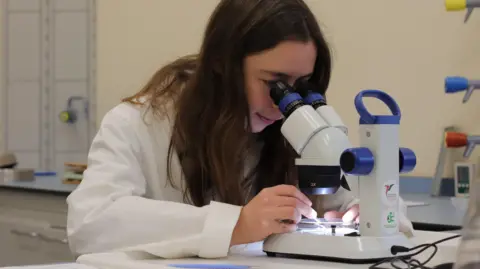 The National Botanical Garden of WalesSample of seeds from each collection are tested to make sure they germinate every 10 years to ensure they are still viable
Shore Dock, one of the world's rarest dock species, went extinct from one of three locations it is found after a landslide in Southerndown, Vale of Glamorgan, said Ellyn.
Luckily, the duo had collected seeds from the population and could restore the species.
But, with weather events get more extreme with climate change, the environment is changing and time is running out.
With only 11% of Wales' 15,000 species banked, these two conservationists are racing to collect all of the country's species.
"The first challenge of the job is to find out actually where these rare plants grow, finding the kind of viable populations, because not all populations of the rare plants actually produce good seed or have got high enough numbers," said Kevin.
It can be very challenging to find the species at the right time, and without the help of passionate botanists across the country notifying them of rare species locations, their job would be even harder.
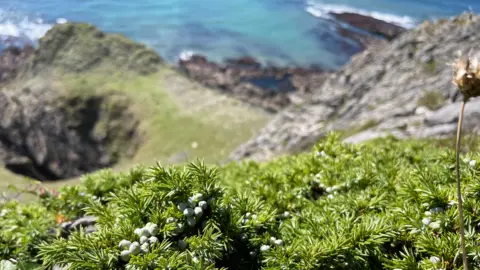 The National Botanical Garden of WalesUnripe juniper berries cannot be collected, they must be ripe so the seeds are ready
Of all the species they have tried to bank, Ellyn said Juniper had foiled them three years in a row.
Though they have found shrubs, only some are seed-producing females and these take three years to ripen.
"Obviously that varies by the individual. And for a seed collection, we want to make sure that we're getting lots of seeds. So the aim is about 10,000 seeds per collection."
If they miss the window, it is a long wait for that individual to fruit again.
"Even with the best planning in the world, you need to time the seed collections when things are naturally falling off the plant to make sure that the seeds are fully ripe, which obviously varies by species."
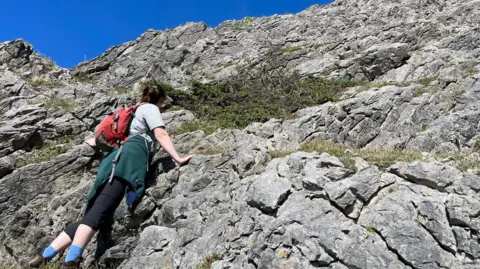 The National Botanical Garden of WalesEllyn Baker said the Juniper plants are a hike to get to every time they attempt it
If a species is not ready, the pair return several weeks later, sometimes only to find all the seeds have dispersed already or been eaten.
It can be a bit frustrating, but "it's all part of it", Ellyn said.
The team's summers can be very busy, attempting to travel across the entire country at the correct times to gather enough healthy seeds.
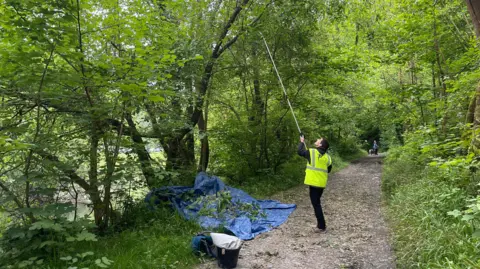 The National Botanical Garden of WalesTo collect tree seeds, the conservationists use a long pruning pole
While the pair both wanted to be conservationists as children, neither knew they would be on the frontline of Wales' insurance policy against plant extinction.
"It's fantastic to be able to come to work and feel like we're not only feeding our own personal passion around plants and then also feel like you're making a difference," said Kevin.
"There's still a whole range of Welsh plants that I've never got to see in the wild, but hopefully now over the next few years, I will be able to."
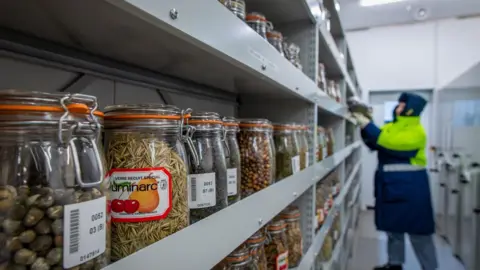 Ines Stuart-Davidson / RBG KewThe Millennium Seed Bank is the largest in the world, with 2.5 billion wild plant seeds from countries worldwide
Wales' seed bank was created in 2018 after the world's largest, the Millennium Seed Bank, found that 75% of Welsh plants had not been banked, said Ellyn.
Since then, they have collected more than five million seeds.
Half of everything they collect is sent to the flood-proof, bomb-proof and radiation-proof sub-zero vault in the Millennium Seed Bank in Sussex, which contains more than two billion seeds from around the world, ready to restart ecosystems in every continent.
The other half is stored in the lab freezers at the National Botanic Gardens of Wales - a big step up from the typical household kitchen freezers they began with.
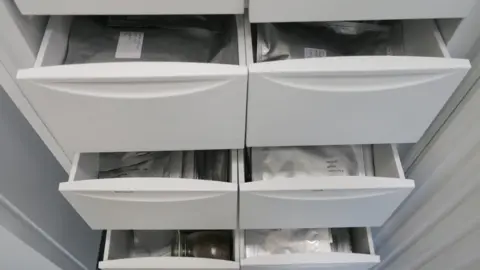 The National Botanical Garden of WalesThe seed bank in Wales was able to upgrade from household freezers to lab-grade
In 2024, the team collected priority crop wild relatives, said Dr Christopher Cockel, the UK conservation projects co-ordinator for the Millennium Seed Bank.
They banked almost 500,000 seeds from 19 species, including relatives of lettuce, parsnip, strawberry, radish, quinoa, blackberry, alfalfa and several species used as fodder crops for livestock.
One of the species related to quinoa may even provide cancer fighting compounds, he said, but added that more research was needed.
Kevin said their mission for the next two years was 100 collections from Wales' Sites of Special Scientific Interest.
"If we weren't doing the work that we're doing, then it's likely that plant populations that will disappear in the future won't have a back up seed collection."
Plants and seeds may not be the first thing to come to mind in the event of a natural disaster, but this pair's work and the 2.5 million seeds waiting in freezers in the Welsh countryside could be the only line of defence against total ecological collapse.
More top stories