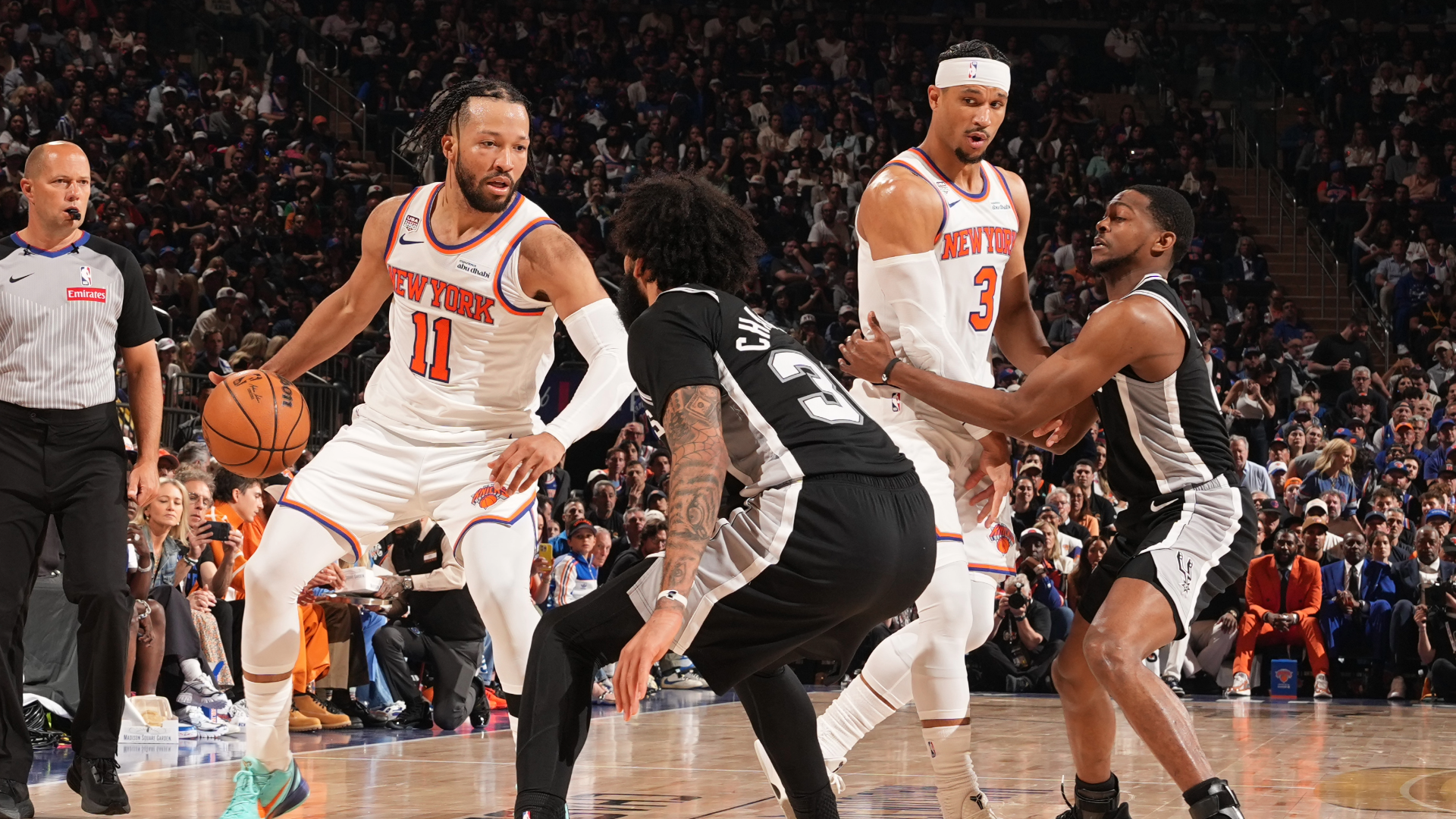
Mike Brown has high standards for how he wants the New York Knicks to play offense. When they don't live up to them, he lets them know it. "I talked to our guys, I thought the second half, the ball came to a standstill," Brown said. "I think you guys all felt it in the second half. The ball didn't move. Whoever had it was like, 'ok, let me try to get my own,' or 'gimme the ball, gimme the ball, gimme the ball.' So our pace went out the window in the full court and the front court. Our spacing went out the window because we just wanted the ball. Quick decisions went out the window because when we had the ball, it was 'ok, lemme see what I can do.' We didn't get the ball reversed because we held onto it quite a bit."
You might think that quote came after Game 3 of the NBA Finals. It certainly applies to their offense on Monday. But it didn't. That actually came after Game 4... of the regular season, a 121-111 loss to the Milwaukee Bucks, and it underlines the job Brown was hired to do.
The Knicks had a lot of bad habits offensively under Tom Thibodeau. They took the wrong shots. They played too slowly. They dribbled too much. Fixing those issues has been a year-long process. They didn't fully seem to buck them until after Game 3 of their first-round series against the Atlanta Hawks, their second consecutive one-point loss in that series. After reimagining their offense for Game 4 and fully buying into Brown's preferred playing style, the Knicks won 13 consecutive games and took a 2-0 series lead over the San Antonio Spurs in the NBA Finals.
But doing so required buy-in from the entire team and meant kicking habits that lasted for most of their careers. Change like that is intentional, and it takes a lot more than 13 games to form new habits. The Knicks were stress-tested in Game 3 of the NBA Finals, and for the first time since that Hawks series, the new habits they're trying to form gave way to the old ones they're trying to overcome. Just look at some of the numbers:
- The Knicks averaged 2.57 dribbles per touch during their 13-game winning streak. They averaged 2.77 in Game 3 of the NBA Finals. The Knicks held the ball for 3.36 seconds per touch during their 13-game winning streak and 3.49 seconds per touch in Game 3 of the Finals. Not enormous differences, but notable ones.
- The Knicks played at a pace of 96.65 possessions per game during their 13-game winning streak and 98.75 in the first two games of the NBA Finals, but fell down to 93 in Game 3.
- The Knicks averaged only 257.3 passes per game in the first three games of the Hawks series. After Game 3, that figure jumped to 285.3. It stayed in that range at 283 in the 76ers series, and jumped again to 290 in the Cavaliers series. The first two games of the NBA Finals featured New York's best ball-movement of the season: 295 passes in Game 1 and 301 passes in Game 2. But in Game 3? They fell to 270 passes.
These differences might not look enormous on paper, but we're in a Finals series in which all three games have been within a single possession at some point in the final 71 seconds of the fourth quarter. The margins here are razor-thin, and every little bit counts. The Knicks went from a run-of-the-mill 53-win contender into a historic playoff juggernaut by changing their offensive approach, but for so much of the Finals thus far, they've simply looked like the old Knicks.
Take Jalen Brunson. His two highest usage rates this postseason, which would be two of his four highest of the entire year, including the regular season, have come in the NBA Finals. His lowest-usage game of the Finals came in Game 2 at 35.1%... which was still higher than any figure he posted in the last two rounds of the Eastern Conference playoffs. There have been a total of 98 possessions thus far in the Finals in which a player held the ball for six or more seconds and taken a shot, according to Basketball University, and 57 of those possessions belonged to Knicks. Of those 57, 44 were Brunson's. Nobody else on the team has more than four.
That includes Karl-Anthony Towns. His usage rate was 20.6% during the winning streak, but fell to 14% in Game 3. After touching the ball 63 times in Game 1 and 64 times in Game 2, he was down to 45 touches in Game 3. Notably, this came despite him playing 38 minutes and two seconds in Game 3 after averaging 34 minutes and nine seconds in the first two games of the series.
The Knicks have run more offense through Towns this postseason than ever before, and the results have been, by and large, excellent. He averaged more than six assists during the winning streak, by far the best passing stretch of his career. He had just one in Game 1, tied for his low of the postseason, and the Knicks had only 18 assists, their team low for the playoffs. That wasn't the result of poor shooting, either. The Knicks had only 33 potential assists in Game 3 compared to 85 in the first two games of the series.
Now, this is not just a matter of bad process from New York. The Spurs did their part to make this happen. They doubled Brunson far less in Game 3 than they did in Game 2, and their big, physical guards held up exceedingly well. They made a concerted effort to slow the game down and didn't give the Knicks opportunities to score in transition because they committed only four live-ball turnovers. Foul trouble messed with New York's rotations. Mikal Bridges had to leave the game early, and without him as a release valve, Brunson got a bit too dribble-happy early on. That persisted.
No one is suggesting the Knicks should take the ball out of Brunson's hands fully. There's a balance to be found here, especially late in games. Brunson has taken 25 fourth-quarter field goals to Towns' six, for instance, and that's despite Towns playing more fourth-quarter minutes in that series. The end of games should belong to Brunson, though perhaps not to that degree. The middle of games should more prominently feature Towns. Though Brown didn't mention that balance directly after Game 3, he talked about the offense's stagnancy in terms very similar to those he used after that October loss to Milwaukee.
"We were just playing a lot of drag into what we call summertime, which is just kind of ball movement and body movement. We just wanted to stand and watch one guy dribble a ton," Brown said. "And then when the ball got passed, there were no quick decisions by the guy receiving the basketball.
"So we have actions we can get into that we didn't do a good job of getting into, first of all, but it's okay because you're not going to be able to run plays all the time, especially with how physical they are playing defensively. Sometimes you've just got to go by guys. But you've got to be smart. You have to take care of the basketball. You have to space right. You have to move the ball. You have to move bodies. We've done that quite a bit, and we didn't do a good job of it tonight."
It took the Knicks all season to develop the habits that got them within two games of the championship, but only about two hours to slip out of them. They were, again, stress tested. It's easier to maintain the right habits in October than it is in June. The playoffs are designed to force teams to play in ways they'd prefer not to. The onus is back on the Knicks to rediscover the magic from their winning streak, because as Game 3 showed, the old version of their offense isn't going to cut it against a San Antonio defense this good.
Add CBS Sports on Google Join the Conversation comments