NOW PLAYING
It’s crunch time in the fiercest and most divisive Democratic primary battle of the year.
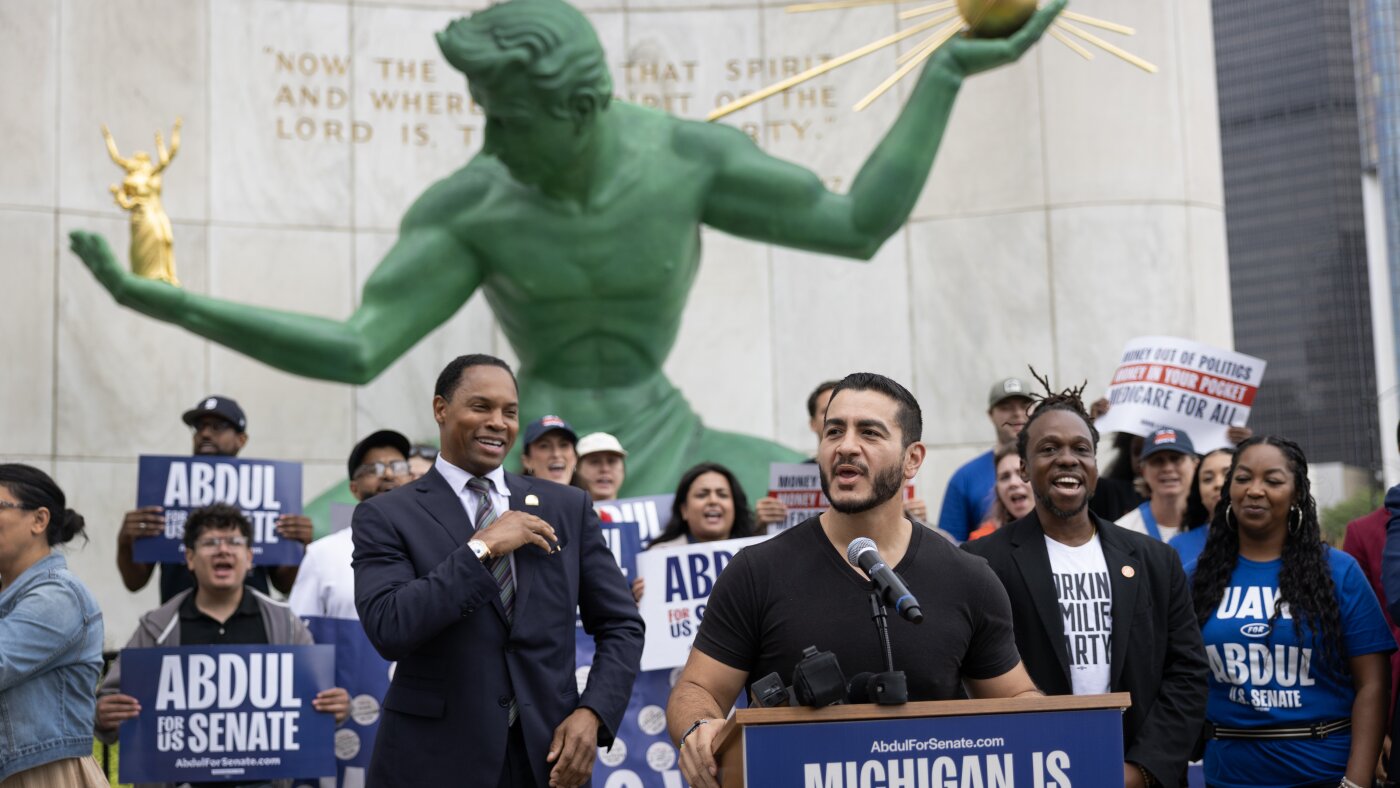
On Tuesday, Democratic voters in Michigan will decide whether progressive Abdul El-Sayed or centrist Rep. Haley Stevens (D-Mich.) will be their Senate candidate as the party tries to retain the seat being vacated by Sen. Gary Peters (D).
The race is vital for the party’s chances of taking the upper chamber, given that Republicans currently have a 53-47 majority, and a GOP gain anywhere in the country would almost certainly snuff out Democratic hopes of overall control.
But the battle between El-Sayed and Stevens is about much more than that.
It is 2026’s most intense battle in a larger Democratic Party war between leftist insurgents and a more centrist establishment. The high stakes mean it has featured its share of heat and personal venom.
The primary comes as the left is surging.
Progressives have won big victories in the past couple of years — notably the election of New York City Mayor Zohran Mamdani (D) in a come-from-obscurity win that involved beating centrist, corporate-friendly former Gov. Andrew Cuomo (D) twice.
This June, Mamdani’s backing helped propel three progressive candidates in New York to victory in House primaries. Two of the three, Darializa Avila Chevalier and Claire Valdez, are members of the Democratic Socialists of America (DSA), while the third, Brad Lander, is a former member. Avila Chevalier and Lander both defeated Democratic incumbents.
In the eyes of the left, the Democratic establishment is not just wrong but rotten: Too in hock to what the left terms “the donor class,” too timid about standing up to President Trump, too reluctant to battle for policies to help the working class and too pro-Israel.
But centrist Democrats levy their own list of indictments against the left.
They fear policies that go down well with primary voters in progressive strongholds like New York and Los Angeles have thin appeal in general elections. They worry that the DSA, in particular, is way outside the American mainstream. And, more broadly, they argue that the left is self-indulgent and that its policies and preoccupations will hurt the party in the very places it needs to win if it is to return to power.
El-Sayed is not affiliated with DSA nor does he consider himself a socialist. But he is plainly on the progressive side of the party, and the left versus center battlelines are very clear in his race with Stevens.
A who’s who of the progressive movement have campaigned with El-Sayed, endorsed him or both.
The list includes Sens. Bernie Sanders (I-Vt.) and Elizabeth Warren (D-Mass.), as well as Democratic Reps. Alexandria Ocasio-Cortez (N.Y.), Rashida Tlaib (Mich.), Ro Khanna (Calif.), Ilhan Omar (Minn.), Ayanna Pressley (Mass.), Pramila Jayapal (Wash.) and Summer Lee (Pa.).
But Stevens is hardly alone in the endorsement game. Peters has endorsed her and desperately wants her to succeed him. She has the support of Senate Minority Leader Chuck Schumer (D-N.Y.). And she landed a big get late last month when Michigan Gov. Gretchen Whitmer (D) endorsed her.
In a video message, Whitmer said that she builds her own activities as governor around the simple idea of getting things done. “That strategy informs everything that I do and that’s why I’m endorsing Haley Stevens for the U.S. Senate,” Whitmer said.
Stevens has cast herself as an unglamorous but effective figure going up against El-Sayed, whom she characterizes as a celebrity figure buoyed by backing from outside the state.
In one recent social media post, Stevens contended that she would “lower the costs of groceries, ban stock trading for elected officials, stop Trump’s abuses of power, and protect Michigan manufacturing.”
By contrast, she contended of her opponent: “You’ll just be a celebrity whining and writing books to get even richer.”
So far, however, it does not appear that Democrat voters are rallying to Stevens’s arguments or her attacks. Polls show El-Sayed as the clear favorite to win the primary.
In the polling average maintained by The Hill’s polling and data partner Decision Desk HQ, El-Sayed leads Stevens by roughly 13 points. One recent poll from Emerson College put the progressive former public health official up by 15 points over the congresswoman.
Part of the reason is surely a general distaste among the Democratic grassroots for a party establishment that many feel has failed them. El-Sayed’s support for long-sought progressive goals like Medicare for All consolidates that backing. So, too, does the candidate himself — a charismatic figure who even some party opponents acknowledge is a highly effective communicator.
But it’s also impossible to disentangle the Michigan race from one of the most emotive issues in the politics of today’s Democratic Party: Israel and the Palestinians.
El-Sayed is adamant that Israel’s assault on Gaza is a genocide. He wants to stop U.S. aid to Israel. He is the son of Egyptian immigrants in a state home to 300,000 Arab Americans — and one in which former Vice President Kamala Harris’s support for former President Biden’s pro-Israel policies cost her dearly in the 2024 presidential election.
Stevens wants traditional U.S. support for Israel to continue. She does not consider the events in Gaza to amount to a genocide. And the American Israel Public Affairs Committee (AIPAC) and its affiliated groups have supported her to the tune of roughly $30 million in the primary.
Notably, El-Sayed seems to be more eager to talk about AIPAC’s backing of Stevens than the congresswoman herself.
Perhaps that should be no surprise. Grassroots Democratic opinion has turned decisively against Israel.
In an Economist/YouGov poll last month, respondents were asked if their sympathies lay more with Israel or the Palestinians. Democrats favored the Palestinians by more than three to one.
Joel Payne, a Democratic strategist, said that for many party voters these days “Israel-Gaza is the foundational test of whether or not I can trust you.”
Payne works with MoveOn, which has endorsed El-Sayed, but he emphasized he was not speaking on behalf of the group to this column.
He added, of the primary, “If this is a referendum essentially on Gaza, I think that is terrain that is helpful for Abdul El-Sayed. Otherwise, Haley Stevens’s chances increase.”
Stevens has one especially strong card: Polls tend to show her doing better in the general election against the Republican nominee, former Rep. Mike Rogers.
That being so, it is still possible she wins a surprise primary victory.
But the odds, for now, favor El-Sayed — and another advance for the left.
The Memo is a reported column by Niall Stanage.
Add as preferred source on Google Tags Haley StevensCopyright 2026 Nexstar Media Inc. All rights reserved. This material may not be published, broadcast, rewritten, or redistributed.
Comments: Link copiedMore Campaign News
See All
 Campaign South Carolina Republicans jockey to replace Graham on Senate ballot: Key takeaways from first debate by Julia Mueller 10 hours ago Campaign / 10 hours ago