What design actually delivers the best sound?
By Roger Fingas Nov. 21, 2026 7:00 pm EST Inside Creative House/Shutterstock Add Engadget on Google: Preferred Source Google Discover
Wireless earbud design has evolved in leaps and bounds. Some of the earliest models would occasionally lose sync between each ear, never mind questions like battery life or sweat resistance. Now, the best wireless earbuds can last an entire workday and will survive the sweatiest gym sessions. You can even use the AirPods Pro 3 as hearing aids.
Our question today is this: What design actually delivers the best sound? The industry has evolved to support many different form factors, but not all of them are actually geared towards fidelity. Some may prioritize maximum comfort, particular environments or simply a consumer price point. Make the wrong choice, and the results can be extremely disappointing.
Considerations include the type of eartips, how buds secure to your ear, and noise cancelation features. We'll also explain when it's worth making some sacrifices, since vanilla audio may be better than nothing at all.
The form factor for wow factor
 MMPhoto21/Shutterstock
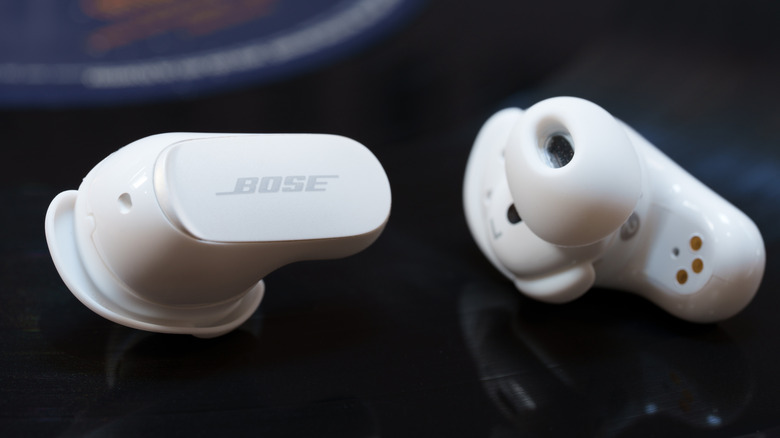
When it comes to form factor, you'll want to begin with in-ear (sometimes referred to as in-canal) earbuds. These provide several major benefits to audio quality over open-ear designs, beginning with passive noise cancellation. You're blocking most of the outside world, although some noise will inevitably seep through. This positioning also maximizes the perceived volume of each bud, which can help you catch more of the nuances in your movies and music. You should even experience better bass response because the buds are directly rattling your ear and the air inside it.
From here, further narrow your search to models with foam or silicone eartips. These boost passive cancellation as well as bass response, the latter by trapping frequencies inside a space with increased air pressure. For this reason, it's vital to find tips that form a tight fit. You can sometimes upgrade to third-party tips if the ones bundled with your buds aren't doing the job. Keep in mind that while foam is preferable for sound quality, it's less than hygienic for workouts because it's harder to clean.
Speaking of fit, it's also important to choose buds that lock in as securely as possible without becoming painful to wear. When buds are loose, they can break that ever-so-important sound quality seal, even if you have great tips. You don't necessarily need buds with an external clip, but those may help if you want both quality and the freedom to sprint or do hanging crunches.
You'll also want a design with active noise cancellation (ANC). Passive cancellation merely isolates sound. ANC generates "anti-noise," which partly or completely neutralizing the outside world. This is essential not just for hearing quieter elements in your audio, but also for eliminating distractions such as plane engines or nearby conversation.
You can't always put quality on a pedestal
 Suitablystudio/Getty Images
Some people intentionally choose open-ear or bone conduction earbuds, despite sacrificing significant bass output and noise cancellation. The reason is simple: situational awareness. If you're running or cycling outside, for example, you can't afford to block out ambient noise because you need to be able to hear an engine, horn, siren or yell warning you of imminent danger. Many in-ear ANC products (like AirPods) compensate by offering "transparency" modes, but of course, it's hard to beat direct exposure to your environment.
Bone conduction buds can sometimes operate in conditions where other designs are unusable, such as underwater. Those benefits go out the window with models that add air-based drivers into the mix to improve bass. All bone conduction buds do, however, deliver many frequencies straight to your inner ear, allowing them to remain "pure" despite mixing with ambience.
You'll probably recognize immediately whether these sacrifices are essential. When in doubt, it's better to default to in-ear ANC buds. There's just no way of recovering the lost fidelity if you opt for something else.