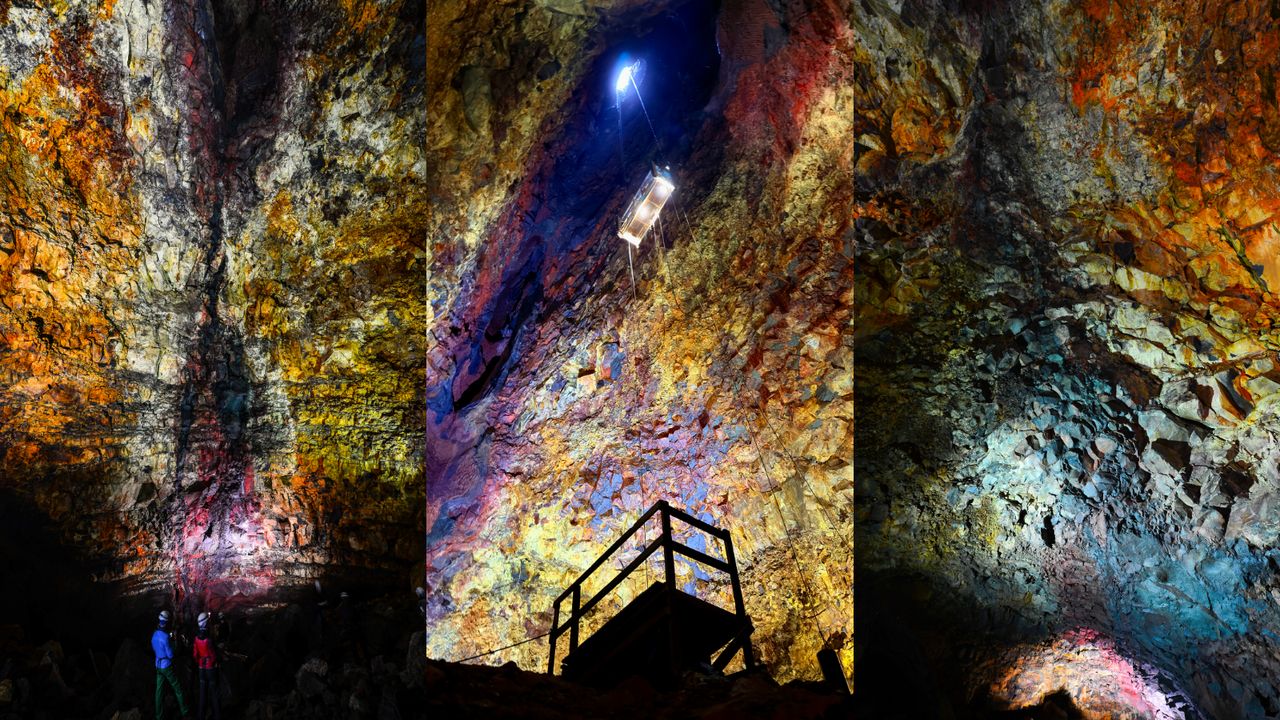
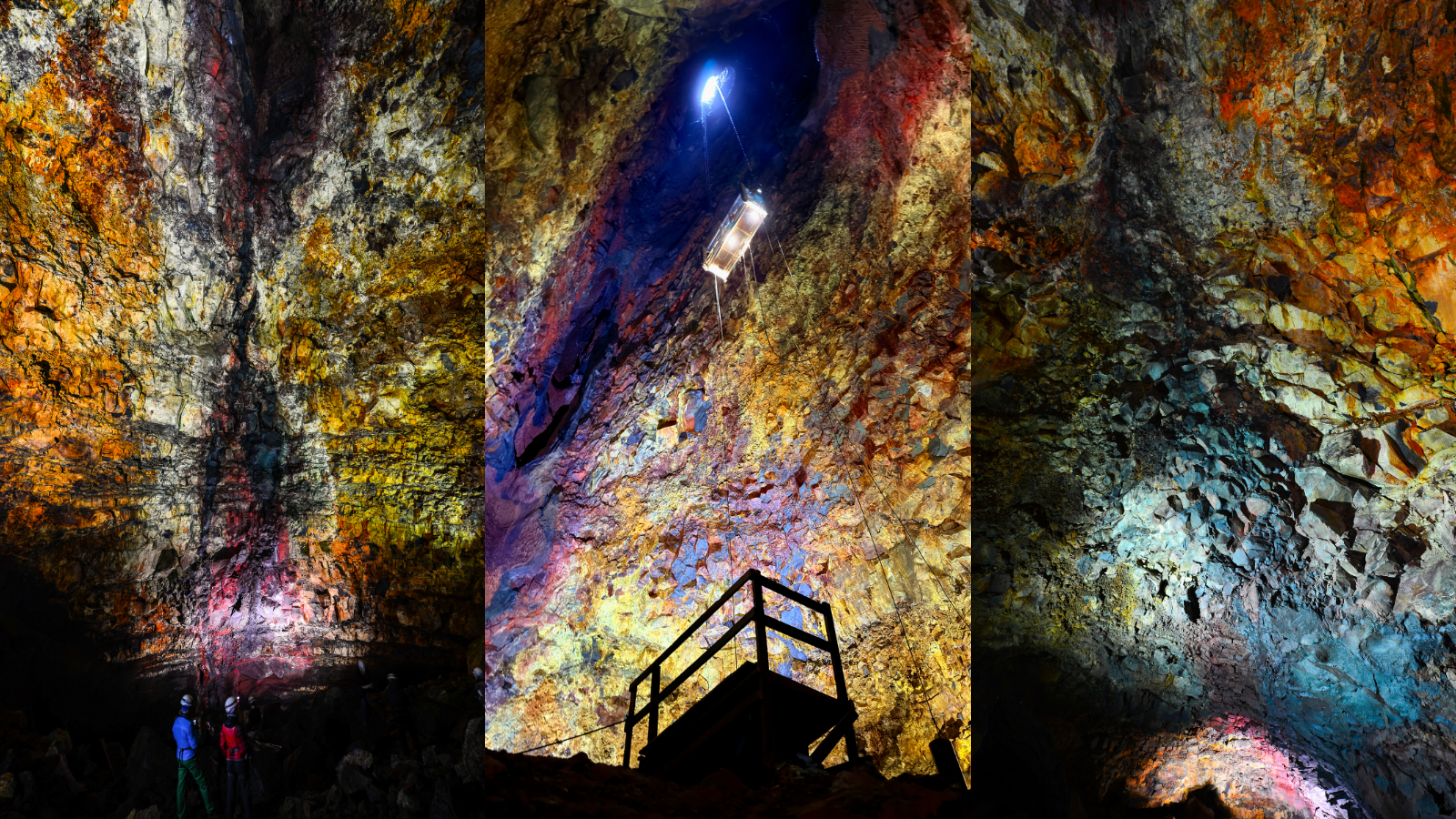
 The colors inside the magma chamber are attributed to microbes, sulfur-rich gases and rocks tumbling off the walls. (Image credit: Pedro Carrilho (left and right) and KKKvintage (middle) via Getty Images) Share this article 0 Join the conversation Follow us Add us as a preferred source on Google Newsletter Sign up for the Live Science daily newsletter now
 Get the world’s most fascinating discoveries delivered straight to your inbox.
Become a Member in Seconds
Unlock instant access to exclusive member features.
Contact me with news and offers from other Future brands Receive email from us on behalf of our trusted partners or sponsors By submitting your information you agree to the Terms & Conditions and Privacy Policy and are aged 16 or over.You are now subscribed
Your newsletter sign-up was successful
Want to add more newsletters?
Join the club
Get full access to premium articles, exclusive features and a growing list of member rewards.
Explore An account already exists for this email address, please log in. Subscribe to our newsletter QUICK FACTSName: Thríhnúkagígur, or Three Peaks Crater
Location: Southwest Iceland
Coordinates: 63.9984, -21.6989
Why it's incredible: The volcano hosts the world's only magma chamber that's accessible to humans.
Thríhnúkagígur is a dormant volcano near Reykjavík whose last eruption 4,500 years ago left a hollow magma chamber with bronze-and-indigo-colored walls. It's the only place in the world where people can climb into a volcano's plumbing system and explore the cavern that held sizzling molten rock before an eruption.
Since 2012, visitors have been allowed to enter Thríhnúkagígur's magma chamber via an open cable elevator that was built in 2010 for scientists. The chamber is about 700 feet (210 meters) deep, or more than double the height of the Statue of Liberty with the pedestal. Visitors are lowered to the bottom of the cave in a metal cage, and then they are free to roam the 33,600-square-foot (3,120 square meters) cave floor.
Volcanoes don't usually have empty magma chambers beneath them. Typically, during an eruption, there comes a point when the pressure in the chamber isn't high enough to eject any more liquid. The leftover magma slowly solidifies inside the chamber, filling the ground beneath the volcano.
Thríhnúkagígur is an exception, but researchers don't really understand why. The magma that fed the most recent eruption seems to have disappeared, and scientists think it may have been sucked back down into Earth's crust.
"It's like somebody came and pulled the plug and all the magma ran down out of it," Haraldur Sigurdsson, a volcanologist and professor emeritus of marine geology and geophysics at the University of Rhode Island, told Inside the Volcano, a company that organizes tours of Thríhnúkagígur.
The colors inside the chamber are attributed to microbes, but not much is known about the organisms that live there. Sulfur-rich gases likely painted some parts of the cave yellow and orange, while rocks falling off the walls formed the indigo and blue patches. Visitors occasionally see puffs of steam rising from corners of the chamber, but these are caused by water dripping onto lamps that illuminate the cave and are not signs of an impending eruption.
Evidence suggests Thríhnúkagígur has erupted three times over the past 50,000 years. The volcano presents three peaks at the surface — hence its name, which translates to "Three Peaks Crater." They are similar in height — about 115 feet (35 m) tall — and they form a line, with about 660 feet (200 m) between each peak.
Sign up for the Live Science daily newsletter nowContact me with news and offers from other Future brandsReceive email from us on behalf of our trusted partners or sponsorsThe opening where people can descend into the magma chamber is located atop one of Thríhnúkagígur's three peaks. (Image credit: Jorge Castellanos/SOPA Images/LightRocket via Getty Images)MORE INCREDIBLE PLACES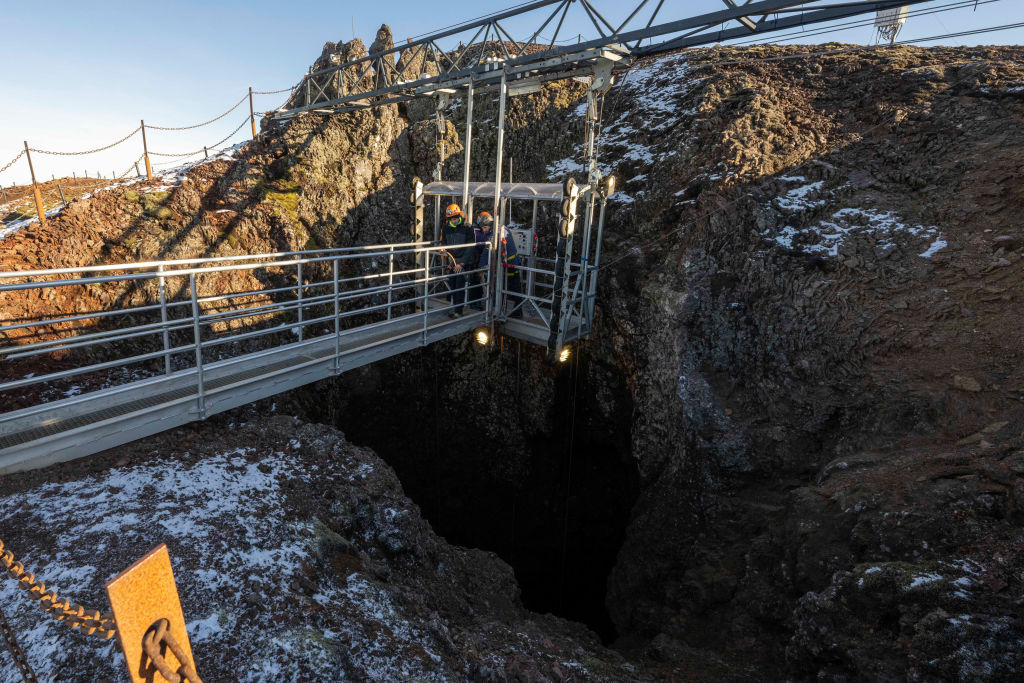
- Sørvágsvatn: The lake that 'floats' above the ocean thanks to a unique optical illusion
- Bandera Volcano Ice Cave: The weird lava tube in New Mexico whose temperature is always below freezing
- Sistema Ox Bel Ha: A vast hidden system that's the longest underwater cave in the world
The youngest peak dates to the eruption 4,500 years ago. At the top sits the opening where scientists and tourists start their journey into the heart of the volcano. The next peak in the line formed 5,000 years ago, and it is partly encircled with solidified lava from the most recent eruption, according to Inside the Volcano. The oldest peak formed 50,000 years ago, when Iceland was covered with a thick ice sheet. It is composed of hyaloclastite, a volcanic rock characterized by sharp, glassy fragments that appear when lava comes into contact with water and ice.
It's unlikely that Thríhnúkagígur will erupt anytime soon, even though the volcano sits within the Mid-Atlantic Ridge, a tear in Earth's crust where the Eurasian and North American tectonic plates are separating, according to Inside the Volcano.
Discover more incredible places, where we highlight the fantastic history and science behind some of the most dramatic landscapes on Earth.
 Sascha PareStaff writer
 Sascha is a U.K.-based staff writer at Live Science. She holds a bachelor’s degree in biology from the University of Southampton in England and a master’s degree in science communication from Imperial College London. Her work has appeared in The Guardian and the health website Zoe. Besides writing, she enjoys playing tennis, bread-making and browsing second-hand shops for hidden gems.
View MoreYou must confirm your public display name before commenting
Please logout and then login again, you will then be prompted to enter your display name.
Logout LATEST ARTICLES 1New York City is at major risk of flooding that could leave 4.4 million people exposed to extreme damage, study finds
 - 2'A completely new reality': Bolder measures are needed to prevent extreme water shortages in cities like Phoenix and Las Vegas that depend on the Colorado River
- 3El Niño could be here by May, new forecast reveals — here's what it means for summer weather
- 4Claude Mythos explained: Is Anthropic's most powerful AI model really too dangerous to release to the public?
- 5DNA study of nearly 200 Indigenous genomes reveals unknown Asian 'ghost' population contributed to American ancestry