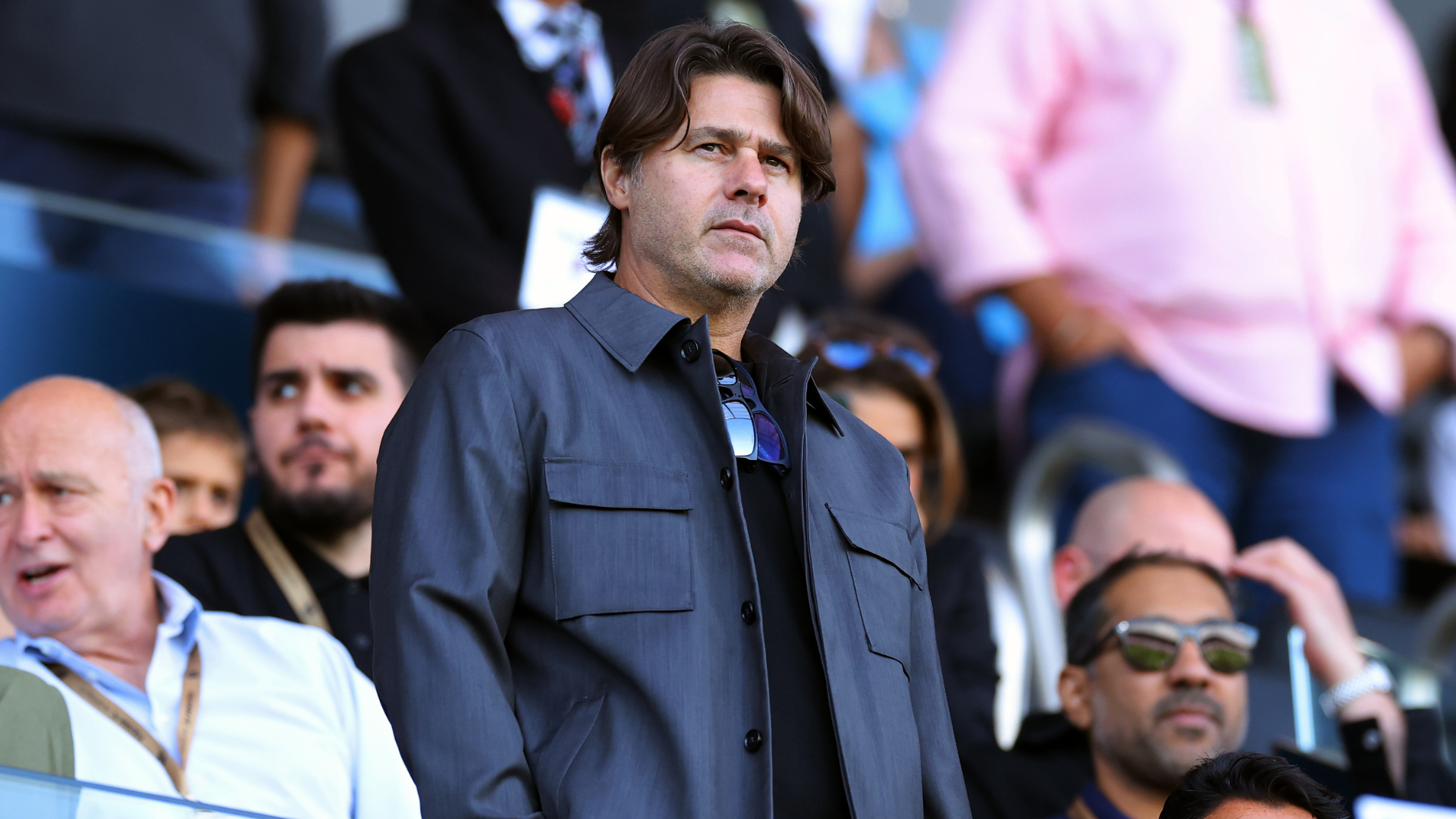
U.S. men's national team head coach Mauricio Pochettino said that he intends to call up a crop of rising talents for the group's first matches following this summer's World Cup, aiming to mix them into a squad that will also feature experienced players as he begins to pave the road to the 2030 World Cup.
Pochettino, who signed a new deal last month that runs through the 2030 tournament, said he is working with a pool of around 100 players before he whittles the list down to 26 for four friendlies this fall. The contenders for the fall friendlies include the 26 that made this summer's World Cup team, the roughly 40 other players that Pochettino worked with in the build-up to the competition and a list of young players eager to make their case to be part of the senior national team as soon as possible.
"I think our idea [is] we are going to do a mix [of] experienced players," Pochettino said Monday. "I think experienced players with young players that can fit together and start to work and how the young kids start to manage the pressure to play in the first team [in the] very next games … It's tough, but I think it's important now to have this pool of a lot of players because I think players can evolve from one month to another, six months, one year and it's important to keep that connection."
Two years after initially taking the job, Pochettino has dubbed the upcoming friendlies as a "new start" with his newfound luxury of time. Though he was not shy about incorporating inexperienced talents in the quick run-up to this summer's World Cup on home soil, the expectation is that the USMNT will undergo a generational shift in the next four years in large part because several promising players are knocking on the door. The headlining acts include the Philadelphia Union's Cavan Sullivan, who has already committed to join Manchester City after his 18th birthday next September, and 19-year-old Zavier Gozo, who made his Premier League debut for Crystal Palace last month after a move this summer from Real Salt Lake. The list, though, does not end there.
"Philadelphia have good young players, good kids that maybe we will call a few," he said. "New York, yes, Orlando, Nashville, Atlanta. I can keep going, no? But I think yes, we are so excited because I think we can add young kids that can bring the fresh start and you can feel something different."
Pochettino and federation staff are also in communication with dual nationals who are eligible to play for the U.S. but have yet to make a decision on international futures, though it is unclear how many of them will make the cut for the upcoming friendlies. One player is already off the list for the time being -- defender Noahkai Banks, who is still deciding between representing the U.S. and Germany a year after taking part in a USMNT camp.
"Still no decision and of course, we cannot consider him for the next camp," he said. "In that case, Noahkai is still in the same situation that [he] was [in] before the World Cup when we talked."
Pochettino said he and his staff have worked in close collaboration with U-23 USMNT head coach Steve Cherundolo on establishing the player pool and will continue to do so in the build-up to the 2028 Olympics in Los Angeles. The men's soccer event at the Olympics is a youth tournament and will serve as an important mid-cycle check-in before the 2030 World Cup. Each international break along the way will likely serve as a marker of progress for the USMNt's incoming talent who could be divided up between the senior team and the youth team in a mix-and-match approach.
"We are going to be [available], always, with Steve, working [with him] and him working with us and being always involved in trying to make the best decision for them because I think we have a a core of young players that need to play [in] the Olympic Games," Pochettino said, noting the goal is to compete for the U.S.' first-ever gold medal in that event.
"I think it's an objective for our federation and for the country to try to be a contender for the gold medal and I say it's important. It's going to be in our country, and we are going to support that, and always, the decision on the first team with the players that are in that process is going to be [that] we are going to take the best decision all together, always."
The upcoming friendlies are as far away from a World Cup as the calendar allows, but the USMNT's return to play also marks Pochettino's foray into the inexact science of player development, and inside the unique confines of American soccer. U.S. Soccer hopes to use World Cup fever to reorganize – and ultimately simplify – the country's fractured youth soccer structure, Pochettino and his staff set to play a part along the way. Recruiting young players for the national team is merely one step for the head coach, who picked up an advisory role when he signed his new deal a month ago.
"It's an exciting moment, and to settle the new rules, the new view," he said, "to build something different and to establish USA, improve in every season and to, of course, arrive to the World Cup and try to arrive within the conditions to be a real contender. It's going to be tough because you always need time but I think that is not only our desire or wish, if not to feel confident that we can arrive in four years being a real contender."
USMNT's fall friendlies
All times U.S./Eastern)
- Sept. 26: USMNT vs. Peru (4:30 p.m., TNT)
- Sept. 29: USMNT vs. Chile (8 p.m., TNT)
- Oct. 3: USMNT vs. Mexico (10 p.m., TNT)
- Oct. 6: USMNT vs. Canada (8 p.m., TNT)
Pochettino's 'new rules'
Pochettino started his latest session with reporters by singing a few lyrics from "End of Beginning," the melancholic 2022 song from 'Stranger Things' star Joe Keery, but stopped himself before getting to what might be the ballad's most relevant line -- "the song has started now, and you're just finding out."
Pochettino has insisted the objectives for the next four years will vary greatly from his first months on the job, initially taking the role with just 18 months in between his first match in charge and the USMNT's World Cup opener. That includes a more exaggerated look at a favorite pattern of his over the course of his coaching career -- being unafraid to offer young players a platform to perform, no matter the pressures that might await them. He found ways to integrate younger players in the national team in the build-up to the World Cup, chief among them Alex Freeman, who went from an unknown talent to a starter and goalscorer this summer in a matter of 400 some-odd days.
With plenty of time on the clock this time around, patience is a virtue he is happy to adopt.
"We need to be careful, no?" he warned. "We need to be careful because when you are young, of course you need to be confident. You need to have the trust in yourself and believe that you can perform and you can do well, but I think [there's] a limit, no? The balance is the most important and one of our responsibilities is to protect these guys because sometimes if you are 17, 16 or 18, and you play well and people start to talk that you are [Lionel] Messi or you are a big star in the world because you do [a] few good things, after, you are confused and you don't manage well, that can be dangerous for your career and that is what we don't want. We don't want that. [For] the people, the young guys with potential [of] being top players, [we want] to provide the platform for them to evolve and to be professional, to build their career in the best way, improving every day, being humble, being careful when they talk in the media, when they talk with the teammate, when they talk with the opponent."
Pochettino also admitted that he has some unfinished business in American soccer, returning to a frequent talking point of his in his two years in the job so far – a dissonance between what he believes the demands of being a national team player are and an apparent unwillingness for some in the ecosystem to meet those expectations.
"We were talking [about] the habits. Before, [it] was difficult to make the roster for the [Concacaf] Gold Cup one year before because the mindset was different. [They'd] say, oh, if I have [no] holidays, I cannot arrive fresh for the World Cup," an apparent reference to Christian Pulisic's decision to skip the 2025 tournament. "With time, you know now that is bullshit, no? Sorry and yes, [it's] to change this type of ideas that are not right and, under our experience, to build mindset with the coaches, with the people in the organization, in the clubs and of course us and then the players."
Pochettino does not fully blame the players but often attributes these habits to the networks around them, which is why the new advisory role is something that he and his coaching staff welcome. He sees his job as the USMNT's head coach as bigger than preparing the players for the games on the calendar, keeping busy in between international breaks. Pochettino and his staff have spent the opening weeks of the European season watching Americans play for their club teams, most recently taking in Crystal Palace's 3-2 win at Fulham on Saturday and seeing World Cup standouts Chris Richards and Antonee Robinson compete for their respective club sides. Pochettino and his staff will also be in attendance at Palace's EFL Cup game against Middlesbrough on Tuesday (2:45 p.m., Paramount+), where a selection of Boro's American quartet might feature.
"We are watching everything. We are seeing everything," he said. "They need to know that we know everything because also we are creating a very good link with all the coaches in MLS, and I think it's important not only seeing them or watching the games, their performance. Also, what they are talking [about] in the media, how they behave with the opponent, how they behave with their teammates. I think it's so important. If we want to be a very good team, we want to build something different and be competitive, I think we need to be careful in all these aspects and all the interviews that the kids are doing, the players that we are considering and we are following -- in the way that they talk with the coaches, in the way that they behave, how they arrive [to] the training session, if they arrive late or early, if they go early or late. If they are professional, they care about what we expect. I think we have all the information."
Add CBS Sports on Google Join the Conversation comments