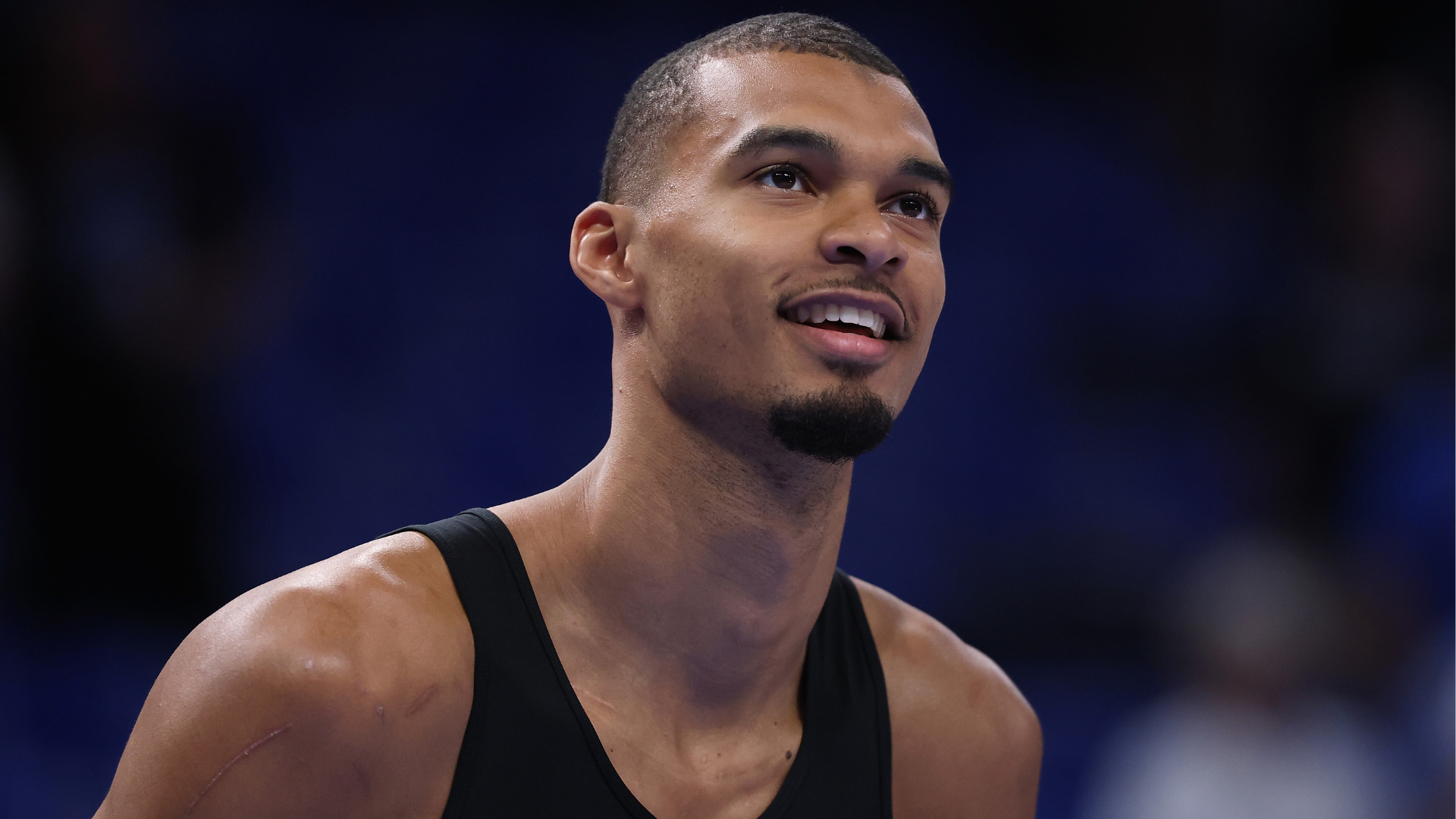
San Antonio Spurs star Victor Wembanyama just had an enormously successful third season in the NBA end in Finals heartbreak against Jalen Brunson and the New York Knicks. Brunson famously elected to take a substantial discount on the contract extension he signed in 2024 in order to help the Knicks build the team that eventually took down Wembanyama and the Spurs.
Now, at least to an extent, Wembanyama is following in Brunson's footsteps.
On Friday, Wembanyama reportedly signed a five-year, $252 million contract extension to remain in San Antonio. In theory, he could have made up to around $303 million. That decision both does and does not represent a substantial discount on his contract. What do I mean by that? Let's dive into the cap mechanics of the deal and its broader implications for both the Spurs and the NBA at large.
Victor Wembanyama reportedly agrees to five-year, $252M extension with Spurs while leaving money on the table Brad Botkin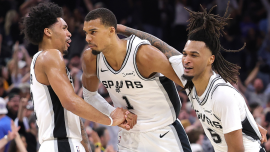
So... is it a discount or not?
The answer here is a resounding "maybe." Not every player has the same max salary, and the issue at play here is what sort of max Wembanyama would have been eligible for.
Max contracts are divided into three tiers. Players with 4-6 years of experience like Wembanyama can start their new contracts at 25% of the cap. Those with between 7-9 years of experience can start at 30% of the cap. Finally, players with 10 or more years of experience can start at 35% of the cap. However, players who hit certain benchmarks can leap up into the next tier. If Wembanyama had won MVP or Defensive Player of the Year or made an All-NBA Team next season, he would have been eligible to jump from the 25% max tier to the 30% max tier.
Most players signing rookie extensions aren't eligible for 30% after their third season. A single MVP award at any point in the three previous seasons automatically triggers eligibility, but if a player is attempting to do so through All-NBA or Defensive Player of the Year as most do, he needs to either get there in the season before the contract starts (the fourth season for rookie extension candidates, like Wembanyama) or in two of the previous three seasons (the second and third seasons for a rookie extension candidate). Luka Dončić is the last player to reach eligibility before the start of his fourth season. Therefore, most players who can negotiate that 30% max do so through escalators. The contract is guaranteed at the 25% max, but if the player hits any of those benchmarks in his fourth season, it jumps to the 30% max.
What Wembanyama is doing here is foregoing those escalators. He just took a 25% max, no questions asked. Even if he makes an All-NBA Team or wins Defensive Player of the Year or MVP, he will not get boosted up to 30%. So the answer to whether or not Wembanyama took a discount depends on what happens this season.
How does this discount compare to Jalen Brunson's?
Wembanyama's decision will inevitably be compared to Brunson's, but they are structurally quite different. Wembanyama is a former first-round pick entering his fourth season, making him automatically eligible for a rookie extension. It was just a matter of what sort of extension he took.
Brunson's case is a bit more unusual. He signed his deal coming off his sixth season. His circumstances would have required waiting a full year to get what he was actually worth. Had Brunson merely played out the 2024-25 season, he would have become a free agent eligible to re-sign with the Knicks on a new deal starting at 30% of the cap. However, he instead elected to take a standard veteran extension following his sixth season. Veteran extensions can give a player up to a 40% raise on their previous salary, and since Brunson was already on a team-friendly deal signed in free agency, that mechanism capped him below his max.
The exact amount that Brunson gave up is a bit overstated. The number you see thrown around frequently is $113 million, because Brunson ultimately signed for $156.5 million, whereas his projected max would have been around $269 million had he waited a year. However, this ignores how much faster the extension would have allowed Brunson to reach free agency again and sign a new deal to replace the discounted one. During the seasons when these contracts overlapped, the discount was closer to $37 million, or about $12 million per year.
That's right around the $10 million or so that Wembanyama is potentially sacrificing annually. Wembanyama is starting his new deal at 25% of the cap rather than 30%. Brunson went slightly further, starting his extension at 22.6% of the cap rather than waiting an extra year to reach 30%. When you consider the extra risk Brunson would have had to have taken on by waiting a year to sign, the degree of favor that each of them did their teams suddenly starts to look comparable. The Knicks used that favor to build a championship team. Now, San Antonio hopes to do the same.
What does this mean for the Spurs?
Managing Wemby's workload
The single most important element of this contract for San Antonio has less to do with roster-building than it does load management. You might look at those Rose Rule escalators and think, "We're talking about Victor Wembanyama here. He was absolutely going to win Defensive Player of the Year and make an All-NBA Team." Well, that might be the case if not for the 65-game rule. Wembanyama just barely skirted beyond the threshold last season, and he didn't reach it in the 2024-25 campaign.
The 65-game rule incentivizes injured players to suit up early for the sake of possible contract escalators. This isn't speculation. It has literally happened. Take Tyrese Haliburton. He played in 33 of the first 36 games for the Indiana Pacers in the 2023-24 season, averaging just under 24 points and 13 rebounds in those games. And then he hurt his hamstring, missing five games, before returning for one and then missing five more. He played every game the rest of the season, but wasn't the same player. He averaged 16.8 points and 9.3 assists the rest of the way on far less efficient shooting than he'd previously mustered.
He was so spectacular in the first half of the season that he still earned a Third-Team All-NBA selection and therefore received a 30% max contract rather than the 25% he otherwise would have received. But it seemed like he rushed back before he was ready. Haliburton himself essentially admitted that. In an interview with JJ Redick in which Redick alluded to Haliburton's "$53 million incentive to come back," Indiana's superstar acknowledged he might have handled his recovery differently without the 65-game rule.
"I thought I was ready to go for the Portland game. So did our medical staff. Everybody agreed," he said. "But if this was never the case, I might have been like, 'Give it another game or two. Maybe think more through this. Let's try to be 100%.'"
Now apply this thinking to Wembanyama, whose size increases his injury risk every time he steps on the court. The last thing the Spurs want is to ever force him to play hurt. Remember, he averaged only 29.2 minutes per game last season. San Antonio is incredibly cautious with him. Now, he has no contractual incentive to risk aggravating an injury unnecessarily. The Spurs can continue to manage his workload aggressively. Nothing is more important to the Spurs moving forward than Wembanyama's health.
The NBA's seven biggest non-LeBron James and Kawhi Leonard questions left to be answered this offseason Sam Quinn
Ducking the luxury tax
The Spurs would have happily paid Wembanyama any legal amount because, if healthy, he is almost certainly to outplay his next contract. But getting this discount does still potentially mean quite a bit. The most obvious immediate benefit here is that, with Wembanyama at 25% rather than 30%, it becomes far easier for the Spurs to avoid the luxury tax in the 2027-28 season. Right now, they're looking at around $10 million in tax room with three roster spots to fill. If Wembanyama were making 30%, he'd essentially fill that gap himself, forcing the Spurs to dump a contract to duck the tax.
You might say that the Spurs are a championship-caliber team that should be willing to pay the tax, but remember, this is an exceedingly young team hoping for a very long window. The new repeater tax is almost comically punitive. The Denver Nuggets are staring down a $400 million payroll if they keep Peyton Watson at market value, for instance. The Spurs have a lot of tax years ahead of them and they play in a relatively small NBA market.
Delaying the repeater clock for as long as possible absolutely matters. The Spurs likely would have done it one way or another. Now, doing so won't have to mean, say, dumping Luke Kornet's partially guaranteed contract or trading Tobias Harris.
The weight of De'Aaron Fox's contract
And then of course, there's the De'Aaron Fox of it all. As has been widely discussed, the Spurs signed Fox to a four-year, $221.7 million max extension last offseason that is only now kicking in. With each passing year, that contract becomes cumbersome. This season, it's fairly manageable. Wembanyama, Stephon Castle and Dylan Harper are all still on rookie deals. But Wembanyama's new deal kicks in for the 2027-28 season, and then Castle follows a year after that, with Harper getting paid last in a deal that will start in the 2029-30 season. We can safely assume that Castle and Harper are getting something close to the max, barring a catastrophe. Therefore, the Spurs were staring down a nightmare scenario in 2030 in which Wembanyama and Fox were on 30% max deals while Castle and Harper were at least making 25%, if not 30%, themselves. That would have been untenable.
The one-year overlap between Fox's deal and the rookie extensions signed by San Antonio's star-studded core is still a concern, but Wembanyama taking 25% instead alleviates the year-to-year weight of overpaying Fox meaningfully. They might still eventually decide to trade Fox, but they'd be doing so from a slightly stronger position. Teams won't be able to point at their payroll as easily and say, "You have to do this, so you'd better give us something great to get us to take on Fox's contract." The Fox situation remains potentially problematic. Wembanyama's discount just makes it less so.
And to this point, we've only really talked about Wembanyama's discount in a vacuum. The Spurs have a history of convincing their best players to take less. Tim Duncan, Tony Parker and Manu Ginobili all did so. Perhaps Castle and Harper cooperate as well and take slight haircuts for the sake of building a championship roster. That would make life far easier for the Spurs moving forward. Of course, there's a catch: perhaps Wembanyama's decision compels stars on other teams to take slightly less for the sake of the team, creating tougher competition for the Spurs moving forward. Yet most such cases will be much more complicated than Wembanyama's.
What does this mean for everybody else?
Pressure on other stars to take discounts?
When Brunson won the championship, there was plenty of debate about whether or not his decision would trigger a wave of similar discounts from stars. But Brunson's situation is anomalous on so many levels that it is essentially irreplicable. Team president Leon Rose is a former power agent whose first client was Brunson's father, Rick, who is now a coach on the team. Their relationship spans decades. The Knicks have gone out of their way to acquire three of Brunson's college teammates. He hosts a podcast with one of them, Josh Hart, about their experience as former roommates. They paid five first-round picks to get another of them, Mikal Bridges.
The degree of trust between Brunson and the Knicks is unique in all of basketball. We will likely never see a situation as specifically conducive to a discount as Brunson's ever again. He could always safely assume that the Knicks would make him whole down the line. Most players can't make that assumption with their teams.
Wembanyama's situation, though, is a bit more notable. Think back to LeBron James. When he joined the Miami Heat in 2010, he took a sizable enough discount for Pat Riley to bring back Udonis Haslem and sign Mike Miller. When he returned to the Cleveland Cavaliers in 2014, however, he made it clear he would accept only a max contract. He would not take less than the max again for a full decade. Soon after returning to Cleveland, he was elected vice president of the NBPA.
The next Jaylen Brown? Three high-paid NBA players whose contracts could eventually make them trade candidates Sam Quinn
James was and remains the face of the NBA. At that point, he was at the absolute peak of his powers. By taking a discount, he was giving the owners and general managers of other teams ammunition to convince their own players to do the same. Essentially, they could say, "Do you really think you deserve more than LeBron James? How are we supposed to compete with him if you're making more money than he is?" Taking the max in 2014 removed some of that pressure on his fellow stars to take less.
Now, especially in the ultra-restrictive apron era, teams have that ammunition once again. We just watched Jaylen Brown get traded in part because of his 35% max contract. Karl-Anthony Towns was moved for similar reasons. Teams will once again pitch their players on the idea that competing with Wembanyama might mean taking the sort of discount that he did. NBA salary numbers are so cartoonish now that some teams will probably get away with it. Remember, $250 million is the discounted version of Wembanyama's contract. There is a very real chance that he earns $1 billion solely in NBA salary before it's all said and done. Teams are inevitably going to try to sell their stars on the idea that they are going to retire with generational wealth either way, so they might as well prioritize winning in their contracts.
Some players will do so. Others won't. This has always been true to an extent, but the divide will probably get starker. Ironically, the teams that get these discounts are usually the ones that need them least. James took less to play for the historically competent Heat. Chet Holmgren eschewed these same escalators for the Oklahoma City Thunder a year ago. Brunson plays for the exceptionally well-run Knicks. Wembanyama's Spurs won five championships in the two-and-a-half decades before his arrival. They have all been among the NBA's more expensive teams, of course, but they are also among the smartest. Fortune tends to favor the prepared.
Contract management has never been more important
Having a smart front office has always been an enormous advantage. That advantage is even more meaningful under the draconian reign of the 2023 CBA. If the smart teams have contractual advantages on top of their strategic ones, well, that's going to make it that much harder for the teams paying their players at the top of the market to compete. The Knicks just won their championship, thanks in no small part to Brunson's discount. Oklahoma City's title came with many of its best players on cheap rookie deals. Contract management has never been more important than it is today, and one day soon, discounts like this might become a necessity to winning championships.
The more players who take these discounts, the less powerful each of them becomes. After all, there's still only one trophy at the end of the season. No matter how it happens, 29 teams and the hundreds of players they employ won't win it every year. In practice, this means these discounts will no longer be a superpower for the teams that get them. Instead, max contracts could become anchors dragging down those that don't.
We're halfway through the 2023 CBA, assuming either side exercises its opt-out after the 2028-29 season. Maybe the rules will change again in ways that avert all of this by then. But what Wembanyama did here could drastically alter the contractual landscape superstars face. At the very least, taking every last cent is likely to draw some criticism. At most, it's going to make it substantially harder for such players to realistically win championships.
The Spurs were already a terrifying opponent. Wembanyama just made them that much scarier.
Add CBS Sports on Google Join the Conversation comments