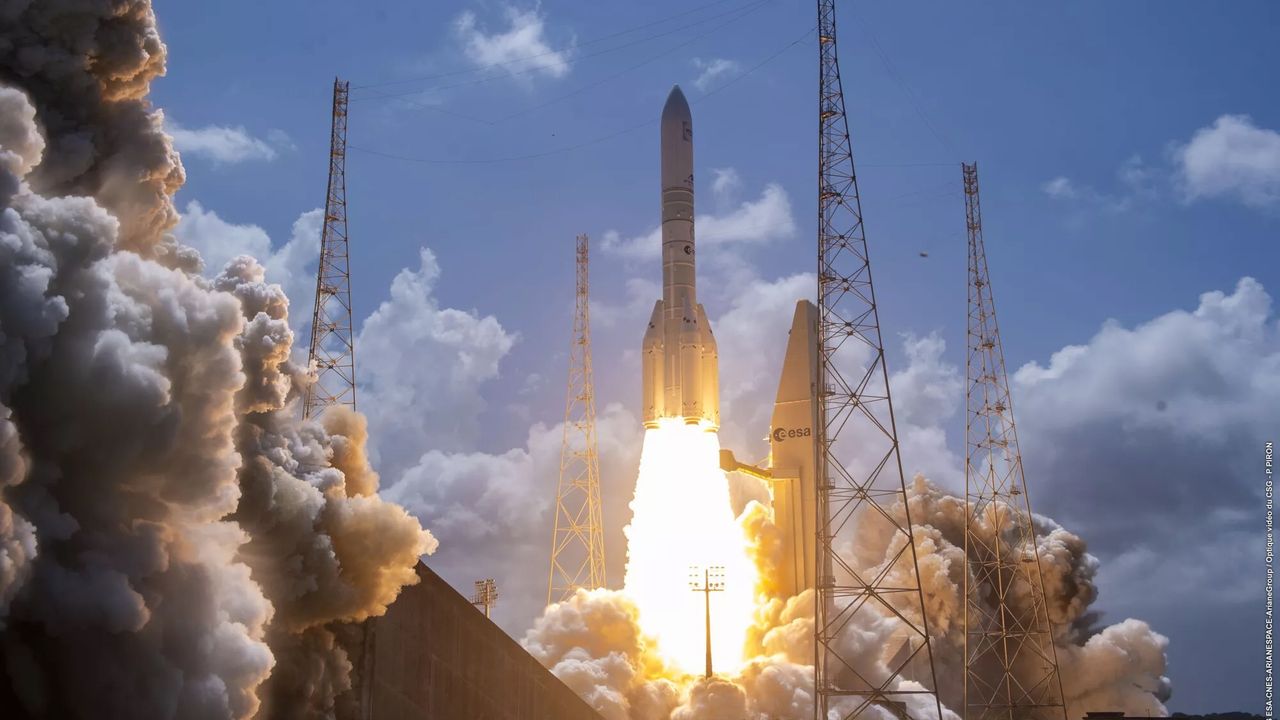
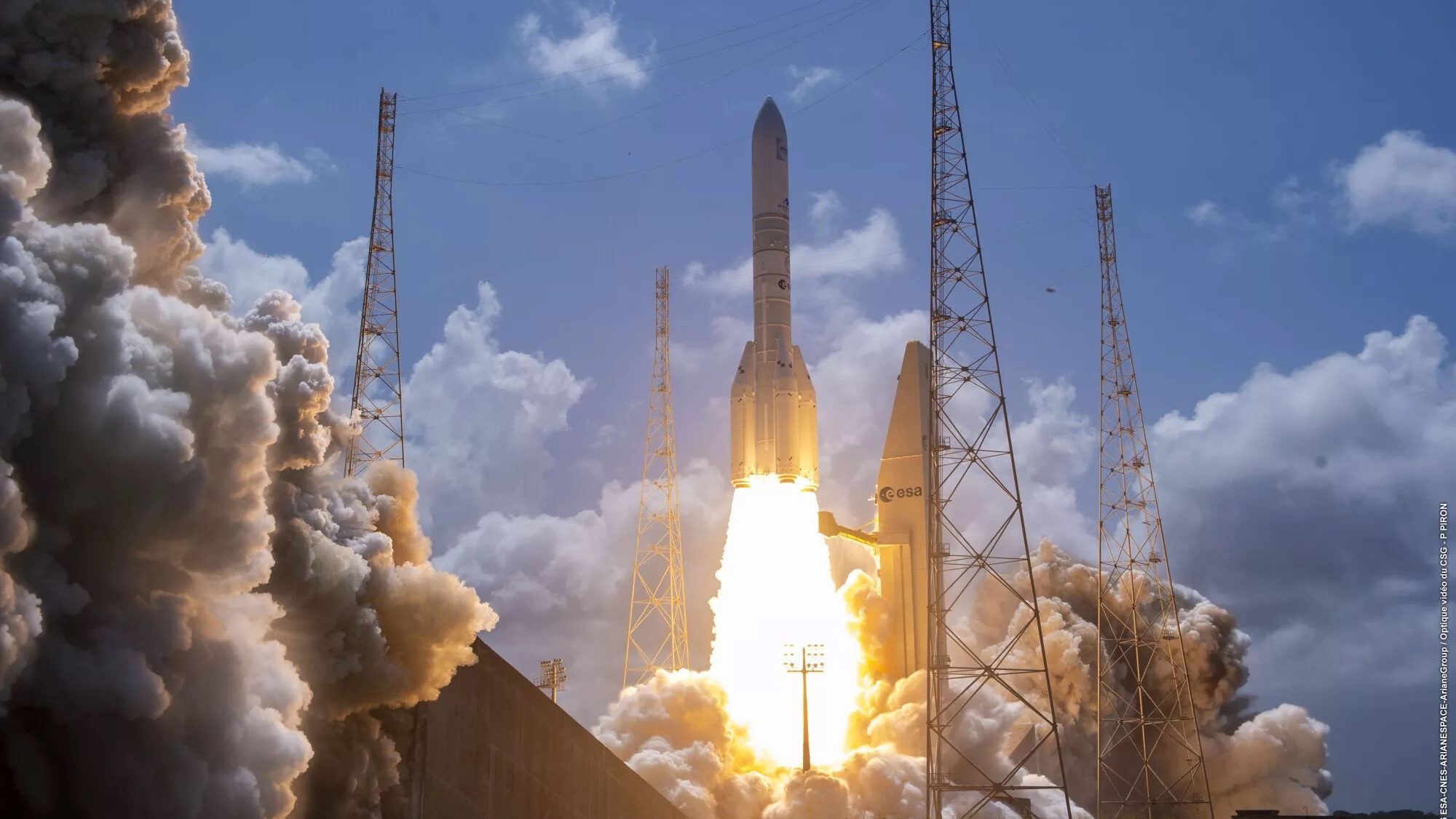
 An Ariane 6 rocket launches 32 Amazon Leo satellites to orbit from French Guiana on Feb. 12, 2026. (Image credit: ESA/CNES/Arianespace-ArianeGroup/Optique Video du CSG-P. Piron) Share this article 0 Join the conversation Add us as a preferred source on Google Newsletter Subscribe to our newsletter
 A European rocket will launch a record-breaking load to orbit on Wednesday morning (June 17), and you can watch the action live.
An Ariane 6 launcher is scheduled to lift off from Europe's Spaceport in Kourou, French Guiana on Wednesday, during a 29-minute window that opens at 7:53 a.m. EDT (1153 GMT; 8:53 a.m. local Kourou time). The rocket is topped with 36 Amazon Leo broadband satellites, which together weigh more than any payload ever lofted by an Ariane vehicle.
You can watch it live via Arianespace, the French company that operates the Ariane 6, beginning at 7 a.m. EDT (1100 GMT). Space.com will carry the feed as well, if Arianespace makes it available.
Amazon Leo, previously known as Project Kuiper, is the broadband megaconstellation that Amazon is assembling in low Earth orbit (LEO). It will eventually consist of more than 3,200 satellites, which will be lofted over the course of more than 80 launches by a variety of different rockets.
That's a lot of satellites, but Amazon Leo's scope is dwarfed by that of SpaceX's Starlink, a competitor network that's already up and running in LEO. Starlink currently consists of more than 10,500 spacecraft, and that number is growing all the time.
Wednesday's mission will be the 14th Amazon Leo launch overall (counting the flight of two prototype spacecraft in October 2023), and the third performed by an Ariane 6. But this one will break new ground; the first two Ariane 6 Amazon Leo flights carried 32 satellites apiece, while Wednesday's will send up 36 of them.
The mission will therefore be "the biggest stack configuration and heaviest payload ever launched by an Ariane launcher," Arianespace representatives wrote in the flight's press kit, which you can find here.
The press kit doesn't say exactly how heavy that payload is. But we know from other documentation that 29 Amazon Leo satellites tip the scales at 37,000 pounds (16,800 kilograms), yielding a per-spacecraft weight of about 1,275 pounds (578 kg). So 36 of them weigh roughly 45,900 pounds (20,820 kg).
The Ariane 6 is getting some extra oomph on this flight from four strap-on, solid-propellant P160C boosters. The rocket has flown with four solid rocket boosters before, but Wednesday's launch will mark the debut of this particular, more powerful SRB variant.
"The P160C upgrade will increase Ariane 6 payload capacity to low Earth orbit (LEO) by more than two tons, supporting the deployment and early orbit operations of large satellite constellations," Arianespace representatives wrote in the press kit. "It also delivers substantial performance improvements for geostationary, scientific, and exploration missions, expanding the range of missions that Ariane 6 can serve."
If all goes according to plan on Wednesday, the Ariane 6 will deploy the Amazon Leo satellites about 289 miles (465 kilometers) above Earth. All 36 should be flying freely by one hour and 51 minutes after liftoff, according to the press kit.
Wednesday's launch will be the eighth overall for the powerful, long-delayed Ariane 6. The heavy lifter was originally supposed to debut in 2020, but it didn't get off the ground until July 2024 on a test flight that was mostly successful. (The rocket reached orbit and deployed nine cubesats as planned, but its upper stage failed to complete a final engine burn that would have set up the deployment of two experimental reentry capsules.) All of its missions since then have been fully successful.
View MoreYou must confirm your public display name before commenting
Please logout and then login again, you will then be prompted to enter your display name.
Logout Mike WallSpaceflight and Tech Editor
Michael Wall is the Spaceflight and Tech Editor for Space.com and joined the team in 2010. He primarily covers human and robotic spaceflight, military space, and exoplanets, but has been known to dabble in the space art beat. His book about the search for alien life, "Out There," was published on Nov. 13, 2018. Before becoming a science writer, Michael worked as a herpetologist and wildlife biologist. He has a Ph.D. in evolutionary biology from the University of Sydney, Australia, a bachelor's degree from the University of Arizona, and a graduate certificate in science writing from the University of California, Santa Cruz. To find out what his latest project is, you can follow Michael on Twitter.