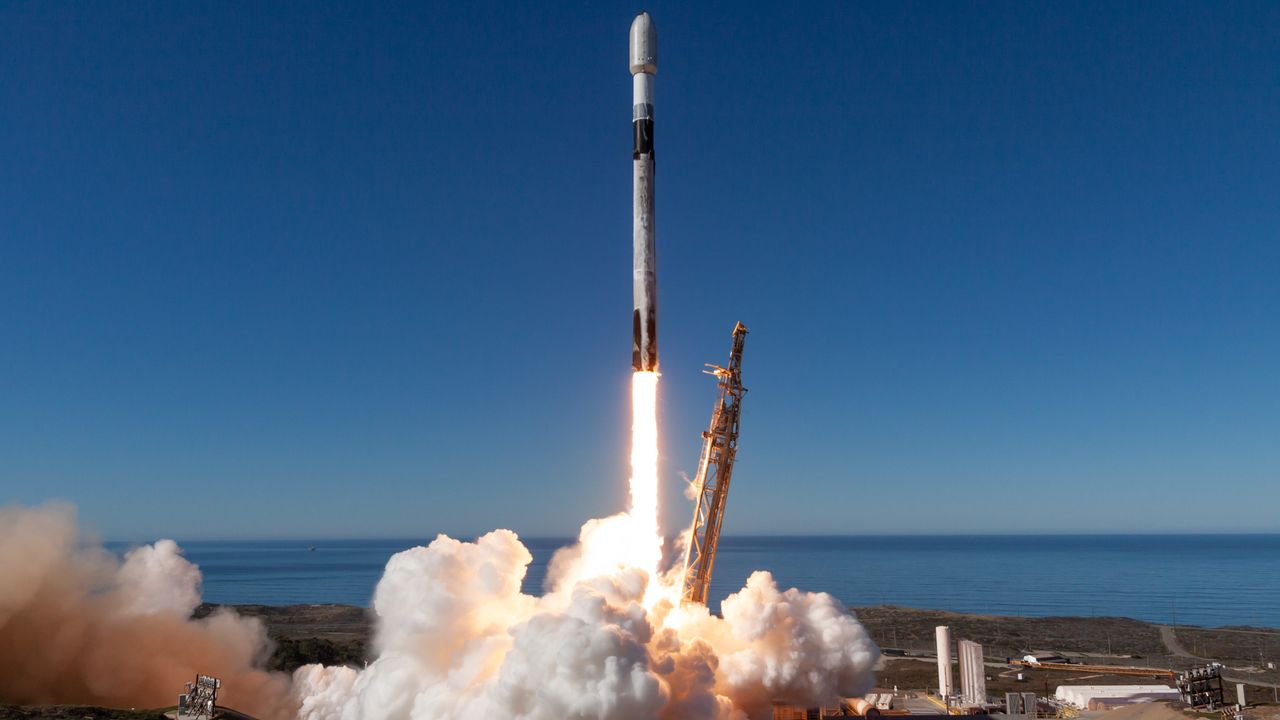
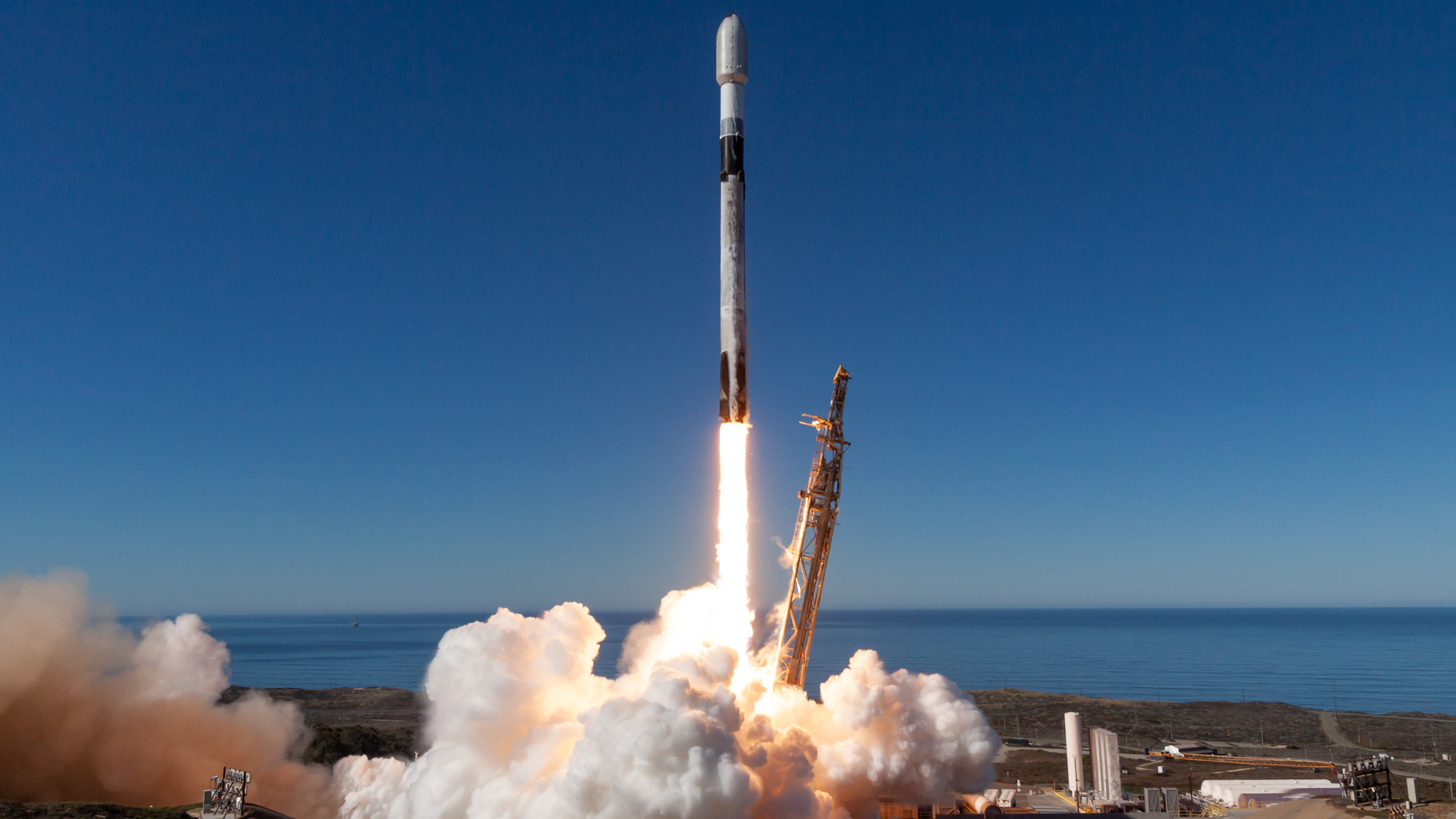
 A SpaceX Falcon 9 rocket launches the 131-satellite Transporter 12 rideshare mission from California’s Vandenberg Space Force Base on Jan. 14, 2025. (Image credit: SpaceX) Share this article 0 Join the conversation Follow us Add us as a preferred source on Google Newsletter Get the Space.com Newsletter
 Breaking space news, the latest updates on rocket launches, skywatching events and more!
Contact me with news and offers from other Future brands Receive email from us on behalf of our trusted partners or sponsors By submitting your information you agree to the Terms & Conditions and Privacy Policy and are aged 16 or over.You are now subscribed
Your newsletter sign-up was successful
Want to add more newsletters?
An account already exists for this email address, please log in. Subscribe to our newsletterSpaceX will launch more than 100 satellites to orbit from California early Monday morning (March 30), and you can watch the action live.
A Falcon 9 rocket is scheduled to lift off from Vandenberg Space Force Base in California on Monday during a 57-minute window that opens at 6:20 a.m. EDT (1020 GMT; 3:20 a.m. local California time).
Article continues belowAs its name suggests, Transporter-16 will be the 16th mission of SpaceX's Transporter rideshare series. The company also operates another rideshare program called Bandwagon, which has four launches under its belt so far.
Together, these two programs have lofted a total of more than 1,600 payloads to orbit — including 143 on Transporter-1 in January 2021, which still holds the single-launch record.
Transporter-16 will loft 119 payloads, "including cubesats, microsats, hosted payloads, a reentry vehicle, and orbital transfer vehicles carrying eight of those payloads to be deployed at a later time," SpaceX wrote in a mission description.
If all goes to plan on Monday morning, the Falcon 9's first stage will land about 8.5 minutes after launch on the SpaceX droneship "Of Course I Still Love You," which will be stationed in the Pacific Ocean. It will be the 12th launch and landing for this particular booster, according to the mission description.
Get the Space.com NewsletterContact me with news and offers from other Future brandsReceive email from us on behalf of our trusted partners or sponsorsThe rocket's upper stage, meanwhile, will haul the 119 payloads to low Earth orbit, where they'll be deployed starting about 55 minutes after liftoff.
 Mike WallSpaceflight and Tech Editor
Michael Wall is the Spaceflight and Tech Editor for Space.com and joined the team in 2010. He primarily covers human and robotic spaceflight, military space, and exoplanets, but has been known to dabble in the space art beat. His book about the search for alien life, "Out There," was published on Nov. 13, 2018. Before becoming a science writer, Michael worked as a herpetologist and wildlife biologist. He has a Ph.D. in evolutionary biology from the University of Sydney, Australia, a bachelor's degree from the University of Arizona, and a graduate certificate in science writing from the University of California, Santa Cruz. To find out what his latest project is, you can follow Michael on Twitter.
View MoreYou must confirm your public display name before commenting
Please logout and then login again, you will then be prompted to enter your display name.
Logout MORE FROM SPACE... 1'We are ready': NASA still on track to launch Artemis 2 astronauts to the moon April 1
- 2'Warhammer 40,000: Dawn of War 4': Release date, plot, factions, & everything else we know about the upcoming 40K strategy game
- 3Kristen Stewart will play Sally Ride, the 1st American woman in space, as Amazon finally greenlights mini-series 'The Challenger'
- 4NASA's Artemis 2 moon astronauts are 'fortunate' to have a private space toilet — Apollo crews pooped in plastic bags
- 5'We work for them, too': Artemis 2 moon mission is for everyone, NASA astronaut Victor Glover says (video)