It's almost inconceivable that 40 years have passed since what's been called the greatest sci-fi action film of all time (and not just by us) assaulted theaters with the juiced-up sequel to Ridley Scott's 1979 classic, "Alien."
Director James Cameron's propulsive vision for a gung-ho military-style movie would call upon Stan Winston Studio's elite creature effects crew from 1984's "The Terminator" — a team that would later work on "Predator," "Terminator 2: Judgment Day," "Jurassic Park," and "Predator 2."
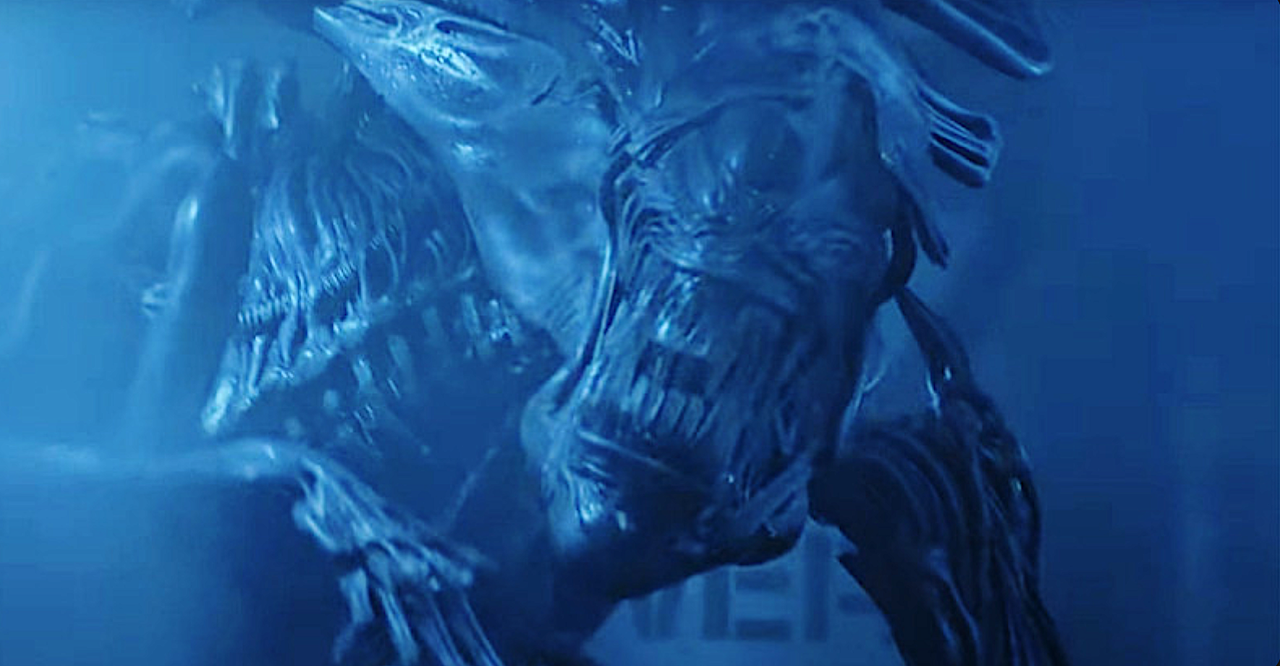
Cameron's "Aliens" greatly expands upon the xenomorph life cycle with the inclusion of a matriarchal beast that his screenplay described as "a massive silhouette in the mist, the ALIEN QUEEN glowers over her eggs like a great, glistening black insect-Buddha. Her fanged head is an unimaginable horror. Her six limbs, the four arms and two powerful legs, are folded grotesquely over her distended abdomen."
The brilliant filmmaker and Winston's energetic gang would craft and operate this 14-foot-tall articulated hydraulic puppet fabricated from fiberglass, foam rubber, and plastic. It contained two stunt performers in the torso and puppeteers on the ground manipulating legs and limbs.
Production was led by Stan Winston, Shane Mahan, Alec Gillis, John Rosengrant, Tom Woodruff Jr., and Lindsay MacGowan, the core wizards who’d later found the acclaimed Legacy Effects firm with J. Alan Scott following Stan Winston’s unfortunate death in 2008. Gillis and Woodruff would eventually split off to form Amalgamated Dynamics in 1988.
We caught up with Mahan and MacGowan to have them offer memories of working on "Aliens" at Pinewood Studios and specifically constructing this magnificent drooling, hissing monster that's spawned countless nightmares since the blockbuster landed on July 18, 1986.
"It was 1983 when I started at Stan's on the first 'Terminator,'” Mahan tells Space. "I’d worked with Jim on a Roger Corman movie that Makeup Effects Lab was doing, 'Battle Beyond the Stars.' [...] During 'Terminator,' Jim had drawings of Sigourney and the Power Loader he'd brought into the shop. I'd see them out of the corner of my eye and knew exactly what it was supposed to be. It was clearly an alien of that world with Sigourney Weaver.
"I was intrigued by it all because four years before, when 'Alien' had come out, it was so amazing cinematically. The lifecycle of the creature, and the organic nature of it. I had no idea that seven years later we'd be in England doing a sequel."
Mahan and posse began working on the Queen's preliminary designs in Southern California at Stan Winston's shop, where they conducted the infamous 'garbage bag test' out in the back parking lot, so named due to the flailing puppet being wrapped in black plastic trash bags.
"It was a proof of concept of how that was going to work," he explains. "Moving to Windsor, England, and setting up shop at Pinewood Studios was extraordinarily exciting. We then started making the full-size process of making the Queen and all the other effects, and we met the English crew, and Lindsay was one of them."
MacGowan fondly remembers his experience on the ambitious project and being recruited to join Stan Winston and the rest of the guys.
"They were legends at that point for us. We were also young and goofy, and it's amazing they actually let us do what we did when we were that young," MacGowan notes. "I was at college at the time, and I’d skip off college and make my way to Pinewood. It was like here’s the rock ‘n' roll Americans, and then we have our more reserved English team that got influenced by the American team. It was a lot of fun and some of my favorite memories of starting in the business.
"I remember it being incredibly cold at Pinewood at the time. There was no insulation in the warehouse, and we had these giant propane jet heaters, and they kept going out. We’d be nice and warm, then suddenly the flame would be out. It was a great time to get to know Shane, John, Alec, and Tom. I look at them as my American brothers."
Having everything under one roof, being created pre-shooting, was a great asset as it allowed Cameron to constantly oversee the process and monitor the progress being made.
"We were life-casting all the actors, various teams were doing the xenomorph warriors and the eggs and the facehuggers," Mahan adds. "It was a pretty big build list, and we had four or five months to get everything done. John Richardson was a great special effects man from the Bond films, and we all thought that was cool to work with guys that had done James Bond movies.
"That was my first time in England, so the setting was very new and exciting. Of course, we blew off a lot of steam occasionally, but we were very serious about just getting it all done. We knew we had a lot to live up to because of the first film. Very few people, if any, had come back from working on that first film. You don’t know how it's going to turn out. We all thought the 'Aliens' script was great. Jim had a lot of turmoil there and didn’t have a good time on his own for various reasons, but we weren't really privy to that."
Before hopping across the pond to the UK, Mahan and his ace crew did molds and castings using a quarter-scale maquette of the Alien Queen sculpted at Stan Winston's shop for their design master.
"Back then, everything had to be done by measurements, by plotting out, and by eye. Today, it's so simple to have a computer generate and mill out a perfectly formed section. You had to use a really focused artistic eye to get exactly where we were supposed to be.
"We also had to make action suits, and there were a lot of them. I think there were 13 or 14, and then there were like eight eight-foot-tall puppets that were more spindly and long that were going to be used on wires and get hit and blow up and get shot. Then there was one articulated half-animatronic that would play in various scenes. You have to imagine an era that was pre-CGI. There was no reliance on rod removal or performer puppeteer removal. You had to hide everything and everybody in the frame. So in the dropship fight, it’s an enormous amount of people making the Queen operate, and you don’t see them.
"That all comes down to Jim Cameron and his magnificent eye for framing this action scene without seeing the crane or any of the support devices. Directors today, most of them don't even have any idea how to do that. And that was the magic of Jim Cameron and still is. He had the designing thought of shot composition and action that played off the best attributes of that hydraulic/actor-driven Queen. Because there were two guys inside and nine of us on her tail, her head, the cable, her hands, the feet. We were everywhere."
MacGowan took his role very seriously to get the fit and finishing perfect for this elegant egg-laying beast that would end up being the seething, android-ripping superstar of the popular 1986 sequel. -
"It was really just to honor what Giger had done in the past, but also to give Jim what he was looking for in his vision for the Queen," he recalls. "The Queen is really Jim's design and entire look. Our focus was making sure that we got what Jim wanted, but still make sure that fans of the original movie, which was all of us, could really appreciate."
As a mentor to his dedicated young crew of VFX creators, Winston schooled them in the subtle art of injecting personality and emotion into their creature performances.
"It's something they always reinforced, but if you’re a student of horror and science fiction films, you know all the great creatures and monsters have got some sympathetic or some interesting personality," adds Mahan. "Even the xenomorph in the first film, the personality is that it does not care. It's just going to kill you. But that’s still a personality trait.
"We were always taught by Stan that these are not effects; these are characters that we’re making; these are actors in the film. It just happens to be a creature from space, or a robot from the future, or a dinosaur. Whatever it is, it has to be believed, and we’ve always carried that philosophy through."
As to the mystery of exactly where the original Alien Queen screen-used puppet ended up, Mahan has a few clues, but sadly admits that most of it has unfortunately been lost to time.
"Jim has one in his museum, and I think collector Bob Burns did have a head," Mahan shares. "The rest of it might be that it's fallen into disrepair. I know when we left, a lot of it was put into containers at Pinewood, and it sat and rotted for years. We always wanted to get that back, but I’ve not seen a real Queen in a while.
While the classic design hasn't changed much over the years, Mahan notes that the materials used to make creatures like the Alien Queen have.
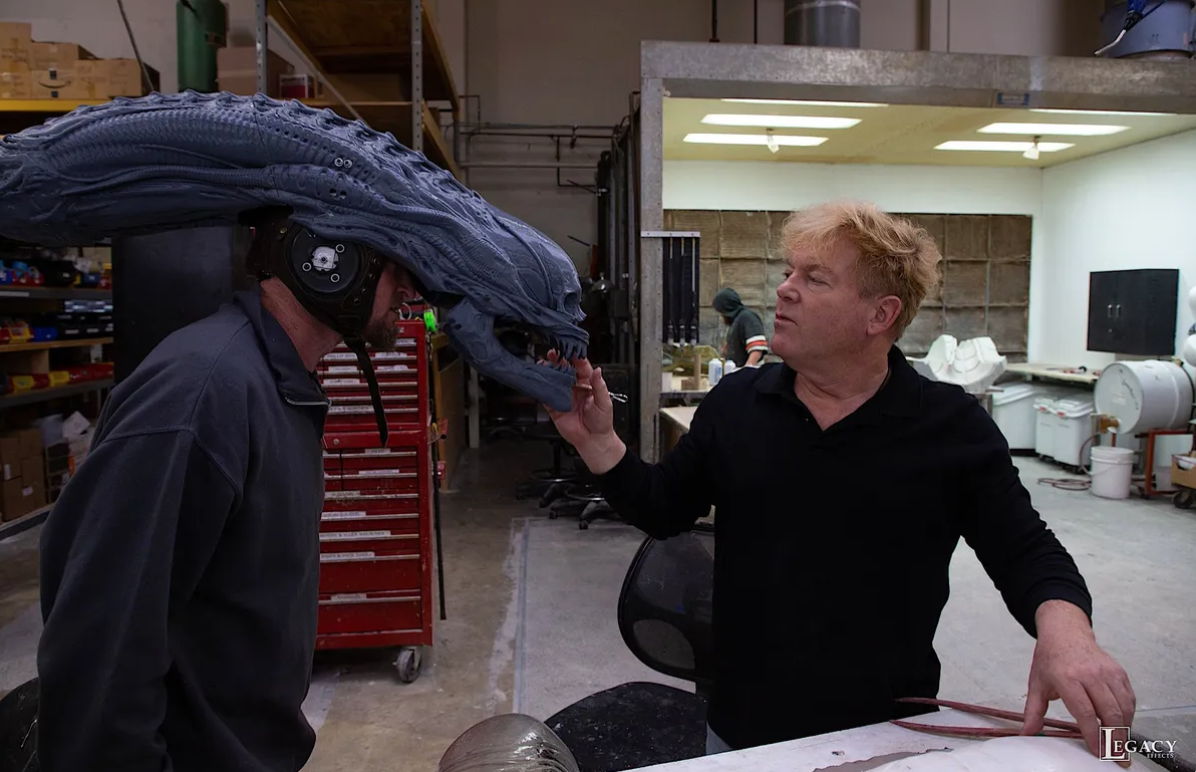
"The head was fiberglass and had other foam rubber parts. The materials back then were not very sophisticated," explains Mahan. "The materials we have today, like what we did on 'Alien: Romulus', are like from outer space. They're translucent silicones, and they stretch well, and there’s lightweight plastic 3D-grown parts."
"Back then, the only thing we had was clear urethane that I got the cowl of her head to kind of move around. The original idea was that the skin on her face was supposed to be translucent. It ended up being foam rubber painted to look translucent. A lot of those materials have just fallen apart. On screen, it's pretty impressive.
"When we did 'Alien: Romulus,' Lindsay and I had not done an 'Alien' film since 'Aliens.' When that opportunity came up to revisit that world, the sensory memories came flooding back. It's one of those movies where I think I remember every day that I was on set for that film.”
"Aliens" is available to stream on Disney+ in the UK, and to rent and buy on various platforms in the US.