
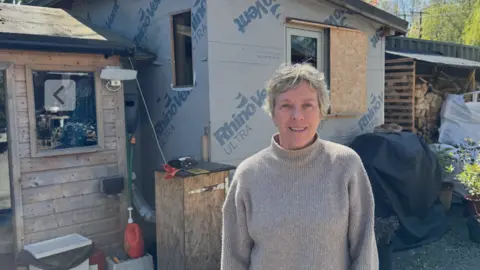
 BBCJane says they only expected to be living in this shed for a few months
People living and working in Herefordshire say ongoing pollution in the river Lugg is causing "significant damage" to the local economy.
Since 2019, there have been restrictions on building in the area because of increasing pollution levels in the protected river.
Jane and Tony Coyle are building their own home, but they have had to live in a caravan, and now a shed, on the site while they wait for planning permission.
"This delay has cost us time, money and health," said Jane Coyle.
In 2018, the Coyles bought a plot in the village of Edwyn Ralph which had planning permission for a 5-bed bungalow.
They reapplied to build a 3-bed home using sustainable wood, air source heating and solar panels, but the restrictions on building kept delaying their case.
They were granted permission in 2025, but the delay has cost them tens of thousands of pounds extra in legal fees, phosphate credits and building materials.
"Our daughters have to rent accommodation when they come to visit us and Tony has had serious health issues which are really concerning," said Jane Coyle.
"We lived near the Wye for 20 years, and saw it deteriorate, but we didn't imagine that river pollution would affect us so much."
"I studied agriculture, and we've always lived in the countryside, waterways are really important to us."
The couple are among 4,500 people who have added their names to a legal case which claims industrial scale chicken farming and sewage spills are causing pollution in the rivers Wye, Lugg and Usk.
The case against Avara, Freemans of Newent, and Welsh Water starts at the High Court in London tomorrow – all three firms vigorously deny the claims.
'Significantly damaged'
The restrictions on building were brought in by Herefordshire Council in 2019 to protect the River Lugg from further pollution.
Known as the Lugg Moratorium, developers can buy credits to offset the phosphate and nitrate added by building, and the money is used to fund wetlands.
Leominster Town Council estimates the restrictions have put 2000 new homes and renovations on hold and it's having a huge impact on the local economy.
The town council supports the moratorium, but says Leominster has been "significantly damaged" by the water pollution and restrictions.
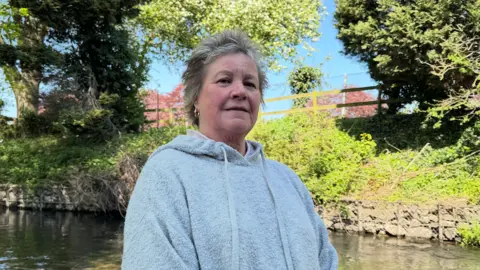 Tessa Smith-Winnard says the pollution is affecting Leominster's economy
"Young families are concerned about the lack of housing, older people are concerned about the loss of wildlife," said the town's mayor Tessa Smith-Winnard.
"People can't find a house, so they have to continue to live in unsuitable housing or remain with family members when they really need their independence."
"More people living in the town would help the shops, pubs and restaurants."
"Tourism is a big boost to our local economy but who would want to canoe or swim in a dirty river?"
"When you live this close to beautiful countryside, you're aware when it's starting to fail and a lot of people are very concerned about the state of the Lugg.
"Something has to be done, these are natural resources, if they're not looked after they won't come back."
Leominster Town Council members voted to support the legal case which alleges that pollution in the Lugg, Wye and Usk is caused by chicken muck spread on land as fertiliser, and human sewage being released into the rivers.
The poultry producers Avara Foods Limited and its subsidiary, Freemans of Newent, employ thousands of people in Herefordshire and the borders.
Avara says the legal claim is based on a misunderstanding, not supported by scientific data and it was confident there was no case to defend.
Welsh Water said the case was misguided and it had invested more than £76m in the past five years to improve water quality on the Wye, Lugg and Usk.
The not-for-profit company said any financial penalties would directly reduce the funding it was able to invest in essential services.
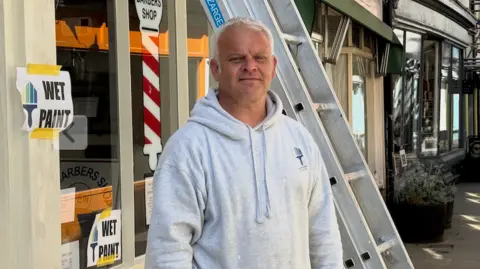 Matthew Newman says Leominster needs new homes and businesses
 Painter and decorator Matthew Newman says renovations in Leominster are taking so long that the town is looking tired.
"Leominster is a beautiful place with wonderful old buildings which need doing up but they're just rotting because planning is taking so long."
"There are so many people desperate for homes, my son has just bought an old house which he'll have to do up bit by bit as he can afford it."
"This town could be brilliant, but at the moment there's nobody out in the evening. It's very frustrating for everybody."
Follow BBC Hereford & Worcester on BBC Sounds, Facebook, X and Instagram.
More on this story