
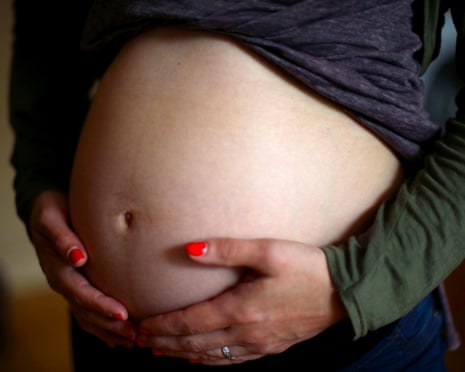
 The final report of England’s national maternity and neonatal investigation was published on Tuesday. Photograph: Yui Mok/PAThe final report of England’s national maternity and neonatal investigation was published on Tuesday. Photograph: Yui Mok/PAExplainerHow has maternity and neonatal care in England failed?
Amos review confirms patients received unacceptable care that led to stillbirths, serious injuries and maternal deaths
Valerie Amos, a Labour peer and former diplomat, has published her long-awaited review into maternity and neonatal care across England. This is what we know:
How safe is it to give birth in the UK?
The rate at which mothers die during childbirth, or shortly after, stands at about 12.8 deaths per 100,000 maternities in the UK, according to the most recent data. This is 20% higher than it was in 2009-11, when the government set an ambition to halve the rate of maternal mortality in England.
Compared with other European countries, the UK’s maternal mortality death rate is high. A 2022 study found that the UK had the second highest maternal death rate of eight European countries, with UK mothers being three times more likely to die around the time of pregnancy compared with those in Norway.
The number of women experiencing serious complications after labour has also risen. The proportion of mothers in England experiencing postpartum haemorrhage, a form of severe bleeding, has increased from 27 per 1,000 births in 2020 to 32 per 1,000 in 2025, a rise of 19%. Furthermore, the number of mothers sustaining a third- or fourth-degree perineal tear while delivering their baby has risen from 25 in 1,000 in June 2020 to 29 in 1,000 in June this year – a 16% increase.
Why was this major review commissioned in the first place?
Last June, the then health secretary, Wes Streeting, announced a national investigation into NHS maternity services in England. The investigation, led by Lady Amos, was asked to examine maternity and neonatal care across the country while also specifically examining maternity services at 12 NHS trusts, and what Streeting described as the “systemic causes of unacceptable care affecting women, babies and families”.
The investigation follows a series of high-profile maternity failings at several trusts, including at Shrewsbury and Telford NHS trust, where a 2022 review by the midwife Donna Ockenden found that 300 babies were left brain-damaged or dead, outcomes that were otherwise avoidable. Last week, Ockenden’s review into maternity services at Nottingham University hospitals NHS trust revealed that more than 500 babies and mothers died or were injured as a result of inadequate care.
Ockenden has also been commissioned by the government to conduct an independent review into the maternity services at Leeds teaching hospitals NHS trust and University hospitals Sussex NHS foundation trust, which are due to be published over the next few years.
Amos’s investigation has the aim of developing one set of national recommendations to drive improvements in maternity and neonatal care across England.
What factors are leading to failures in NHS maternity care?
Inadequate maternity care experienced by women remains a key issue. Across England, many maternity wards have also fallen short of the required standards, with inspections by the Care Quality Commission finding 36% of NHS maternity services required improvement, while 12% were inadequate.
These problems have been found to be the result of understaffing as well as deeper, more systemic issues such as institutional racism. The NHS across England has a shortage of 2,500 midwives, according to the Royal College of Midwives, while one in three graduate midwives have reported struggling to find a job.
Recent changes in methods of delivery may also factor in poorer birth outcomes. Last year, births through caesarean section overtook vaginal births for the first time, with almost half (45%) of births by caesarean, which carry a higher risk of complications than a vaginal delivery. About a quarter of all births across England are delivered via emergency C-section.
skip past newsletter promotionafter newsletter promotion
Existing ethnic and socioeconomic inequalities are also evident throughout maternity care. Black women are almost three times more likely to die during childbirth than their white counterparts, and women from the most deprived areas are twice as likely to die during childbirth than more affluent counterparts.
What is in the Amos report?
The report is a devastating indictment of maternity care and has to be a “watershed moment” for how the NHS treats pregnant women and babies, the health secretary has said.
James Murray pledged that it would lead to significant improvements and that “toxic dynamics” that damage relationships between hospital staff providing childbirth care would be dismantled.
A powerful maternity commissioner will be appointed to push through an urgent transformation of childbirth care in England.
The Amos report found that maternity care in England had not kept up with major changes such as older motherhood and the dramatic rise in the proportion of women having a caesarean section.
Amos published two interim reports on the national maternity and neonatal investigation. The findings were similar to those uncovered in Ockenden’s reviews – that many women and babies received unacceptable and negligent care that led to avoidable stillbirths, serious injuries and maternal deaths, while hospital trusts often resorted to covering up their mistakes and denying bereaved and traumatised families answers.
Explore more on these topicsShareReuse this content