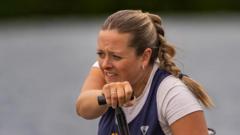
After four months in hospital, Saffron Cresswell was dreading coming home.
She knew the field would be empty.
Before she had the fall that would leave her paralysed at the age of 23, she had 25 horses that she trained and rode in a business she had been running since she was 15 and was a talented eventer on a pathway towards the Olympics.
Eight years earlier her parents had sold their house to buy a yard to support her career, with the family living in two tiny touring caravans for six years before they converted part of a barn into a home.
For years, Cresswell had been up at 5am, riding four ponies before school, then more afterwards - if she even went in. She puts her school attendance at "68% or something ridiculous" because she was "so busy riding".
'Busy' in fact turns out to be a common theme with Cresswell. During rehab at the hospital, she'd be waiting outside the gym for it to open so she could get an hour in before her physio session was even due to start.
There had only been five days during the four months where she hadn't had a visitor and so when she finally returned home to Worcestershire, where the horses had all been sold, reality was anything but hectic.
"I came home and fundamentally the next day, both my parents went out the door and went to work," says the now 25-year-old Cresswell. "So, I was home alone in a house that I couldn't really get out of and I couldn't really do anything."
There was only one thing for it: find a new sport. Little did she know that within eight months of sitting in a canoe for the first time, she would be heading for a World Championships.
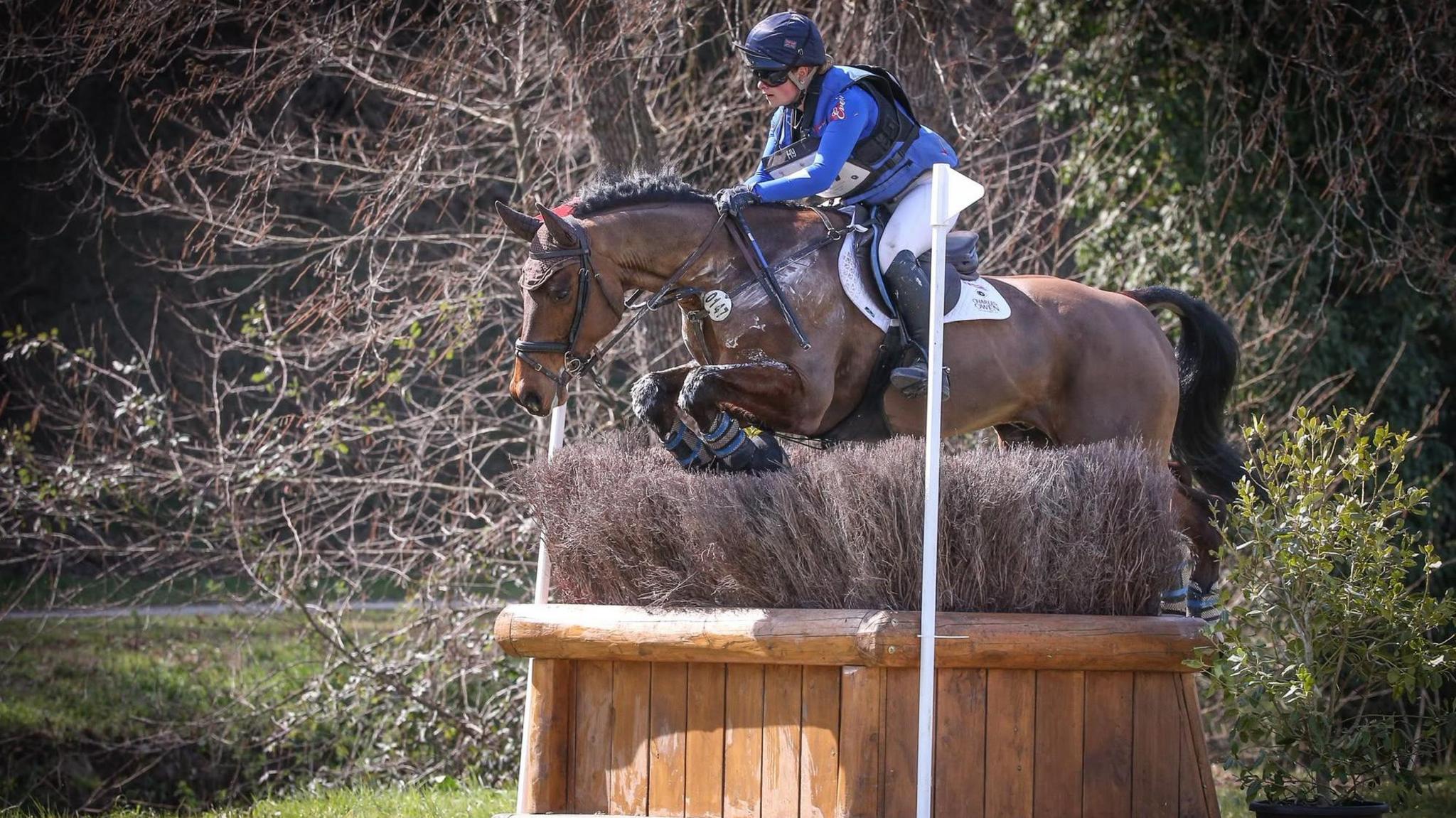 Image source, Saffron CresswellImage caption,
 Saffron Cresswell got into eventing in her teens
Cresswell started riding when she was three, introduced to the sport by her mum, who was "horsey" but "doing low-level amateur stuff".
And she was hooked.
"I was the only child at primary school that was allowed a phone because I used to cycle from my primary school to the yard so I could start riding before my mum came home from work," she says.
She got into eventing "properly" at 13 when she produced her own young pony from beginners level to eventually representing Great Britain at three European championships.
She glances at the medals on her wall, saying: "One gold and two team silvers... so that sort of sparked the whole eventing career."
Then came the leap of faith from her parents - "much to my poor brother's trauma who was not horsey in any way" and was suddenly now sharing a caravan with his older sister - and Cresswell began running the business of riding and competing horses for other people and coaching.
Since her accident, she has not been back on a horse. Nor does she intend to.
"Because I'd done it so seriously and to such a high level that every day was about perfecting my technique and being better, I think, to get back on and not be able to do that physically, but also not even feel the horse underneath me, I think it would just be very disheartening for me," she says.
Instead, she coaches, which she says has helped her with what has turned out - surprisingly to her - the thing she would miss the most about pre-accident life.
"[What I miss] is literally just having the horse on the yard, to just go and like say 'hello' to them over the stable," she says. "And that comes from somebody who was so busy that I didn't really have loads of time to do that anyway."
The coaching is one of the new parts of the family business, which has had to change since her accident.
"The business is basically having to diversify, which is still very much an ongoing process," she says.
"My parents had given up so much to build something that allowed me to do the sport. It wasn't like we were at home and I left home and did this - they were very invested as well. So it's kind of affected everybody from that side of things."
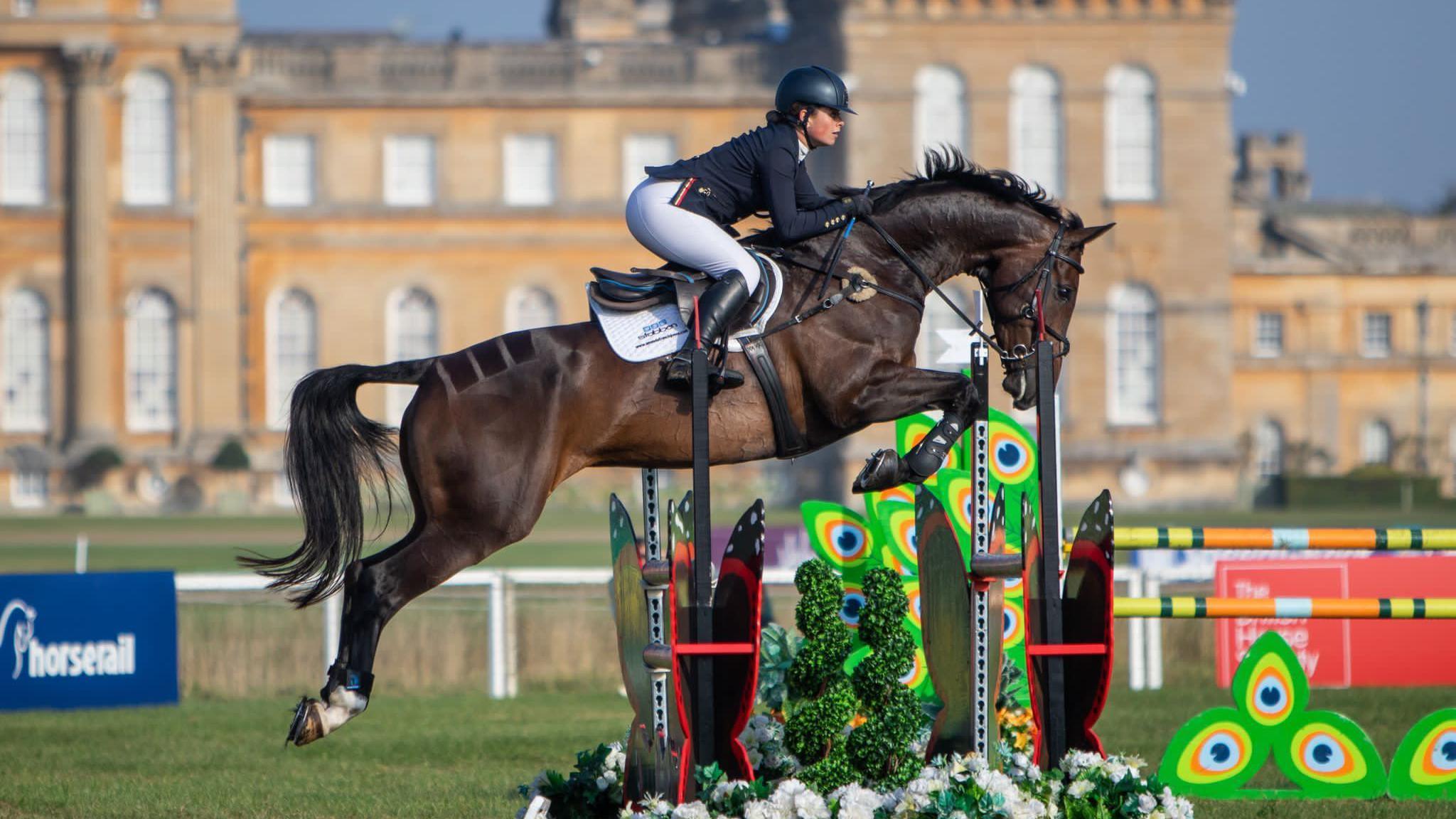 Image source, Sophie TaylorImage caption,
 Three-day eventing is like an equestrian triathlon, with riders competing in three phases of dressage, cross-country and showjumping for a cumulative score
Cresswell had been beginning to make her mark at senior level when she was competing at Bramham Horse Trials on 8 June, 2024.
Three fences before the end of her under-25 cross-country round, she came off her horse Vivendi Hero.
"I remember all of it because I didn't even get knocked out," she says. "[It was] just a freak accident.
"I just landed on the back of my head and unfortunately broke my back at T4 level - so chest level - and basically as soon as I fell, instantly knew I couldn't feel my legs."
She remembers an "awful" 45-minute ambulance ride to Leeds General Infirmary, where she had emergency surgery.
At that point, she wondered whether the damage would be permanent, because only couple of weeks previously she had been chatting to a friend - Olympic silver medallist Nicola Wilson - who had broken her neck in a fall.
"She said, 'when I fell, I couldn't feel my arm for 20 minutes, and then my feeling came back'. So when I had my accident, I had this really weird thing, like I just thought, 'oh, it's fine, it'll be 20 minutes, and my feeling will come back'," she says.
Wilson, who visited Cresswell in intensive care, regained her feeling in her legs in three or four weeks.
"So I have this really weird thing because then I was sort of waiting for three to four weeks as if I was going to get feeling back," says Cresswell, who was moved to a spinal unit in Wakefield.
"It was probably not until about six weeks that the realisation really hits... that actually this wasn't going to be the outcome that I had hoped for."
Cresswell was bedbound for six weeks in what she calls her "hotel room", a private room in the hospital where the wall was covered in get-well-soon cards.
Even then, she kept busy as the physios would give her some weights she could use for her arms.
"They were tiny, but in my head, it was a principle of having something to do every day," she says.
One of the first parts of rehab was learning to sit up again.
"With a spinal injury your blood pressure gets really lowered. So I couldn't sit up in a wheelchair for longer than about five minutes without feeling faint," says Cresswell.
Then there were things like putting on socks or tying up her hair, although even by the time she left hospital she still could not do the latter while sitting up because she did not have any core strength or balance.
She remembers her timetable at the unit - official physio was 2pm til 3pm but she would be at the gym when it opened at 1pm, having also been at the physio room at 10am when that opened.
She was determined to keep busy - and creative about how to make that happen.
Take, for example, when she was told that it would take too many people to help her swim.
"Instead of saying anything, I just used to say OK, that's fine, but can I come and sit and watch? So, I was basically just making myself known by the swimming pool," says Cresswell, who credits her athlete's mindset for her drive and ability to take positives from every situation.
"So, I went for two weeks. I sat and watched these other people in the physios do swimming.
"And funnily enough, by the third week, they thought, 'we're going to have to let her go in the swimming pool now because she's just going to annoy us otherwise'."
It turned out, water was going to become a huge part of her life.
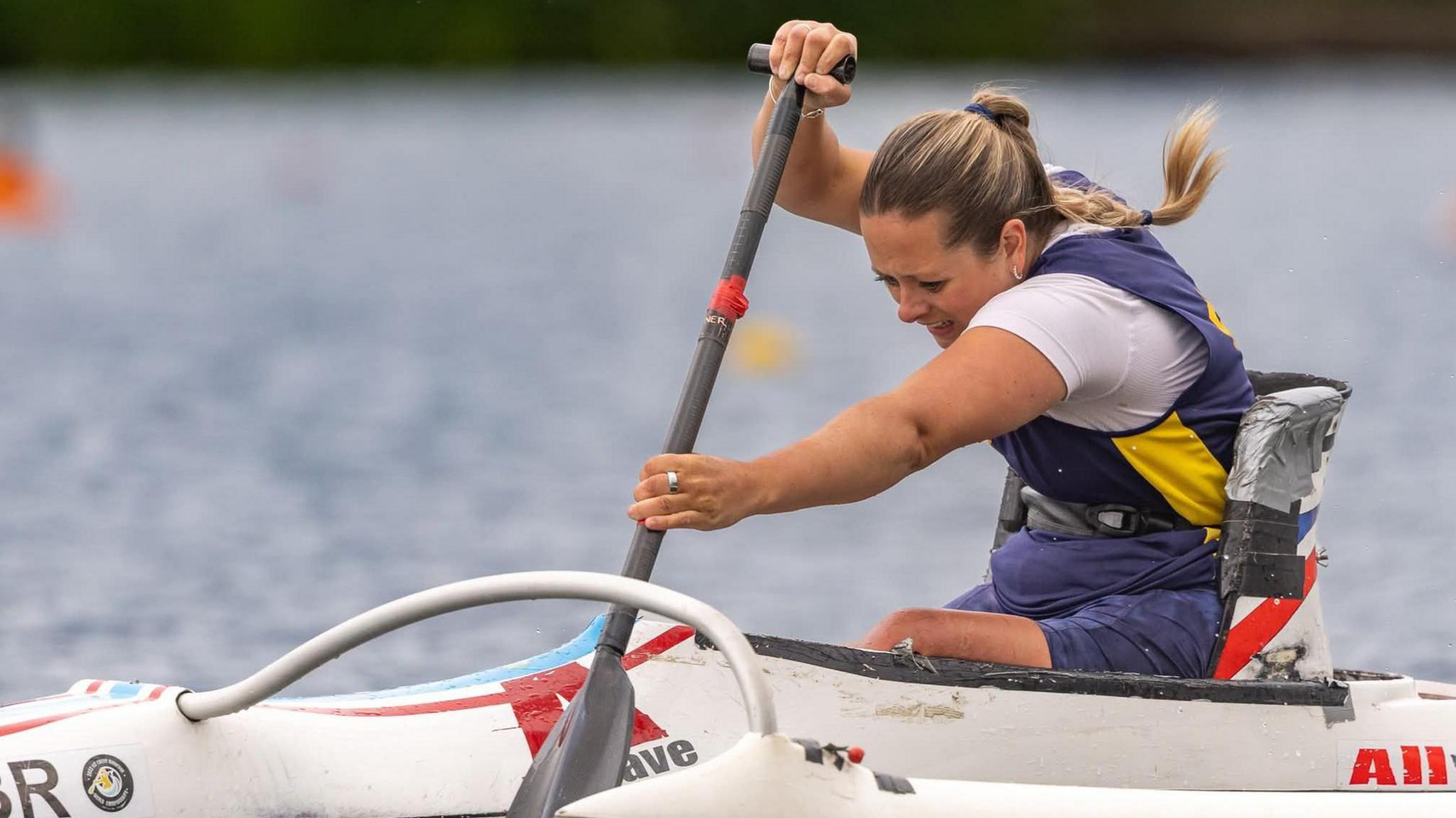 Image source, Antony EdmondsImage caption,
 Saffron Cresswell sat in a canoe for the first time in December 2025
Around a week before she left the spinal unit, Cresswell attended the Spinal Games at Stoke Mandeville Hospital, which is for patients with spinal injuries who are either still in hospital or within a year post-accident, and is an opportunity to try different sports over four days.
You name it, she tried it.
"I got six out of six bull's eyes and won the archery out of 110 people," she says.
"It was a great stepping stone to coming home. And I think I kind of held on to that when I came home initially because the first while was really tough at home."
She left hospital on 8 October and by December had started wheelchair racing, going on to race 10Ks and a half-marathon, also doing wheelchair tennis and basketball.
The trouble was, she didn't love them.
"I was worried I would never find a sport that I wanted to put my whole energy into," she says. "I think I knew that horses were my hobby that got to turn into my sport and my career and lifestyle so I didn't know if that would be possible to find something like that."
Enter para-canoe.
Cresswell had got chatting to Olympic canoe athlete Deborah Kerr at an event run by the Women's Sport Trust charity who had told her to "have a go".
So, on 23 December last year, she did. Winter was "not the time to start a water sport" and she was "not a natural".
"My coach was too scared to let me off the bank in case I capsized," she laughs. "And that probably stayed, I don't think I left the bank for about a month."
A one-off taster session turned into twice a week and then eventually five times a week on the water. Four-hour training sessions, plus gym work three days a week.
One of the biggest challenges has been staying upright.
"I don't have any feedback of any part of my body if I am losing balance," she explains. "So I'm strapped into a seat because I've got no core function, but I can't actually feel that seat. So I basically feel like I'm floating.
"So my only thing I've got to know if I've lost balance is my head and my eyes. So that took a while to start to hone in and they always say, deaf people hear better than anybody else, don't they? And I think it's a bit the same.
"It's like, I've now tuned into how to balance myself without the use of the rest of my body. But I'd say the balance aspect is a big part of it alongside the technical, constant skill-based stuff that needs to be improved."
It is the technical aspect that she thinks has similarities to equestrian and which is why she thinks she enjoys it so much.
Her progress has been rapid, by anyone's standards. Not least her own.
"World Championships was definitely not the plan. It was a quiet goal after a while that if I could get the time, I might be able to go," says Cresswell, who alongside training is also doing media work.
"The time I needed to achieve was, I think, one minute 26 seconds. And anyway, I'm now down to one minute 18. So I've kind of over-achieved on that one, which has just been through repetition, practise, finding new ways to do things."
She has been selected to represent Great Britain at this month's Canoe Sprint and Para-Canoe World Championships in Poznan, Poland.
Having only ever raced once before in the UK her aims are modest.
"Honestly, stay up and get through the start and finish line," she says, explaining that she capsized before the start of a race she was due to do in April.
It is more about getting an international classification - which involves a series of medical tests to assess an athlete's impairment and demonstrating how much of your body you can use when paddling - so that she can be eligible to earn points at events that can lead to qualification for the 2028 Paralympics in Los Angeles.
Could she have pictured this when she was in hospital?
"I certainly wouldn't have imagined I was going to do para-canoe - I didn't even know [that] was a sport when I was in hospital," says Cresswell, who will compete in the VL1 (a canoe with a support float) and KL1 (kayak).
"But to be honest, I think what actually is more kind of crazy in my head is I couldn't even imagine January me doing this."