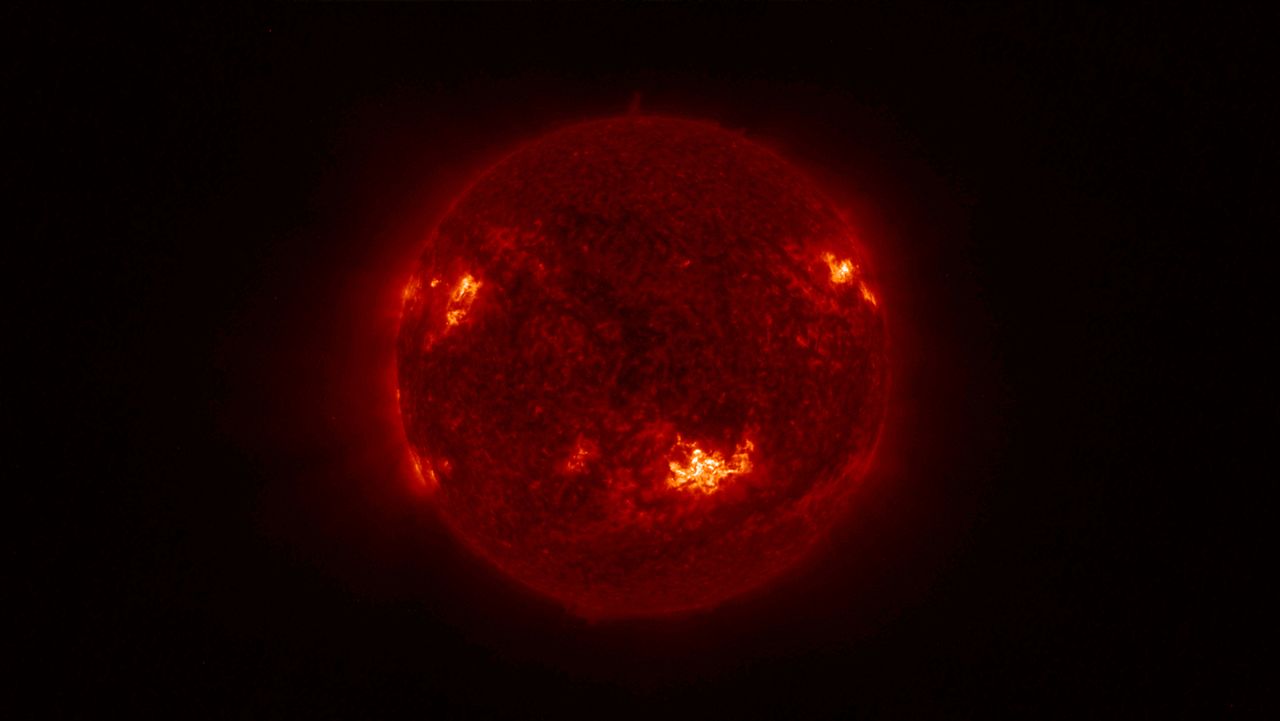
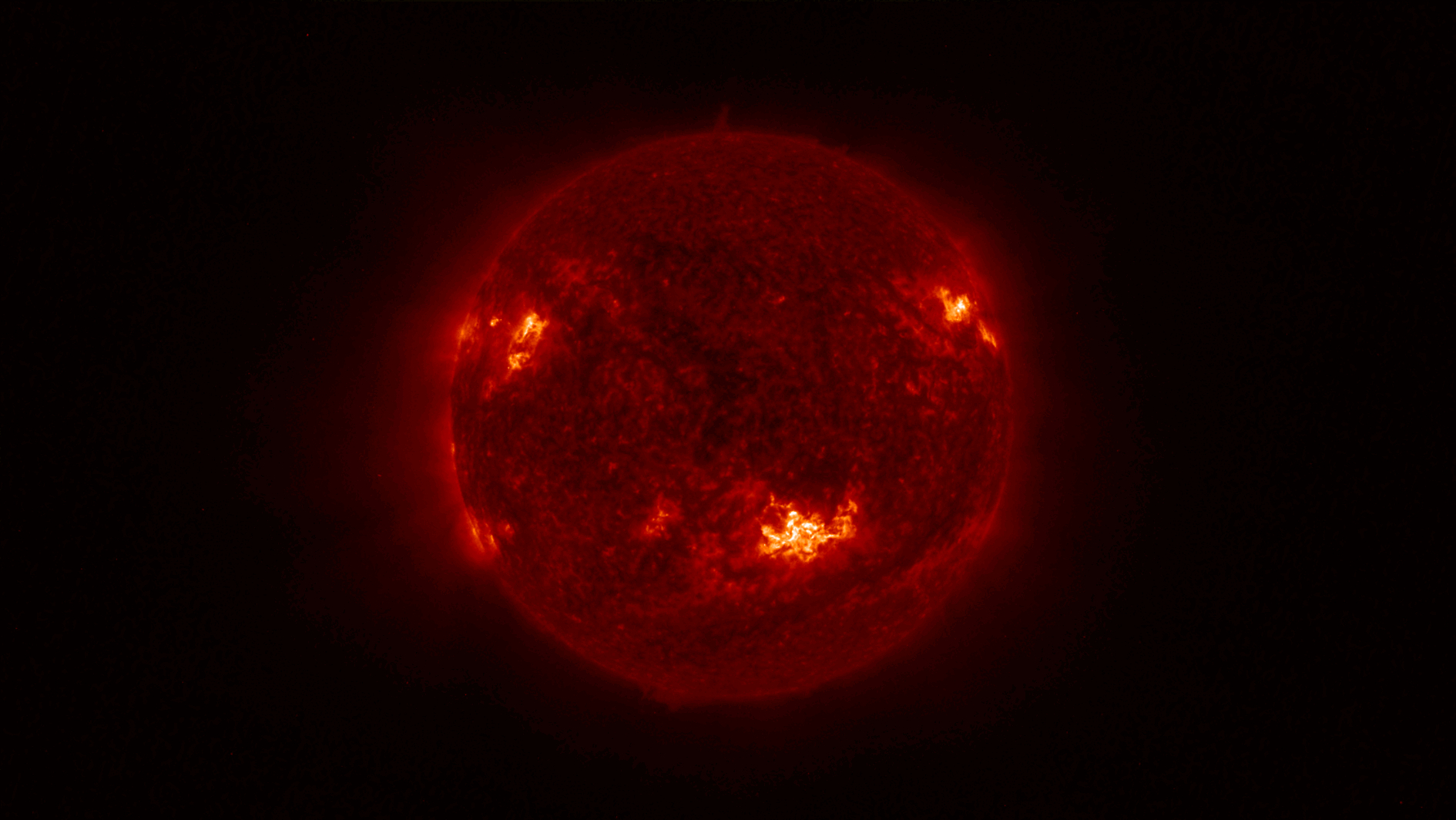
 The sun seen in two different X-ray wavelengths, 17.4 and 30.4 nanometers, on 21 May 2024. (Image credit: ESA & NASA/Solar Orbiter/EUI Team) Share this article 0 Join the conversation Follow us Add us as a preferred source on Google Newsletter Get the Space.com Newsletter
 Breaking space news, the latest updates on rocket launches, skywatching events and more!
Contact me with news and offers from other Future brands Receive email from us on behalf of our trusted partners or sponsors By submitting your information you agree to the Terms & Conditions and Privacy Policy and are aged 16 or over.You are now subscribed
Your newsletter sign-up was successful
Want to add more newsletters?
An account already exists for this email address, please log in. Subscribe to our newsletterActing as stellar archaeologists, scientists have found fossilized magnetism on long-dead stars known as "white dwarfs." This discovery may help explain how stars evolve from their "puffed out" red giant phase to their compact and smoldering white dwarf phase, a process our sun will undergo in around 5 billion years.
The team behind this research linked a theoretical model to observations of stars at different stages of their evolution, connecting evidence of magnetic fields at the surfaces of white dwarfs to magnetism detected at the cores of red giants. The team's model hinges on the idea that magnetic fields, which form early in a star's life, persist throughout all of their later stages, finally emerging on white dwarfs billions of years later as "fossil fields."
"The magnetic field in a star is important for how the star works on the inside and how long it lives and evolves," team co-leader Lukas Einramhof of the Institute of Science and Technology Austria (ISTA) said in a statement. "Generally, more of the older white dwarfs tend to be more magnetic than younger white dwarfs."
To understand the connection between red giants and white dwarfs, consider the final evolution of our own star, the sun.
From red giants to white dwarfs
In around 5 billion years, the sun will have exhausted the hydrogen in its core, no longer able to perform its nuclear fusion process that converts this element into helium. As this process is the main source of energy produced by the sun, this will mean the outward pressure that stops the sun from collapsing under its own gravity also ceases.
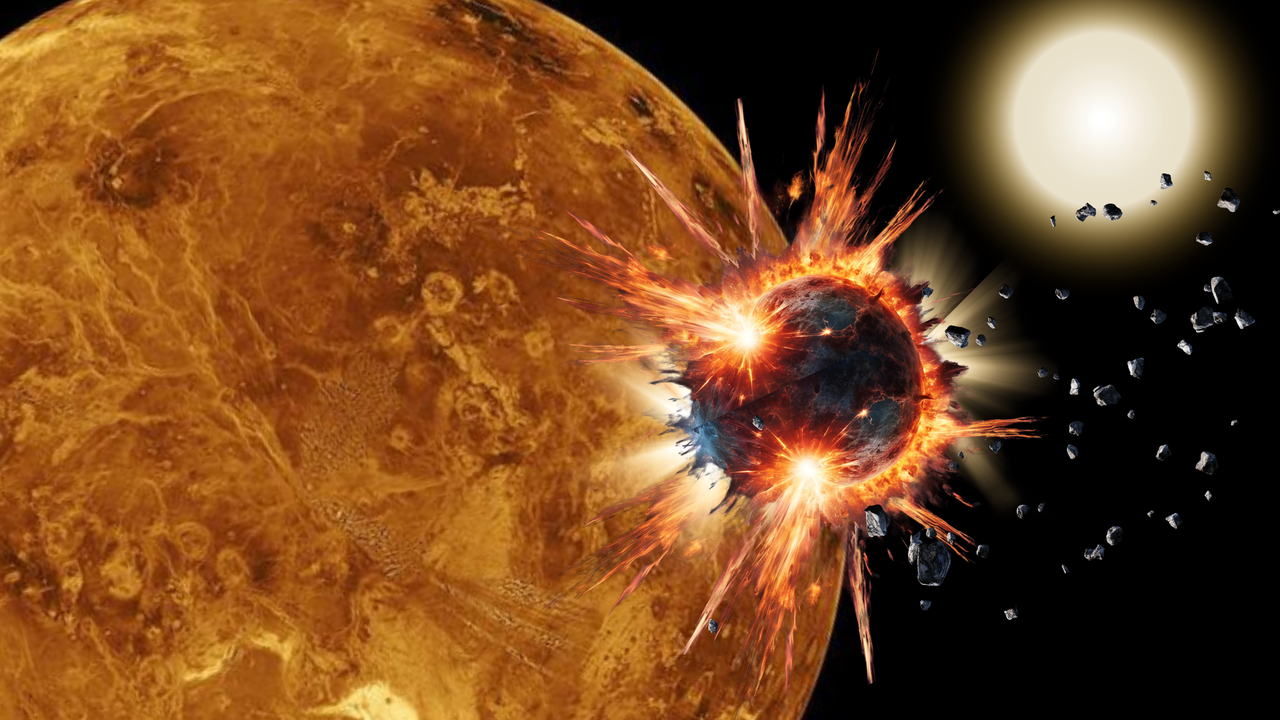
As the sun's core collapses, its outer layers, where nuclear fusion is still occurring, will puff out to around 100 times the original width of the sun — maybe more. This is the red giant phase. the solar system, it could see the sun swallow the rocky planets, including Earth, right out to the orbit of Mars.
Get the Space.com NewsletterContact me with news and offers from other Future brandsReceive email from us on behalf of our trusted partners or sponsorsThe red giant phase of the sun will be relatively short-lived, expected to last just 1 billion years. The outer layers of the star will eventually cool and disperse, leaving a nebula of ex-stellar material surrounding the sun's core, which will then become an exposed cooling stellar remnant called a white dwarf. That is the final stage of life for all stars of a similar mass to that of the sun.
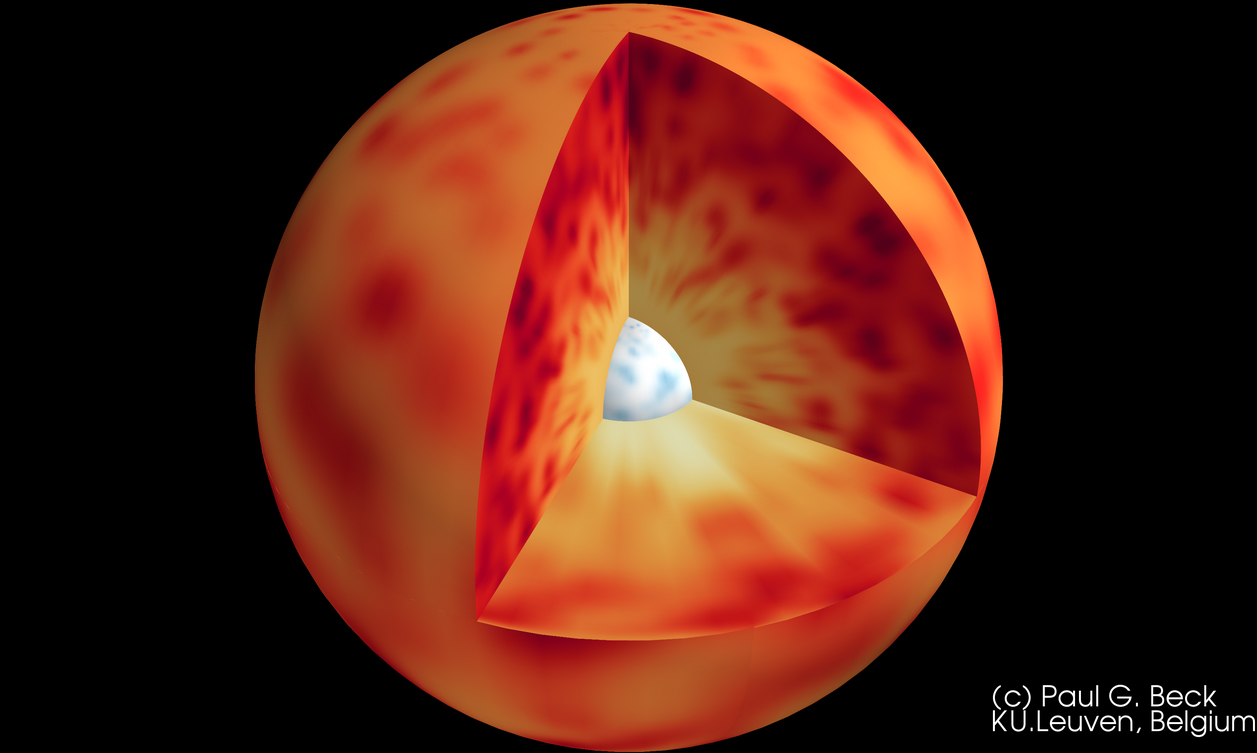
Recently, stellar scientists have been studying the interiors of red giants using starquakes just as seismologists here on Earth use seismic waves and earthquakes to investigate the interior of our planet.
This has revealed magnetic fields exist at the cores of red giants, while white dwarfs seem to have magnetic fields at their surfaces. Einramhof and colleagues think the fossil field model of stellar magnetism connects these magnetic fields at the two distinct evolutionary phases of stars, despite this being a theory that has fallen out of favor with scientists over recent years.
"Because a white dwarf is the exposed core of a red giant that has shed its outer layers, these different observations essentially examine the same region of a star’s interior at different evolutionary stages," Einramhof said. "If the magnetic field observed during the red giant phase is the same as the one that evolves to be observed at the surface of the white dwarf, then the fossil field theory can explain and connect the observations."
He and the team theorize that following the red giant phase, the shedding of a star's outer layers will leave distinctive properties at the surface of its white dwarf remnant successor. One of the key elements of this is how far the magnetism at the core of the red giant extends.
"To connect the magnetic fields observed at the surface of older white dwarfs with the ones found at the core of their red giant progenitors, a larger fraction of the star must be magnetized," Einramhof explained. "However, this doesn’t mean the stars are more strongly magnetized, only that the magnetic fields must already reach a larger portion of their core."
The team also determined how the evolution of a star influences the shape of its magnetic field, finding that instead of being centered at one point, it forms a segmented structure like the surface of a basketball, which is stronger near the surface than it is at the core.
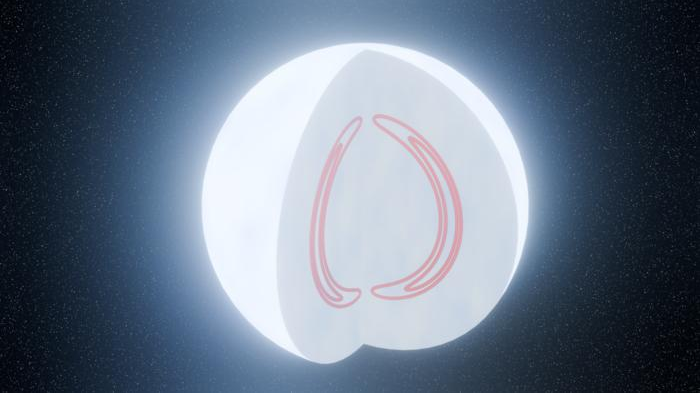
All of this could give scientists a better idea of what the future has in store for the sun and also the general state of our star deep below its surface.
"We still don't know whether the sun's core is magnetic. Even though it's our own star, we're practically blind to what happens at its center," Einramhof said. "Current predictions assume that the sun's core is not magnetic. But if it turns out to be, this information would change everything we know and all the models we’ve based our work on. Given how little we know at this stage, our work suggests that stars are most likely all magnetic. But we can't always detect this magnetism."
Following the team's lead, scientists may also discover that our 4.6 billion-year-old star has a little longer left to live than currently calculated.
"If the sun can somehow bring hydrogen from its outer layers into its core, it would be able to live longer. One way to do this would be through strong magnetic fields," Einramhof said. "However, the magnetic fields might also lead to a very different outcome."
The team's research was published on April 14 in the journal Astronomy & Astrophysics.
 Robert LeaSenior Writer
Robert Lea is a science journalist in the U.K. whose articles have been published in Physics World, New Scientist, Astronomy Magazine, All About Space, Newsweek and ZME Science. He also writes about science communication for Elsevier and the European Journal of Physics. Rob holds a bachelor of science degree in physics and astronomy from the U.K.’s Open University. Follow him on Twitter @sciencef1rst.
View MoreYou must confirm your public display name before commenting
Please logout and then login again, you will then be prompted to enter your display name.
Logout MORE FROM SPACE... 1These 'interstellar glaciers' could give water to young star systems. Could they support alien life, too?
- 2Ancient volcanic ash seen blowing across Mars in new spacecraft images
- 3James Webb Space Telescope peers into a dying star surrounded by mysterious buckyballs: 'The structures we're seeing now are breathtaking'
- 4Interstellar invader comet 3I/ATLAS formed in a world much colder than the solar system
- 5NASA's TESS spacecraft discovers a weird system of exoplanets unlike anything seen before