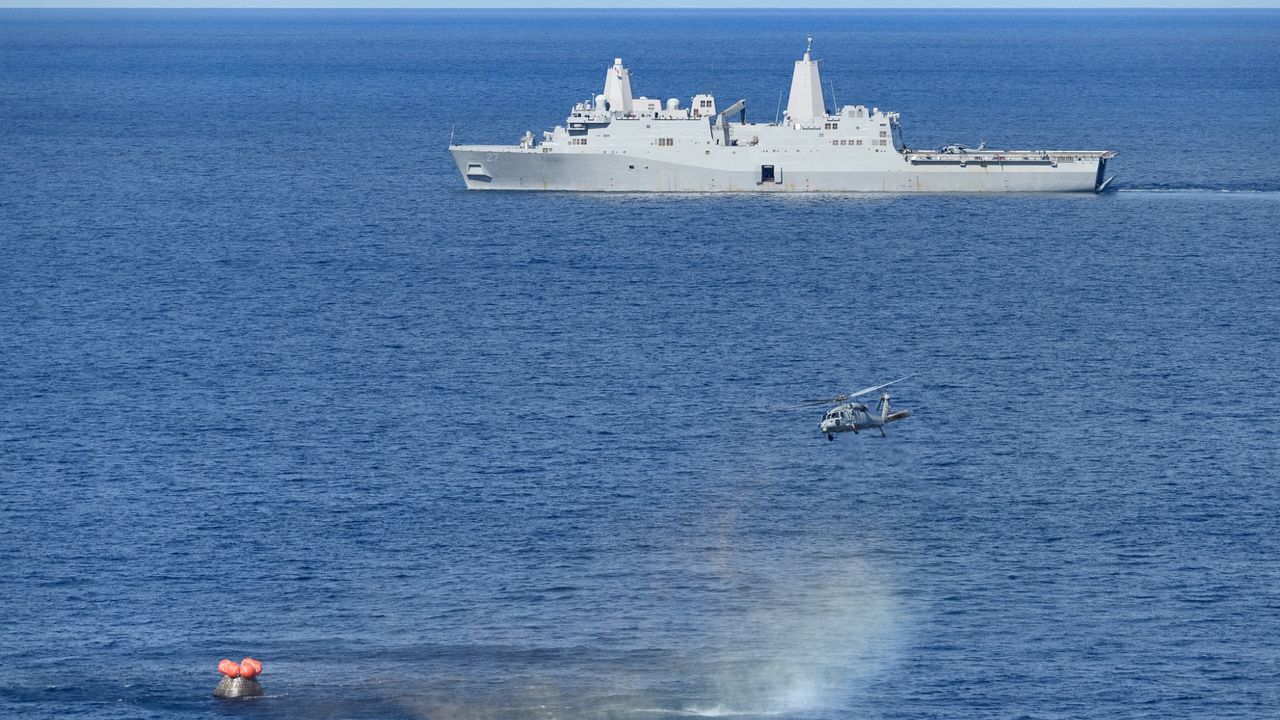
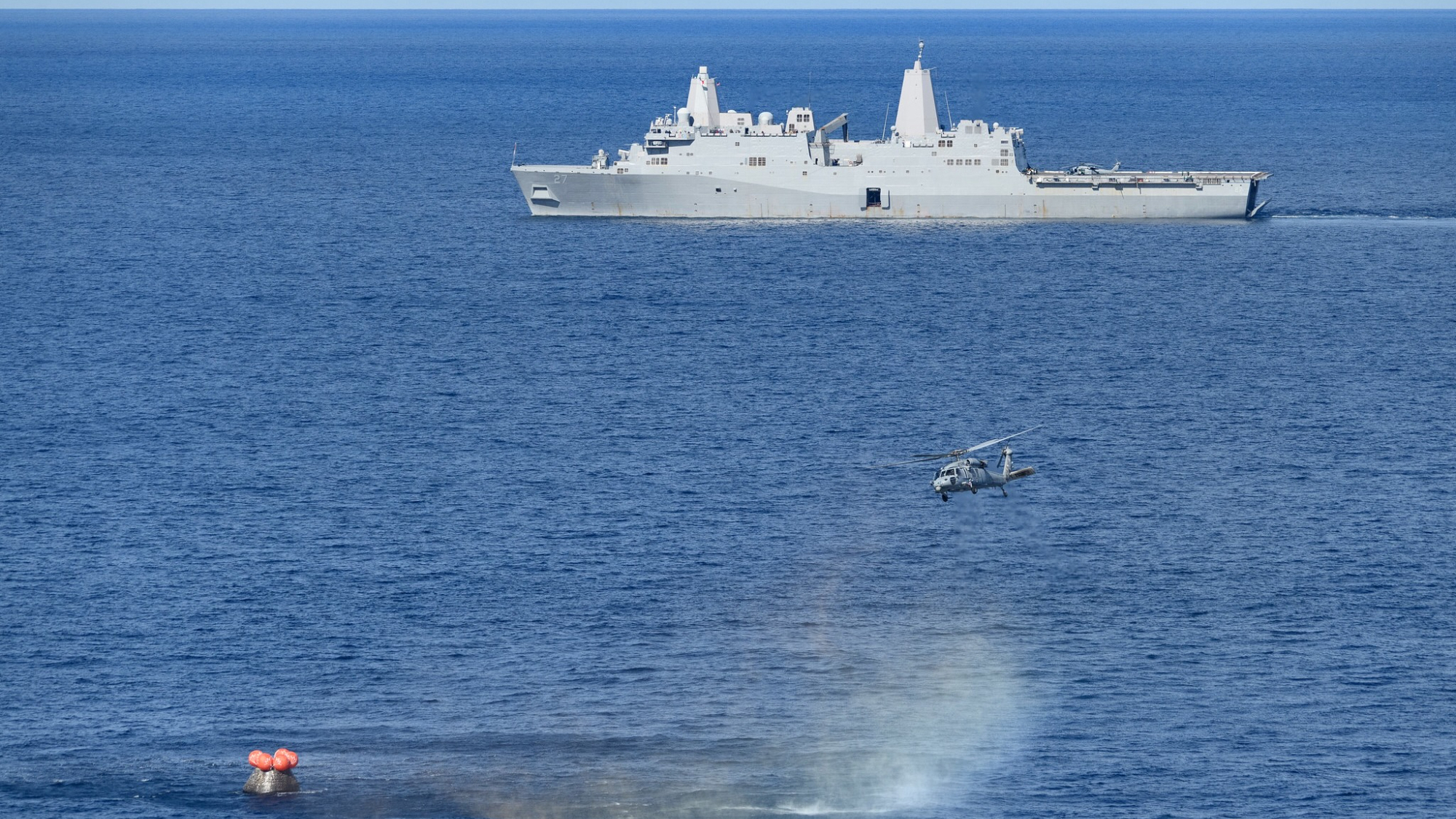
 a gray space capsule floats in a calm ocean with a gray military ship in the background (Image credit: NASA) Share this article 0 Join the conversation Follow us Add us as a preferred source on Google Newsletter Get the Space.com Newsletter
 Breaking space news, the latest updates on rocket launches, skywatching events and more!
Contact me with news and offers from other Future brands Receive email from us on behalf of our trusted partners or sponsors By submitting your information you agree to the Terms & Conditions and Privacy Policy and are aged 16 or over.You are now subscribed
Your newsletter sign-up was successful
Want to add more newsletters?
An account already exists for this email address, please log in. Subscribe to our newsletterThe Artemis 2 astronauts are almost home.
The quartet's Orion capsule will return to Earth tonight (April 10), bringing an end to the first crewed moon mission since Apollo 17 back in 1972.
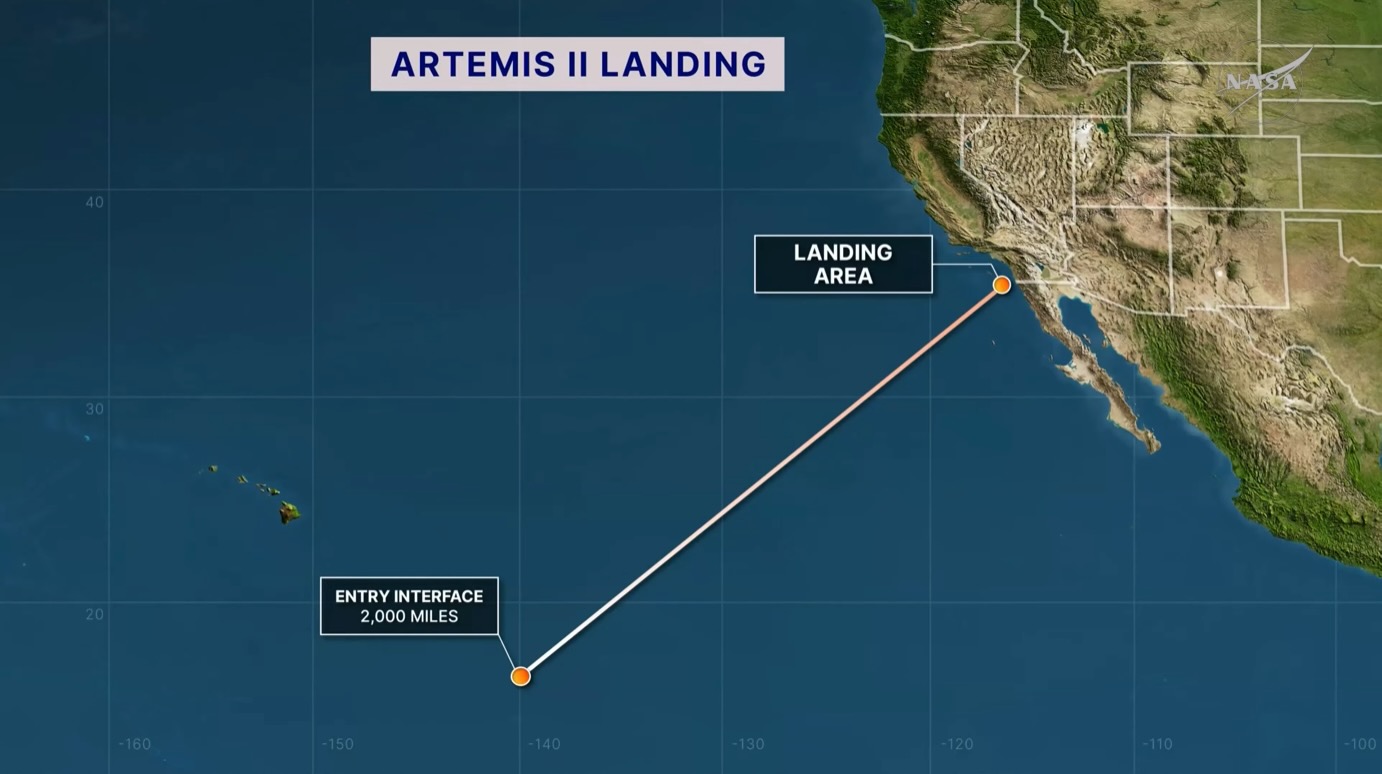
If all goes according to plan, the spacecraft will splash down at 8:07 p.m. EDT (0007 GMT on April 11) in the Pacific Ocean, not far off the coast of San Diego — the same general area where the uncrewed Artemis 1 moon mission came down in December 2022. And there are very good reasons why NASA keeps returning to this spot.
For starters, it's wet. And that's important, because Orion — like the Apollo capsules before it — is designed to splash down in the ocean, not land on terra firma.
And the waters off San Diego — as opposed to Los Angeles, say, or San Francisco — make a lot of sense, because the city hosts a pretty important naval installation.
"Naval Base San Diego is homeport to the Pacific Fleet Surface Navy, with 60 U.S. Navy ships and two auxiliary vessels," the base's official website states. "Naval Base San Diego is also home to more than 200 tenant commands, each having specific and specialized fleet support purposes."
That support is crucial to NASA, which coordinates its crew-recovery operations with the Navy. Indeed, the vessel that will pick up the four Artemis 2 astronauts (NASA's Reid Wiseman, Victor Glover and Christina Koch, and the Canadian Space Agency's Jeremy Hansen) is the USS John Murtha, an amphibious transport dock ship that's homeported at Naval Base San Diego.
Get the Space.com NewsletterContact me with news and offers from other Future brandsReceive email from us on behalf of our trusted partners or sponsorsThe seas off San Diego are also generally benign and well-understood, another important factor for a crewed mission's splashdown zone.
So, the area "is a practical choice: predictable Pacific recovery conditions, nearby naval support and a well-practiced handoff from capsule to ship," Aaron Rosengren, an expert in orbital mechanics at the University of California San Diego, told UC San Diego Today on Wednesday (April 8).
Artemis 2's "free-return trajectory," which sent it on a single, dramatic loop around the moon, "set the broad fact that Orion would come back to Earth in the Pacific," Rosengren said. The Artemis 2 team homed in on the San Diego area by making a few additional, precise engine burns, he added.
The last of those burns will occur today at 2:53 p.m. EDT (1853 GMT), if all goes according to plan. At 7:33 p.m. EDT (2333 GMT), Orion's crew module will separate from its service module, which has been providing power and propulsion throughout the 10-day mission.
Twenty minutes later, the crew module will hit Earth's atmosphere over the Pacific, about 2,000 miles (3,200 kilometers) southwest of San Diego. Orion will be traveling nearly 24,000 mph (38,620 kph) at that point, so it'll cover that ground pretty quickly; splashdown is expected at 8:07 p.m. EDT (0007 GMT).
The USS John Murtha will be in the area, waiting to welcome the four astronauts back to Earth — and to help them get to dry land safe and sound.
 Mike WallSpaceflight and Tech Editor
Michael Wall is the Spaceflight and Tech Editor for Space.com and joined the team in 2010. He primarily covers human and robotic spaceflight, military space, and exoplanets, but has been known to dabble in the space art beat. His book about the search for alien life, "Out There," was published on Nov. 13, 2018. Before becoming a science writer, Michael worked as a herpetologist and wildlife biologist. He has a Ph.D. in evolutionary biology from the University of Sydney, Australia, a bachelor's degree from the University of Arizona, and a graduate certificate in science writing from the University of California, Santa Cruz. To find out what his latest project is, you can follow Michael on Twitter.
View MoreYou must confirm your public display name before commenting
Please logout and then login again, you will then be prompted to enter your display name.
Logout MORE FROM SPACE...- 1NASA's Artemis 2 moon mission is coming home today. Where will it land?
- 2What time is NASA's Artemis 2 moon mission landing today? Full schedule
- 3Artemis 2 moon astronauts splash down today — What to expect at each stage of reentry & landing (timeline)
- 4The Artemis 2 astronauts got a private 'Project Hail Mary' screening before launch. Here's their verdict
- 5Crew of tiny worms readies for April 11 launch to International Space Station