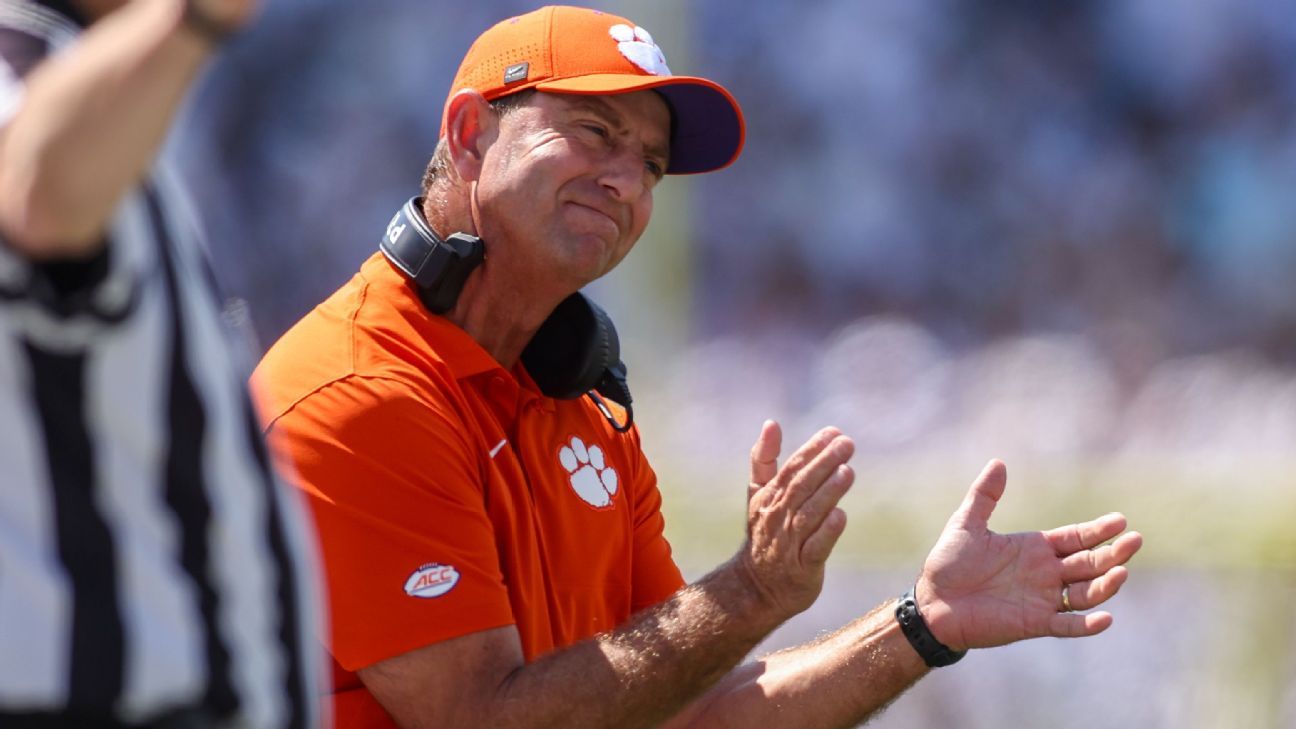
Dabo Swinney takes the blame for the Clemson Tigers' 2025 season in a sit-down interview. (0:58)
The offseason is a time of hope for all sports fans. This year, everyone's favorite team will right its ship, reach its potential (or beyond) and bring joy to the masses. We hope.
For teams, coaches and players, the hope of fans can translate into pressure and raise the temperature in uncomfortable ways. And when things don't go well, hope can be replaced by disappointment and impatience.
Who in college football will be most impacted by these tendencies in 2026? We're thinking about those with expectations that things can be better, that things better get better. There are teams looking for College Football Playoff berths, players who need to bounce back from down years and coaches who are on -- or near -- the hot seat.
Our college football reporters offer their thoughts on the teams, coaches and players who will have the most to prove this fall.
Andrea Adelson: Clemson. We could have put Clemson down as the answer to this question for the past four years, but this time we really mean it. There is no sugarcoating the disappointment from 2025, when the Tigers finished 7-6 despite having a veteran team filled with future NFL draft picks. Coach Dabo Swinney went more heavily into the portal this offseason, particularly on defense, and went back to his past to hire Chad Morris as offensive coordinator to try to fix a stagnant offense. But there are major questions across the board with so many veterans gone. Swinney and his players need to show they have the answers.
Adam Rittenberg: USC. Coach Lincoln Riley has asked for patience as he upgraded the front office and other areas of the program to create a path for sustained success. While other less-decorated teams have risen faster, USC has a roster in place with fewer transfers and an influx of elite recruits from the nation's No. 1 class. The next step is obvious -- the team's first College Football Playoff appearance -- but USC must navigate a very challenging Big Ten schedule that includes home showdowns against Oregon, Washington and Ohio State, and trips to Indiana and Penn State. USC needs an upgrade in performance, but in Year 5 of the Riley era, the time has come.
Jake Trotter: Until the past two years, Wisconsin had not suffered back-to-back losing seasons since 1991 and 1992 -- Barry Alvarez's first two years (and in 1993, the legendary coach went 10-1-1 and won the Rose Bowl). Under Luke Fickell these past two years, the Badgers have won just five Big Ten games total. They've been especially dreadful offensively. Still, Wisconsin refrained from making a coaching change and vowed to invest more heavily in football behind Fickell. Will that reverse the recent decline? Or, in the expanded Big Ten, with so many other winning programs, are the Badgers headed for extended second-tier status? This year could be telling.
Mark Schlabach: Alabama went 20-8 in coach Kalen DeBoer's first two seasons, so it's not like the Crimson Tide have fallen off a cliff since Nick Saban left. DeBoer accepted the unenviable challenge of replacing the GOAT, a job others turned down. Alabama fans aren't used to losing four games in a season, so the Tide need to rebound in 2025. It won't be easy with quarterback Ty Simpson and much of the offensive line moving on. Alabama hasn't been able to run the ball or protect the quarterback, which is why DeBoer brought in new offensive line coach Adrian Klemm.
Bill Connelly: It has to be Alabama. Simpson had to carry the Tide offense at times thanks to the total lack of a run game, and now Simpson is gone and the line is almost completely new (and I'm not sure Alabama got what it needed up front in the transfer portal). The Tide will start an inexperienced quarterback with even less proven personnel. The defensive front seven is taking on a huge reset as well. This is a huge season for DeBoer, and he's looking at his least proven roster yet in Tuscaloosa.
Eli Lederman: Texas Tech hit big on its financial investment in the transfer portal last fall to the tune of the program's first outright conference title since 1955 and its first trip to the CFP. The question now: Can the Red Raiders do it again in 2026 and, in turn, show they're truly here to stay as perennial contenders? Joey McGuire & Co. will return 14 starters in the fall and have filled key holes with ESPN's No. 2 transfer class, headlined by quarterback Brendan Sorsby and the additions of defensive linemen Mateen Ibirogba, Trey White and Adam Trick to replace the dominant trio of David Bailey, Lee Hunter and Romello Height. But the sport's recent history has shown the potential pitfalls of a year-to-year reliance on portal talent and Texas Tech's to-this-point stellar talent evaluation will be tested again in 2026. An upstart renegade this time last year, the pressure now falls on the Red Raiders to prove they're something more than a one-hit wonder.
Adelson: It has to be Florida State head coach Mike Norvell. Nothing has gone right since the CFP snub following a 13-0 ACC championship season in 2023. Since then, Florida State has won only seven games in two years. Despite all that, the school's administration opted to retain Norvell for a seventh season, but there is little doubt the Seminoles have to get back to the postseason. Norvell and everyone associated with the program know the past two seasons have not been acceptable. Florida State made structural changes to its personnel department and went heavy into the portal again to try to win now.
Rittenberg: Norvell is a good choice, but I'm going with the man he beat in last season's opener: Kalen DeBoer. Although DeBoer rebounded from the Florida State loss and guided Alabama to the CFP, he did so with a deeply flawed team that was exposed in lopsided losses to Georgia (SEC championship) and Indiana (CFP semifinal at the Rose Bowl). Alabama just didn't look like Alabama at the end of the season. DeBoer has had another offseason to improve key areas of the roster, adding transfers along both lines. He will be developing Keelon Russell, the first quarterback his staff recruited to Tuscaloosa. DeBoer isn't a hot-seat candidate but faces pressure to deliver a team capable of advancing further in the CFP.
Trotter: Lane Kiffin bailed on Ole Miss and his Rebel players ahead of the playoff to bolt to rival LSU (and yet, people really still fault players for making decisions in their own best interest?). LSU is paying Kiffin $91 million to win national championships. Given the way he left his former team high and dry, and what the Tigers have invested in their roster, anything less won't -- and shouldn't -- be acceptable.
Schlabach: Matt Rhule signed a two-year contract extension with Nebraska through the 2032 season, so it's not like he's on the hot seat. But after his teams went 19-19 in his first three seasons, it's time for Nebraska to start showing some life. The Cornhuskers haven't won 10 games or more in a season since 2012. They've lost six games or more in eight of the past nine. Rhule retooled his offensive line and brought in former Georgia Tech assistant Geep Wade to take charge of that unit. Transfer guards Brendan Black (Iowa State) and Paul Mubenga (LSU) should help on the interior, as Nebraska revamps its offense after quarterback Dylan Raiola transferred to Oregon.
Connelly: Shane Beamer has made the most of a couple of great bursts -- beating 11-win Tennessee and Clemson teams back to back in 2022, ripping off a six-game winning streak to end the 2024 regular season -- and that has earned him a sixth year in charge at South Carolina. But he's only 33-30 in five seasons, and he completely wasted what was supposed to be a breakout season for quarterback LaNorris Sellers in 2025. He brought in offensive coordinator Kendal Briles and made another offensive line overhaul this offseason, and hey, if he's going to thrive, it's evidently going to be in an even-numbered season. But if he doesn't prove himself this fall, he'll probably be out of a job.
Lederman: Louisville's Jeff Brohm isn't under the same level of pressure as the other coaches included in this group. But while the Cardinals have won 28 games over the past three seasons -- second best among Power 4 programs without a CFP appearance over that span -- Brohm & Co. have only a 2023 ACC title game appearance to show for it. A 9-7 conference record since the start of the 2024 campaign has kept Louisville from being anything more than a fleeting, midseason ACC contender the past two years. With an intriguing newcomer under center in Ohio State transfer Lincoln Kienholz and stars returning on both sides of the ball in running back Isaac Brown and defensive lineman Clev Lubin, it's time for Brohm's Cardinals to make a meaningful jump, especially given how wide open the ACC race appears to be behind favorite Miami.
Adelson: There is a long line of candidates, but I am going with DJ Lagway. We saw flashes of brilliance and mediocrity over his first two seasons at Florida, but transferring to Baylor and returning to his home state might be just what he needs. While it is true Lagway has not been fully healthy in either of his first two seasons, his confidence sagged as he underperformed while trying to carry the weight of the hype that comes with being the top-ranked QB prospect in the class of 2024. Lagway is a special player. If he can get to 100% health and regain his confidence, he will have the opportunity to show that again.
Rittenberg: Sam Leavitt interests me on a number of levels. He proved himself to a degree in 2024, winning Big 12 Freshman of the Year honors at Arizona State. But an injury-marred 2025, followed by a controversial exit from the program and a prolonged transfer portal process, places a bright spotlight on Leavitt this fall. He joins Kiffin at LSU with massive expectations. Kiffin's quarterbacks almost always hit it big, but Leavitt will have to display better accuracy and durability as he joins a new team in a new league. LSU has an opportunity to rise quickly under Kiffin but will need a big season from its decorated transfer quarterback.
Trotter: Texas A&M's Marcel Reed did lead the Aggies to an 11-0 start. But in Texas A&M's two biggest games -- against rival Texas and against Miami in the opening round of the playoff -- Reed took eight sacks, threw four interceptions and didn't account for one touchdown, passing or rushing. In turn, the Aggies lost both games. Texas was red hot at the end of last season and Miami went on to make the national championship game, but those are the caliber of teams A&M will have to beat if it's going to become a true national contender. The pressure is on Reed to play his best when it matters most in 2026.
Schlabach: Defending CFP national champion Indiana added former TCU starter Josh Hoover to replace Heisman Trophy winner Fernando Mendoza. Hoover has enough arm strength and mobility to be effective in Curt Cignetti's system, but he has to cut down on the turnovers that plagued him in his 33 starts with the Horned Frogs. Hoover threw 33 interceptions in three seasons at TCU, including 13 last season (to go with two fumbles). Indiana offensive coordinator Mike Shanahan got the most out of Ohio transfer Kurtis Rourke in 2024 and Mendoza last season, and he'll be looking to do the same with Hoover.
Connelly: Texas Tech surged to an unbeaten regular season and Big 12 title in 2025 despite what seemed like clear limitations at quarterback. Those limitations were apparent in the CFP loss to Oregon, so the Red Raiders spent big to bring Brendan Sorsby to Lubbock. He's a big-play hunter and a scrambling threat, and his upside is obvious. But he has to deliver where Behren Morton couldn't last fall.
Lederman: I'm not sure how we got this far without mentioning Arch Manning. Texas' star quarterback played like an All-American over the back half of the 2025 season. This fall, Manning returns as a second-year starter surrounded by a CFP-caliber roster with fresh playmakers on both sides of the ball, including a pair of portal additions in running back Hollywood Smothers and wide receiver Cam Coleman. A return to the playoff will be the assumption for the Longhorns, and Manning will have to manage high-profile meetings with the likes of Ohio State, Tennessee, Oklahoma, Ole Miss, LSU and Texas A&M to get them there. Fair or not, outsized expectations have followed Manning since long before he stepped on campus. In 2026, he'll be looked upon to finally deliver in a big way.
Adelson: Alabama receiver Ryan Williams. Williams went from freshman phenom in 2024 to nonfactor in 2025, so there is little doubt this season is setting up to be a critical year for him and the Crimson Tide. Williams had half as many touchdown catches this past season as his first year, and his yards per catch dipped 4 yards as he dealt with multiple injuries. Suddenly one of the most explosive players in the country looked a step slow and unsure of himself. Perhaps the lowest point was getting zero targets against rival Auburn. Headed into the CFP quarterfinals against Indiana, Williams had just four catches for 63 yards combined in his four previous games.
Rittenberg: Houston running back Makhi Hughes. A year ago, Hughes looked like one of the top non-QB transfers of the cycle, moving from Tulane to Oregon following a 1,400-yard season. But he could barely get on the field with a Ducks offense that had five players log more than 40 carries (Hughes had just 17 in six games). Ranked No. 30 in ESPN's preseason list of top 100 players, Hughes became a nonfactor in Eugene. He now reunites with Willie Fritz, his coach at Tulane, and a Houston team coming off of a 10-win season and set to contend in the Big 12.
Trotter: South Carolina defensive end Dylan Stewart was a preseason All-American going into 2025. Stewart, however, didn't even earn first-team All-SEC honors. He finished with only 4.5 sacks and ranked just 61st nationally with a pressure rate of 12.1%. The Gamecocks were one of college football's biggest disappointments as well, finishing 1-7 in the SEC. Stewart has the talent to be the top non-QB off the board in the 2027 NFL draft. The Gamecocks need him to have a much more productive season in 2026.
Connelly: Agreed on Ryan Williams. His 13.0% drop rate was a sure sign of the yips in 2025, and Alabama desperately needs to be able to rely on him this coming season. But let's go with another SEC receiver: Texas' Cam Coleman. His best plays over two seasons at Auburn certainly backed up his five-star hype, but he had some drops issues, too, and while Auburn's QB situation was messy, you'd still like to see more than the two 100-yard games he managed last fall. He'll be expected to come up huge, again and again, for Arch Manning and a likely preseason top-five team. Can he?