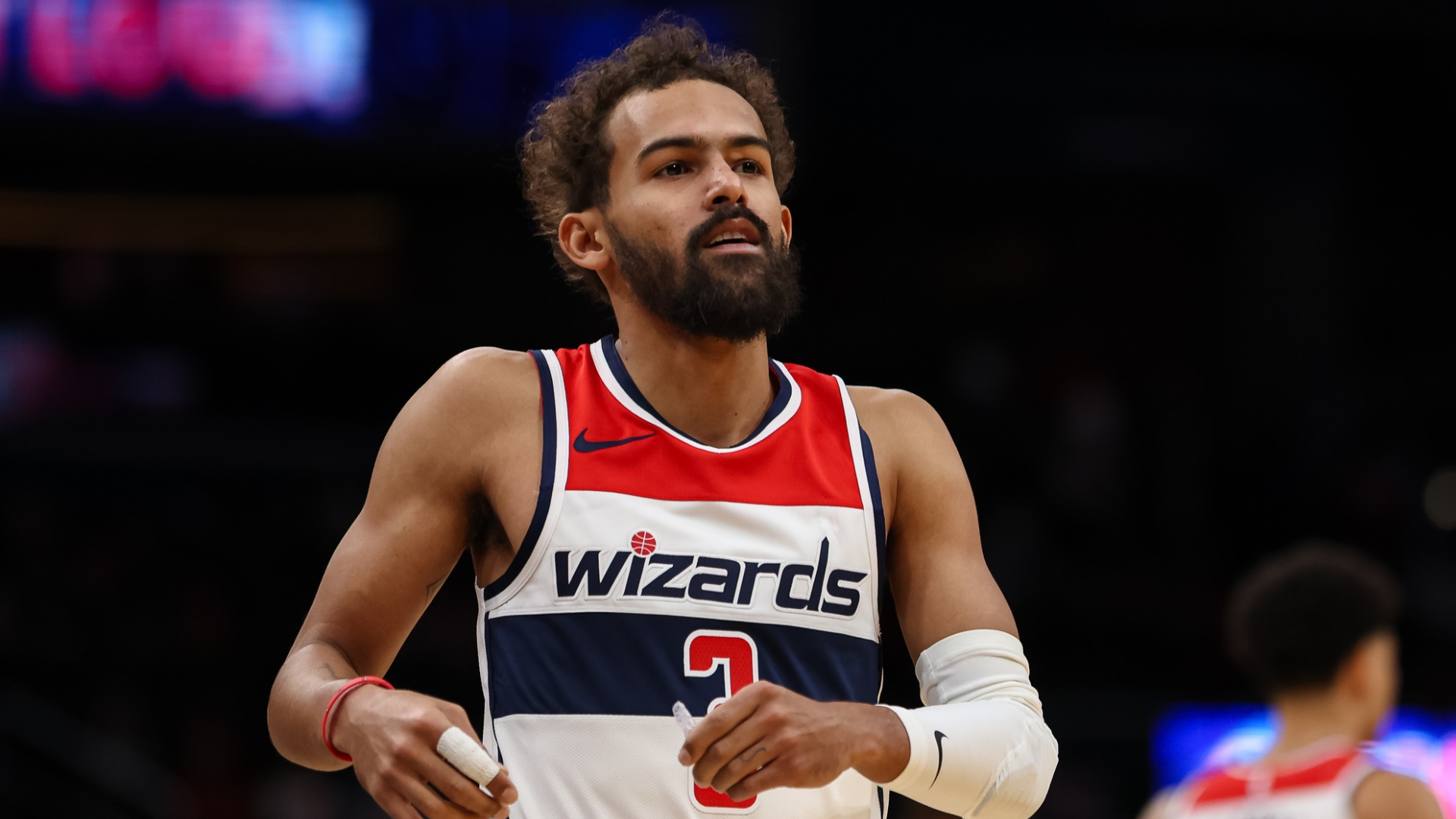
The Washington Wizards entered Tuesday with a 7-11 record. In their seven wins, Trae Young is averaging just under 11.3 shot attempts per game. In those 11 losses, he's averaging 13.3. It's a small difference, but a notable one. The Wizards came into play Tuesday on a three-game winning streak, and a meaningful part of that streak has been Young spending less time on the ball.
In Washington's first 15 games, he averaged around 6.6 minutes of possession per game, tied for the third-most in the league. He's down to 4.5 in his last three games. He's dribbling around one fewer time per touch, and his average possession per touch is down around a second. These aren't glaring changes, but they've been helpful ones. It's not a coincidence, for example, that No. 1 pick AJ Dybantsa's two best offensive games have come in this stretch.
Young, 28, has been a mess as a scorer this season. He's shooting just 36.4% from the floor and 32.5% on 3s. He's barely getting to the basket and struggling mightily when he's in the paint. He can't beat defenders nearly as easily off the dribble as he once could. Getting the ball out of his hands a bit more has been essential.

 Trae Young WAS • PG • #3 FG%36.43P%32.5FT%86.13P/G2.111 View Profile
It's been an intentional shift on Washington's part. Wizards officials have asked Young to focus less on his own scoring and instead emphasize his playmaking, according to The Athletic. Washington certainly won't complain about a 24-to-7 assist-to-turnover ratio in that stretch. Young, despite his noticeable decline as a scorer, remains a stellar passer. That's typically how star decline works. It comes in bits and pieces. Even as essential components of a player's game degrade, years of accumulated basketball IQ allow him to continue finding ways to contribute. After years of abject tanking, the Wizards seemingly wanted an offensive organizer around to help give their younger players some structure. Young can still do that.
But we're in an increasingly financially unforgiving NBA, and the Wizards aren't paying Young a contributor's salary. They're paying him star money, and they chose to do so after just five relatively quiet games with him a season ago. His four-year, $212 million max contract will pay him at the top of the market through the end of Dybantsa's rookie deal. With Anthony Davis on the books through the end of Kyshawn George and Alex Sarr's rookie deals, the Wizards effectively traded the roster-building flexibility those cheap rookie deals afforded them for two declining stars.
Davis has justified the investment, at least as an asset. They haven't extended him. They could potentially flip him for more than they paid him. Young has not.
And that's the dilemma the Wizards are now in.
NBA Hater Report: Celtics can't shoot, neither can Trae Young and James Harden isn't close to a top 10 player Brad Botkin
A daunting shift for Young
Clearly, less Young leads to more winning for the Wizards. But getting enough out of him to justify that enormous contract almost certainly requires more than they're currently getting. The entire value proposition of employing Young rests on him being a high-usage offensive engine. He just doesn't provide enough off-ball offensive value to justify what he gives up defensively at a max price point.
Take his shooting, for example. "Trae's got so much gravity," Wizards coach Brian Keefe told The Athletic. "When he plays off the ball, he's going to draw people, and then we're getting into actions with him on the second side that have been really good." There's something to this in theory, especially since gravity tends to rest more on reputation than reality. But Young has never been a consistently reliable catch-and-shoot player. He's averaging less than two catch-and-shoot 3-point attempts per game this season and has made around 28% of them. He's never averaged more than two catch-and-shoot 3-point attempts per game in a season.
Maybe he improves if his role demands more of these shots, but this is his ninth NBA season. That sort of shift this late in a career is rare.
It's a daunting change. Young spent most of his seven-and-a-half-year Atlanta Hawks run as almost entirely an on-ball player. He's never scored more than 39 points off of cuts in a single season. He has none this season. He's never been an especially active mover or screener, and even if he's grown on that front over the last few years, that's from a starting point of essentially zero. Asking Young to be less of a heliocentric shot creator is essentially asking Young to be a different player entirely.
That was the danger in paying Young sight unseen. They had no idea how he'd fit on this roster when they ponied up a max deal. If he'd picked up his player option and made this a prove-it season, they could have worked out the kinks and tried to sign him to a more appropriate deal next summer. The obvious argument here is that Young might have left had the Wizards refused to give him a long-term extension, but the counter here is that the Wizards would almost certainly have been better off if that had happened.
Stephen Noh's salary model estimates that Young is worth $26.3 million so far this season. That's a bit less than half of what he's getting. If that persists over the life of the deal, it's among the NBA's worst contracts. If his scoring continues to decline as he loses burst with age, it's a borderline crisis. Young may remain a passing genius, but passing skill is not a one-to-one match with passing value. It's easier to set teammates up when you're a dangerous enough scorer to consistently draw help. If Young isn't generating the same sort of advantages he once did, the passes that were once available to him suddenly become harder.
All of this puts the Wizards in an extremely precarious long-term position. They had to get the ball out of Young's hands more in the present. Too much of their offense involved players more important to the organization's long-term plans -- Dybantsa chief among them -- watching him dribble. A lower-usage Young probably makes the Wizards a better team simply by spreading usage to players who need more of it.
But that doesn't mean that a lower-usage Young is especially valuable. On-ball creation is where much of Young's value is generated. His scoring has declined so much that he's not generating the same value he used to, so all of this has stuck the Wizards between a rock and a hard place. They can try to maximize Young's skill set at the expense of everyone else, or they can try to maximize the team as a whole. But in doing so, they're not getting nearly enough out of a player they're paying to be a centerpiece. The latter is probably the right decision, but it's still a choice between two bad options. It's a band-aid on a self-inflicted wound.