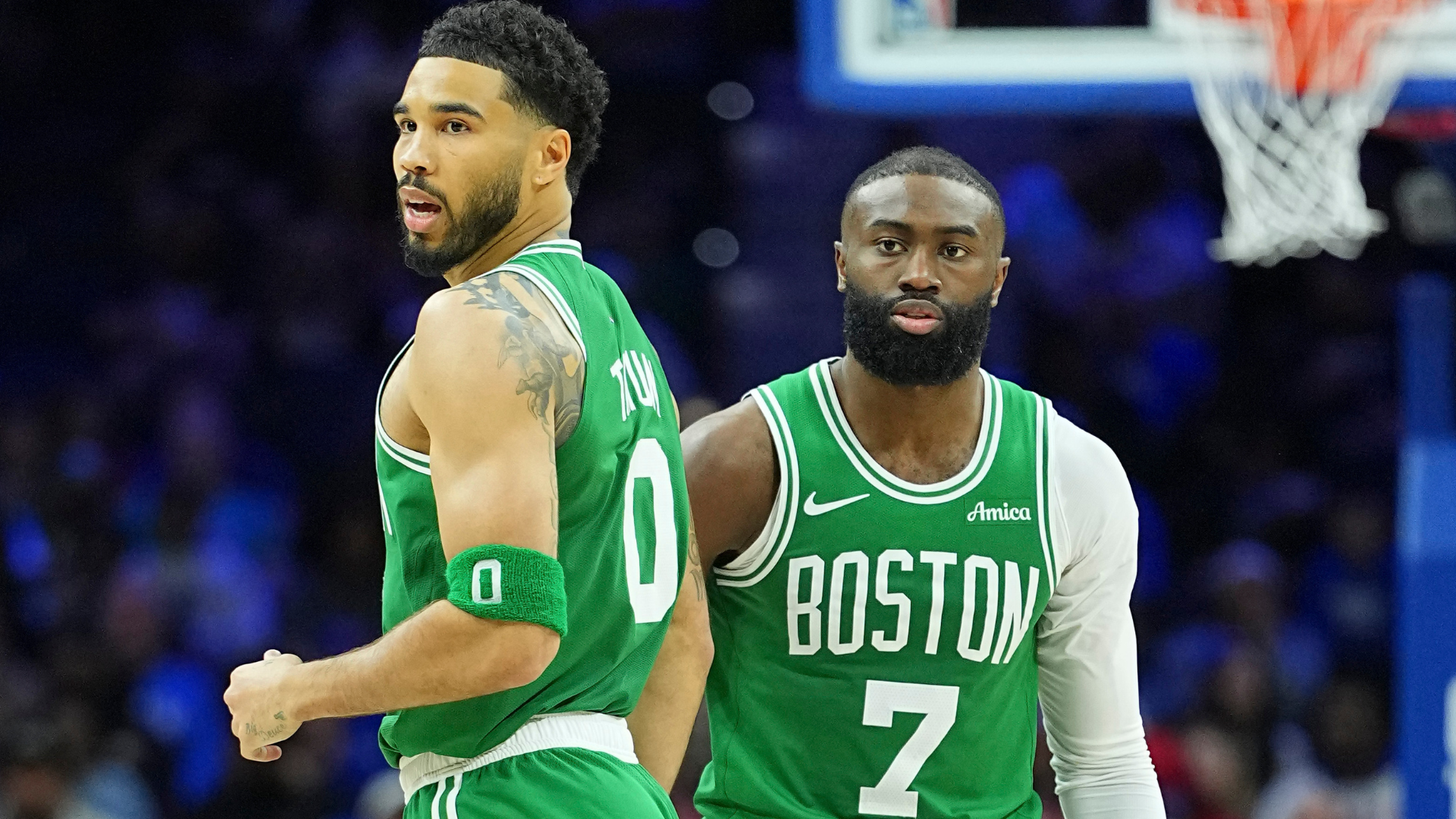
It seems like every debate in today's world is a battle of extremes, and this Jaylen Brown trade to the 76ers is no different. Depending on who you talk to, Brown is either the MVP-caliber superstar that his traditional credentials say he is, or he's the overrated and, more importantly, overpaid player the analytics say he is.
The answer, as is the case with most everything, is probably somewhere in the middle. But first and foremost, the reaction to this trade, and Brown's ongoing war with the analytics community, isn't so much about basketball as it is the growing disdain for the number-crunching nerds who have become, at least in perception, the overriding authority on how to most effectively play it.
"I just always thought analytics were like, geeky, un-athletic white guys that wanted to be a part of the league but just couldn't make it playing basketball," Knicks wing Josh Hart, an analytics darling by the way, said last month. "So they decided to put math into the equation."
There are a lot of people, especially players, who feel exactly like Hart. People who look at the Moneyball scout who tells Brad Pitt "you don't put a team together with a computer" as their lord and savior. It's understandable. High school hierarchies die hard. Sports is the domain of the cool kids. It wouldn't be any different if a bunch of so-called dumb jocks started having real say over the way numbers are crunched at NASA. Buddy, you shoot a ball into a hoop for a living. Now you're going to tell me, an MIT genius, how to launch shuttles?
So again, through this stay-in-your-lane lens, you can understand Brown -- who admittedly hasn't done himself any PR favors of late -- taking issue with the whiz kids who couldn't dribble a basketball and chew gum at the same time using their fancy formulas to deem him, an All-NBA talent and Finals MVP, a negative player.
And here's the thing: Brown isn't wrong. But neither are the nerds -- most of whom, it's important to note, are not making nor have ever made the extremist claims for which they're taking the heat. On balance, the truth is pretty simple. Brown isn't as great as a handful of the NBA's greatest players, and yes, the analytics almost universally support that very measured conclusion.
If you're taking it further than that, you're the problem. To slap the "negative player" label on Brown because the Celtics were 4.2 points per 100 possessions better in relation to their opponents when he sat last year, or even because he registered a negative on/off split over a 10-year sample with the Celtics, is ridiculous.
Brad Stevens' explanation of Jaylen Brown trade is unlikely to soothe Celtics fans John Gonzalez
Brad Stevens agrees. In his first press conference since the trade went down, the Celtics' president of basketball operations said the analytics were a "small piece of information" in his ultimate decision to move Brown -- but he also prefaced that revelation by saying: "Mike and his staff may get mad at me. They do every day."
Mike would be Mike Zarren, Boston's vice president of basketball operations. His speaker profile for the MIT Sloan Sports Analytics Conference reads: "Mike is widely recognized as one of the leaders in the field of advanced statistical analysis of basketball players and teams, and is an important part of [the Celtics'] strategic planning and player personnel evaluation processes."
At the very least, it's fair to say Zarren had some say in this, and it doesn't sound like his spreadsheets reflected Brown with any great favor. Stevens may not have lent as much weight to the analytics, but ultimately, there was one number on which everyone in the organization could agree. And that, more than any PER or VORP or RAPM calculation, was the overriding number that got Brown traded.
$183 million (over the next three years)
If Brown was making $40 million a year, he would probably still be on the Celtics. But he isn't. Next season, he's set to make $57 million. Combine that with Jayson Tatum's $58.5M, and that's $115.5M of next season's $165M salary cap devoted to two players. Those numbers continue through 2029, and it's even worse when you factor in a salary cap that isn't growing as rapidly as expected and is starting to be outpaced by the 8% annual raises of a supermax contract.
An NBA roster has to carry a minimum of 14 players, so do the math. If Brown and Tatum are making roughly $115M, that leaves $50 million for another 12 players before you cross the luxury-tax line. Now add in Derrick White, who's on the books for $30M next season, and suddenly you're down to $20 million for 11 players.
Point is, it's extremely difficult, if not close to impossible, to field an even halfway deep team with two supermax contracts at the top without blowing through not just the tax line but the aprons, too, which we know comes with painfully punitive roster-building restrictions that ultimately keep a guy like Stevens from being able to do his job effectively.
"The path looked a little bit more challenging to me with 70% of our cap, and such a high percentage of our usage, tied into two players." Stevens said of the decision to trade Brown.
It's true. When the Celtics won their title in 2024, Brown and Tatum were only accounting for 47% of their cap. That left room for Al Horford, Jrue Holiday and Kristaps Porzingis. That's why they won. But that depth quality became an impossible luxury to maintain once the extensions of Brown and Tatum activated in 2025-26, when the Celtics became the only team in the league with two supermax players.
Given the squeeze that even one supermax contract, let alone two, puts on the rest of your roster, anyone who is making that kind of money is going to be evaluated under the strongest of microscopes. When Brown was at $31.8 million in the championship season, certain flaws could be overlooked. At $57 million and going up every year, that's where these analytics come into play.
You have to be an almost perfect player at that salary spot in today's financial landscape, and Brown, like it or not, has too many imperfections. He dribbles a lot. He's not an elite playmaker, which further complicates his high turnover rate. Among elite scorers, he's on the wrong end of the efficiency scale.
Usage Percentage 1) Luka - 38.1% 2) Jaylen - 36.2% 3) Kawhi - 33.5% 4) SGA - 33.4% 5) Wemby - 32.4% True Shooting Percentage 7) Shai - 66.5% 25) Kawhi - 62.9% 28) Wemby - 62.6% 39) Luka - 61.6% 125) Jaylen - 57.3%
— Brian Barrett (@itsbrianbarrett) July 6, 2026
The Celtics were willing to stay in the two-supermax business if it meant trading for Giannis Antetokounmpo, but for Brown, the harsh reality is he hasn't proven to be indispensable enough to a team that has, over the last three seasons, gone 36-6 without him (9-2 last season, and 90-36 over his full 10 years in Boston) with negative on/off splits in just about every season to warrant a second supermax commitment.
But doesn't Paul George make as much as Brown?
It's pretty close, yes, meaning the Celtics aren't in much better of a salary position for this coming season than they were with Brown. But as Stevens noted, George's deal is shorter. He'll make $54.1M this season, and then he has a $56.6 million player option for 2027-28. On the other hand, Brown has three years left on his current contract, and he's going to want, and likely get, another huge deal after this one. If nothing else, the Celtics got a pair of draft picks to get out of a future deal they didn't want to make.
Stevens noted the importance of "optionality" in his press conference, and this deal definitely gives the Celtics more roster-building options. Even if George picks up his '27-28 option, Boston could trade him as an expiring deal. They now have two extra draft picks to attach.
Also, George waived his $3.9M trade bonus. That gives the Celtics a little extra room to keep tinkering, leaving them with about $8 million in room beneath their first-apron hard cap. They have a $27.7 million traded-player exception to work with if they can clear the space to use it.
Just as an example, Sam Hauser and Dalano Banton are on the books for a little under $14 million next season. Trade them out, with draft picks attached as incentive, and the Celtics could bring back a player in the $21 million range with their Traded Player Exception TPE. That could be Peyton Watson or Herb Jones territory. Add in a bit more outgoing ancillary money, and maybe you could get into Trey Murphy III range.
Even if the Celtics keep George for at least this upcoming season, which is probably the likeliest bet, there's an actual case to be made that he fits how the Celtics play -- and how they want to play with a clearer hierarchy at the top for Tatum -- better than Brown. He doesn't command nearly the same on-ball control. And he's a much better 3-point shooter, particularly off the catch (47.9% on spot-up 3s last year, per Synergy, against 36.7% for Brown), which plays perfectly in Boston's heavy drive-and-kick offense.
This isn't to say that George is a better player than Brown or even his equal. He's not. He's 36 years old and not likely to stay healthy through a full season. But if the Celtics manage this right and get a little lucky with George being at full strength for the playoffs, he's a good fit as a pure shooter and secondary playmaker who, at this point of his career, is in his sweet spot at 15-17 PPG in a 3-and-D role, whereas Brown might not have been as happy about falling back into a less prominent role upon Tatum's return. There have been reports that Boston was indeed fearful of that dynamic.
So are the Celtics actually better after this trade?
I would argue yes. For all intents and purposes, Tatum was not on the team that won 56 games and earned the Eastern Conference's No. 2 seed last season, so his return replaces Brown's production at a higher efficiency with more playmaking. That's one upgrade.
Now swap out Anfernee Simons for George, and that's two upgrades. Mitchell Robinson, an elite rim protector and offensive rebounder (which was already a great strength for Boston last season), replacing Nikola Vucevic is another upgrade.
Factor in the growth of Payton Pritchard, who could seriously pop with even more scoring and creative freedom, along with young guns Hugo Gonzalez and Baylor Scheierman and the return of breakout center Neemias Queta (four-year, $56 million deal), and you've got a very good basketball team.
The Celtics might not win 56 games. That was a hell of a run they put together last season, and anyone who says Brown wasn't a driving force behind that is basketball blind. But in terms of playoff viability, assuming fair health, there's a pretty strong argument to make that the Celtics will be a better team next season. And if that happens, the "I told you so" nerds are going to be laughing all the way back to their computers.
Add CBS Sports on Google Join the Conversation comments