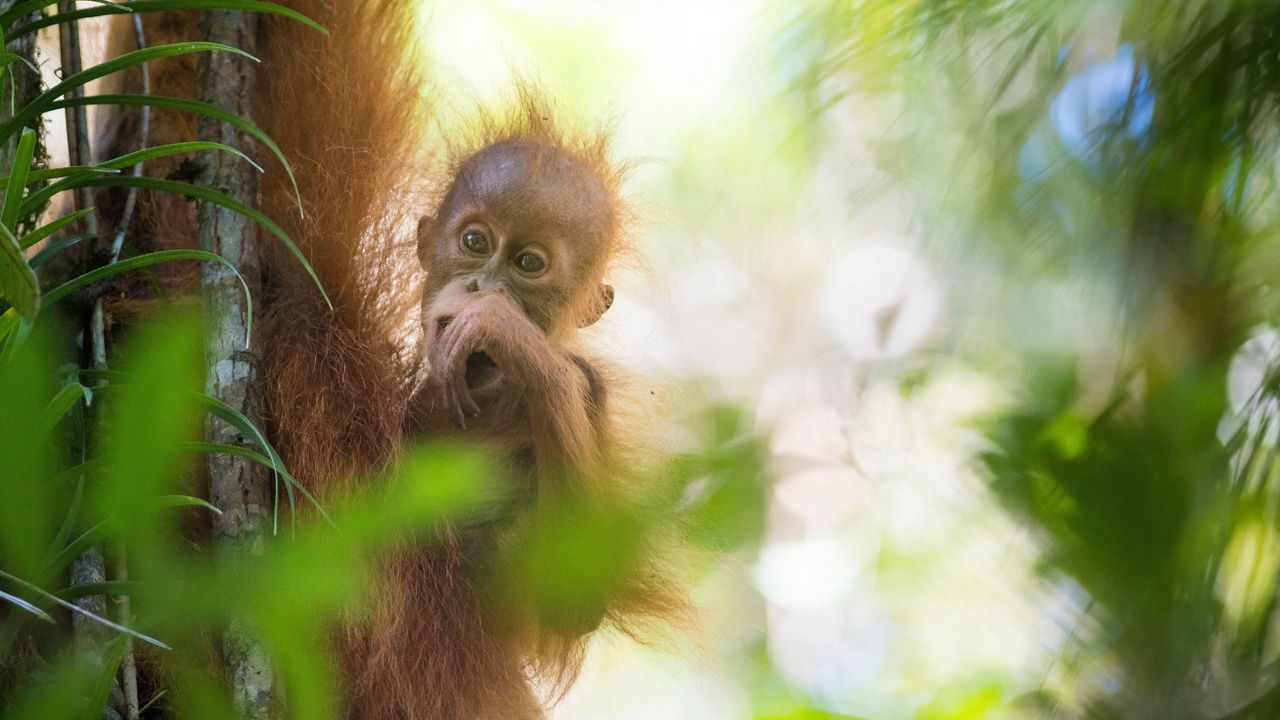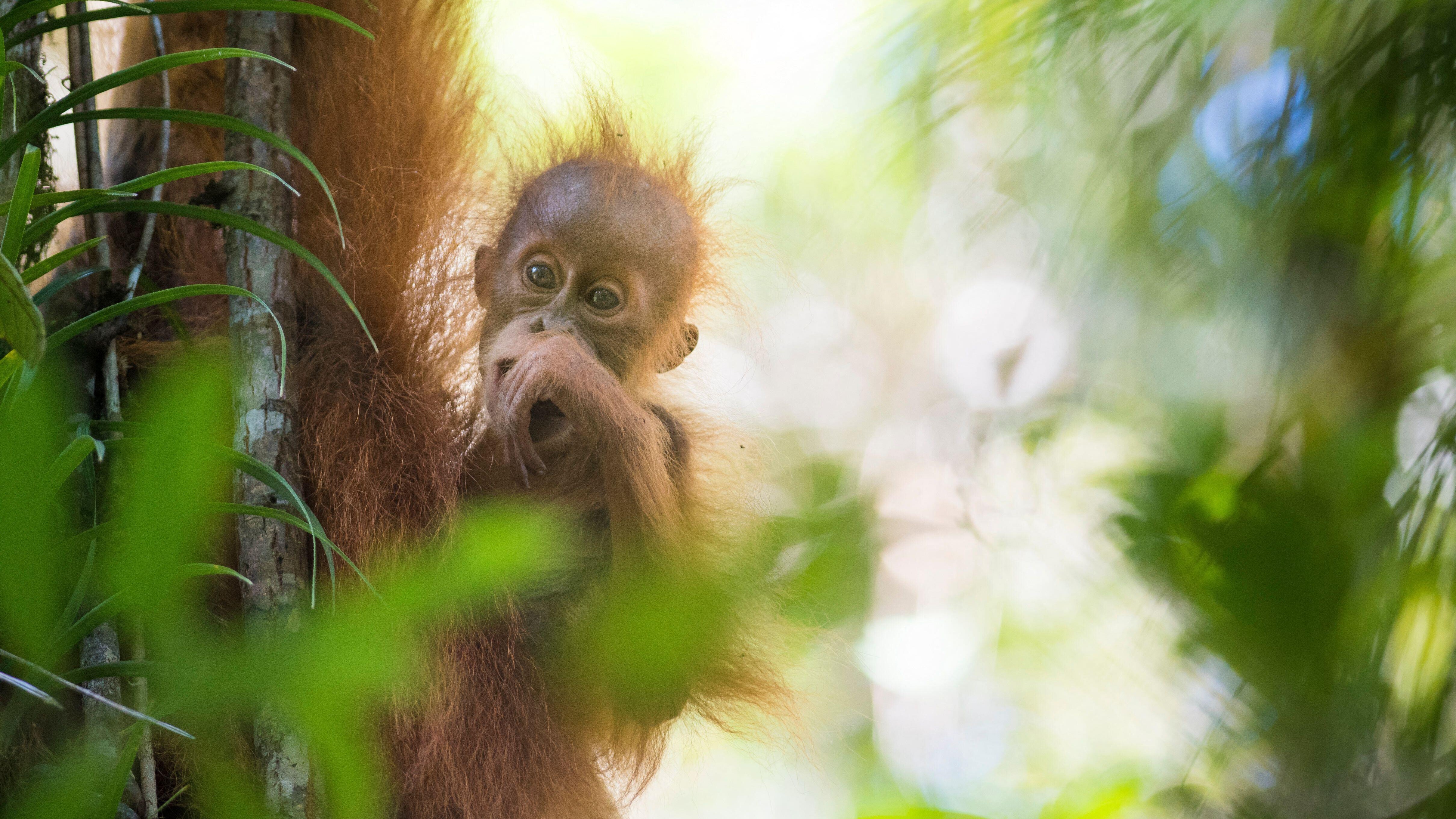
767 individuals made up the entire species of Tapanuli orangutans in 2019, according to an estimate. (Image credit: Nature Picture Library via Alamy)
Share this article Join the conversation
Follow us Add us as a preferred source on Google Newsletter Subscribe to our newsletter
A single climate-change-fueled cyclone killed 7% of Tapanuli orangutans — the world's rarest great apes — in just four days last year, new research reveals.
The study shows that "climate change-driven weather poses an immediate, catastrophic threat to the world's rarest great ape," the researchers wrote.
Tapanuli orangutans (Pongo tapanuliensis) live in the Batang Toru forest in northern Sumatra, Indonesia. Pushed to the brink of extinction by habitat destruction, the entire species consisted of 767 individuals in 2019, of which 581 lived in the forest's west block.
Then, Cyclone Senyar arrived.
Across four days in November 2025, the rare and damaging tropical cyclone caused extreme rainfall and catastrophic landslides across this west block forest region, killing approximately 58 Tapanuli orangutans. These individuals died from drowning, suffocation under landslides, or impacts from collapsing trees, according to the study, which was published June 10 in the journal Current Biology.
The loss equates to 11% of the west block orangutans and roughly 7% of the whole species.
"It is extremely worrying for the future of this ape," study co-author Serge Wich, a professor of primate biology at Liverpool John Moores University in the U.K., told The Guardian.
Sign up for the Live Science daily newsletter now
Get the world’s most fascinating discoveries delivered straight to your inbox.
Contact me with news and offers from other Future brandsReceive email from us on behalf of our trusted partners or sponsors
World's rarest great apes
Tapanuli orangutans were classified as a new species, distinct from their Bornean (P. pygmaeus) and Sumatran (P. abelii) orangutan cousins, in 2017, making them the most recently identified, and rarest, species of great ape.
Orangutans are especially vulnerable to environmental shocks because of their slow rate of reproduction; they have roughly six- to nine-year gaps between each baby. They are also heavily dependent on tree cover to survive.
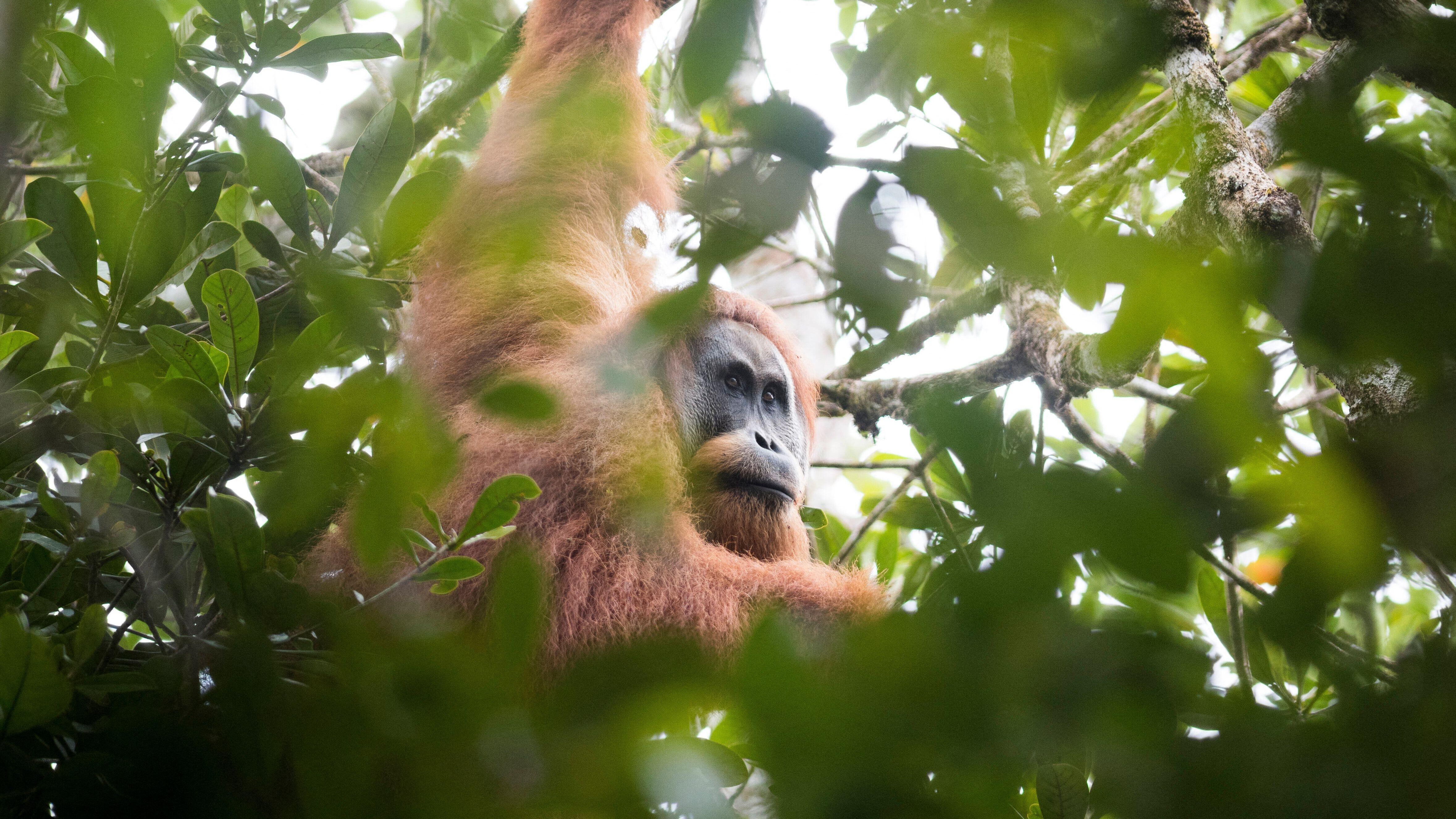
Orangutans' slow reproductive cycles has made them struggle to adapt to human-caused habitat destruction.
(Image credit: Nature Picture Library via Alamy)
In the new analysis, researchers combined pre- and post-cyclone satellite imagery with orangutan population density estimates to evaluate the impact of the flooding and landslides on the apes.
Before the cyclone, 99.3% of the Batang Toru forest west block was forested. Then, after the storm's arrival, 21.8 inches (556 millimeters) of rain fell over four days, leading to landslides across 20,517 acres (8,303 hectares) of Tapanuli orangutan habitat. The researchers identified over 50,000 "scars" from this landslide-induced habitat destruction in the forest landscape.
This habitat loss was catastrophic for the orangutans. "Given the high density (>50,000) of sudden, steppe-slope landslides causing canopy collapse and debris flow into drainage networks, and the limited opportunity for arboreal [via trees] escape during rapid slope failure, we consider mortalities by burial, trauma, or subsequent drowning to be likely," the authors wrote in the study.
The long-term effects of topsoil destruction on the food supply will also harm the remaining orangutans, the authors wrote. With topsoil containing dense networks of plant-feeding fungi, it will take time for the fruit and leaves the orangutans rely on to return.
RELATED STORIES
World Weather Attribution, a research group that studies extreme weather events, found that Cyclone Senyar was intensified by a combination of human-induced climate change, an ocean oscillation called the negative Indian Ocean Dipole, and La Niña, the cooler phase of the El Niño-Southern Oscillation climate cycle.
Climate change is projected to increase the frequency and intensity of heavy rainfall worldwide, including in Indonesia. And now that El Niño is officially here, the climate event will likely make the Pacific hurricane season stronger. This El Niño period is forecast to "rank among the largest El Niño events in the historical record going back to 1950," NOAA officials wrote in a June 11 update.
"El Niño conditions will pour fuel on the fire of a warming world," U.N. Secretary-General António Guterres said in a June 2 video statement. "The world must treat it as the urgent climate warning it is."
Article Sources
Meijaard, E., Wafiy, M., Ni'Mattulah, S., Dennis, R., Hadisiswoyo, P., Sheil, D., Descals, A., Gaveau, D. L., Unus, N., Kühl, H., Otto, F. E., Supriatna, J., Aldrian, E., Petley, D., & Wich, S. (2026). Extreme rainfall further endangers the world's rarest great ape. Current Biology. https://doi.org/10.1016/j.cub.2026.05.029
TOPICS
 Sophie Berdugo
Staff writer
Sophie is a U.K.-based staff writer at Live Science. She covers a wide range of topics, having previously reported on research spanning from bonobo communication to the first water in the universe. Her work has also appeared in outlets including New Scientist, The Observer and BBC Wildlife, and she was shortlisted for the Association of British Science Writers' 2025 "Newcomer of the Year" award for her freelance work at New Scientist. Before becoming a science journalist, she completed a doctorate in evolutionary anthropology from the University of Oxford, where she spent four years looking at why some chimps are better at using tools than others.
View More
You must confirm your public display name before commenting
Please logout and then login again, you will then be prompted to enter your display name.
Logout