
 Getty Images
An American tested positive for Ebola after being exposed while working with a medical missionary group in the Democratic Republic of Congo, US officials said on Monday.
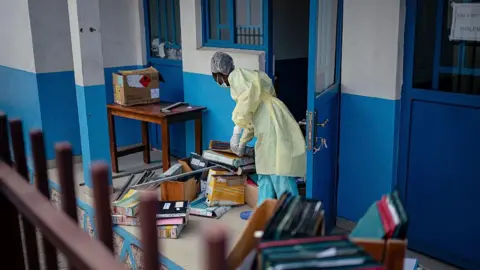
The American is being evacuated to Germany for treatment after developing symptoms over the weekend, said Dr Satish Pillai, Ebola response incident manager with the US Centers for Disease Control and Prevention (CDC).
At least 100 deaths have been reported in an Ebola outbreak in the DR Congo, with more than 390 cases suspected, the head of the Africa Centres for Disease Control and Prevention told the BBC.
The CDC said it is working to evacuate at least six other Americans who were exposed.
The medical missionary group, Serge, said on Monday that one of its American doctors, Peter Stafford, had tested positive for Ebola after being exposed while treating patients at Nyankunde Hospital in Bunia in the Democratic Republic of Congo.
Two others doctors from the group who were exposed while treating patients, including Stafford's wife, do not have symptoms and are following quarantine protocols, the group said in a statement.
Also on Monday, the CDC issued a new order blocking foreign travelers from entering the US if they have visited a country affected by the outbreak in the past 21 days, including the DR Congo, Uganda and South Sudan.
The agency invoked Title 42, a law that temporarily bans noncitizens from coming to the US for public health reasons.
CDC officials emphasized that the risk to the American public remains low. The CDC is sending staff from Atlanta to the epicentre of the outbreak to help with the response.
The World Health Organization (WHO) has declared the outbreak an international emergency.
The current strain of Ebola is caused by the Bundibugyo virus, for which there are no approved drugs or vaccines.
The WHO has said the outbreak in DR Congo's eastern Ituri province is a public health emergency of international concern, but did not meet the criteria of a pandemic.
The agency also warned it could potentially be "a much larger outbreak" than what is currently being detected and reported, with significant risk of local and regional spread.
More than 28,600 people were infected by Ebola during the 2014-2016 outbreak in West Africa, the largest outbreak of the virus since its discovery in 1976.
The disease spread to a number of countries within and outside of West Africa, including Guinea, Sierra Leone, the United States, the United Kingdom and Italy, killing 11,325 people.
Ebola viruses normally infect animals, typically fruit bats, but outbreaks among humans can sometimes start when people eat or handle infected animals.
It takes two to 21 days for symptoms to appear. They come on suddenly and start like the flu, with fever, headache and tiredness.