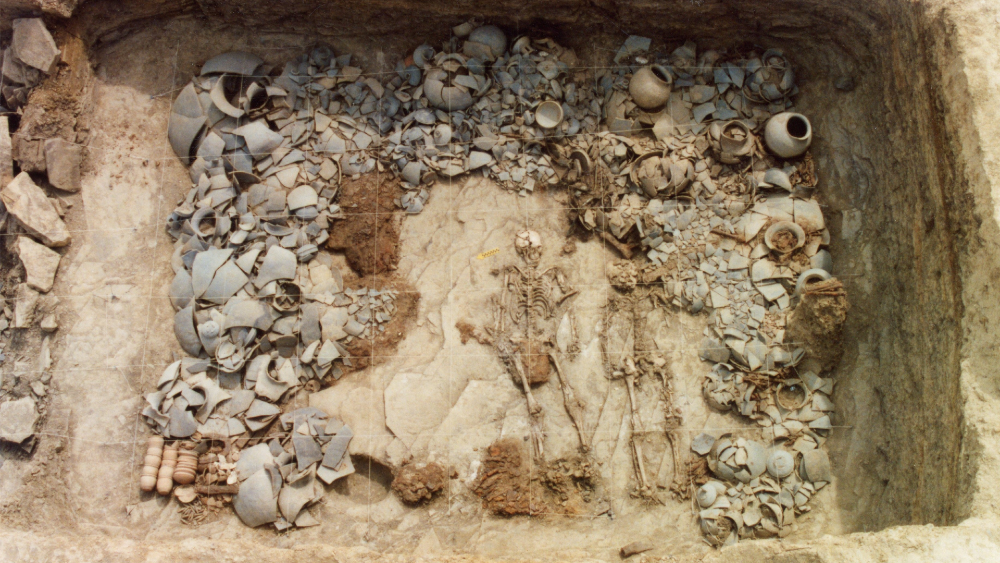
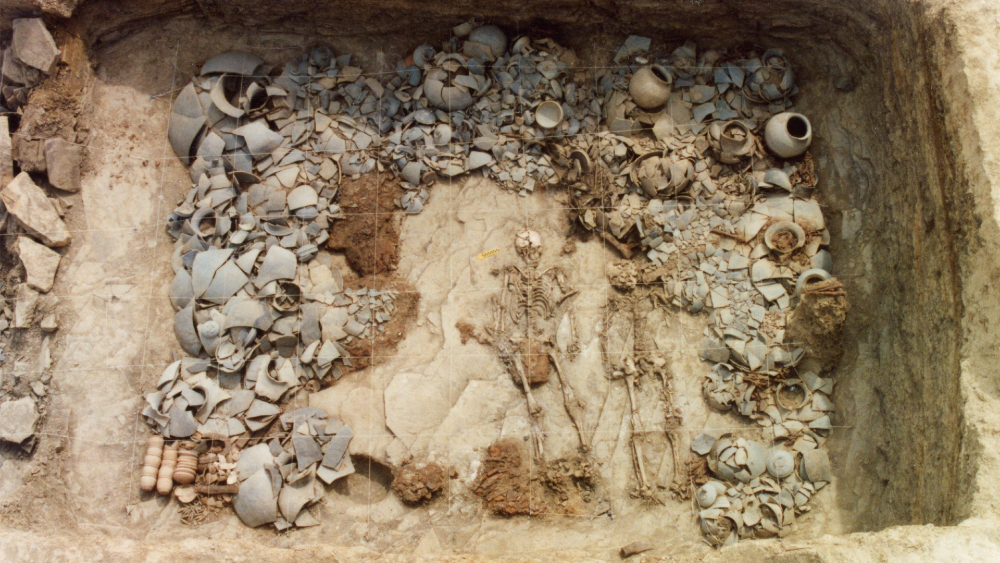
 Excavation of tombs in the Joyeong burial complex in Gyeongsan, South Korea. (Image credit: Gyeongsan City) Share this article 0 Join the conversation Follow us Add us as a preferred source on Google Newsletter Sign up for the Live Science daily newsletter now
 Get the world’s most fascinating discoveries delivered straight to your inbox.
Become a Member in Seconds
Unlock instant access to exclusive member features.
Contact me with news and offers from other Future brands Receive email from us on behalf of our trusted partners or sponsors By submitting your information you agree to the Terms & Conditions and Privacy Policy and are aged 16 or over.You are now subscribed
Your newsletter sign-up was successful
Want to add more newsletters?
Join the club
Get full access to premium articles, exclusive features and a growing list of member rewards.
Explore An account already exists for this email address, please log in. Subscribe to our newsletterAbout 1,500 years ago, entire families were sacrificed to honor local royalty in what is now South Korea, a new genetic study finds. The analysis also reveals a dense kinship system focused on women and their descendants.
In a study published Wednesday (April 8) in the journal Science Advances, an international team of researchers investigated 78 skeletons from the Imdang-Joyeong burial complex in Gyeongsan, located in the southeast region of the Korean Peninsula. The tombs in this cemetery were constructed between the fourth and sixth centuries, during the Three Kingdoms period (circa 57 B.C. to A.D. 668). Historical records suggest that, in the Silla kingdom, people practiced "sunjang," a form of human sacrifice in which servants, or "retainers," were killed and buried with the local elite, and that the society favored "consanguineous" marriage between related individuals.
But the researchers also found five individuals — both royal and nonroyal — whose parents were closely related, including one first-cousin pairing, proving that both the Silla royal elites and the Silla people who were sacrificed to them practiced consanguineous marriage.
Using the genomic data, the researchers reconstructed 13 family trees for the people interred in the Imdang-Joyeong burial complex, revealing an extensive kinship network spanning two burial sites and more than a century focused on maternal lineages.
However, the sacrificed "retainers" had a slightly different burial pattern. While the elite "tomb owners" were given their own burials, the "retainers" were sometimes grouped together as sacrifices.
The researchers found three cases where parents and their children were sacrificed together in the same grave, which confirms historical reports that sunjang could affect entire households.
Sign up for the Live Science daily newsletter nowContact me with news and offers from other Future brandsReceive email from us on behalf of our trusted partners or sponsors"Genetic relatedness among sacrificial individuals over generations may suggest the presence of families that served as sacrificial individuals for the grave owner class for consecutive generations," the researchers wrote in the study.
Jack Davey, director of the Early Korean Studies Center in Cambridge, Massachusetts, who was not involved in the research, told Live Science in an email that the study is an important contribution to Korean archaeology, particularly because preservation of skeletons from the Three Kingdoms period is rare.
RELATED STORIES- 1,300-year-old royal flush toilet used by crown prince discovered at palace in Korea
- Legendary 'women of the sea' in South Korea freedive well into their 80s. A new study hints at how.
- Male human heads found in a 'skull pit' in an ancient Chinese city hint at sex-specific sacrifice rituals
"If correct, the presence of what seems to have been a sacrificial caste in this regional polity outside of the Silla core has profound implications for how we understand Silla society," Davey said. Specifically, the practice of sunjang on entire families raises questions about institutionalized violence, slavery and social mobility in this 1,500-year-old Korean kingdom. "This study could serve as a model for future work on other sites that have yielded skeletal material," he added.
According to the researchers, this is the first study to analyze genome-wide data from the Three Kingdoms period and to reveal the "distinctive family structure" of the Silla kingdom, which differs from male-focused systems found elsewhere in ancient Korea and ancient Europe.
"We believe further archeogenetic studies on the Korean peninsula will reveal more information on the population dynamics and family structures of ancient East Asia," the researchers wrote in the study.
Article SourcesMoon, H., Kim, D., Hiss, A.N., Lee, D.-N., Lee, J., Skourtanioti, E., Gnecchi-Ruscone, G.A., Krause, J., Woo, E.J., Jeong, C. (2026). Ancient genomes reveal an extensive kinship network and endogamy in a Three-Kingdoms period society in Korea. Science Advances 12(15). https://doi.org/10.1126/sciadv.ady8614
 Kristina KillgroveStaff writer
Kristina Killgrove is a staff writer at Live Science with a focus on archaeology and paleoanthropology news. Her articles have also appeared in venues such as Forbes, Smithsonian, and Mental Floss. Kristina holds a Ph.D. in biological anthropology and an M.A. in classical archaeology from the University of North Carolina, as well as a B.A. in Latin from the University of Virginia, and she was formerly a university professor and researcher. She has received awards from the Society for American Archaeology and the American Anthropological Association for her science writing.
View MoreYou must confirm your public display name before commenting
Please logout and then login again, you will then be prompted to enter your display name.
Logout LATEST ARTICLES 1Chimpanzees in Uganda are locked in a deadly 'civil war' after their group split apart — and scientists don't know why
- 2James Webb telescope spots 'stingray' galaxy system that could solve the mystery of 'little red dots'
- 3'RIP, Comet MAPS': Watch the superbright sungrazer become a 'headless wonder' after being ripped apart by the sun
- 4Scientists create new type of encryption that protects video files against quantum computing attacks
- 5There's an issue with the Artemis II heat shield, but NASA isn't worried. Here's why.