Craig Burley slams Real Madrid's postmatch criticisms of the officiating in their Champions League defeat to Bayern Munich. (1:36)
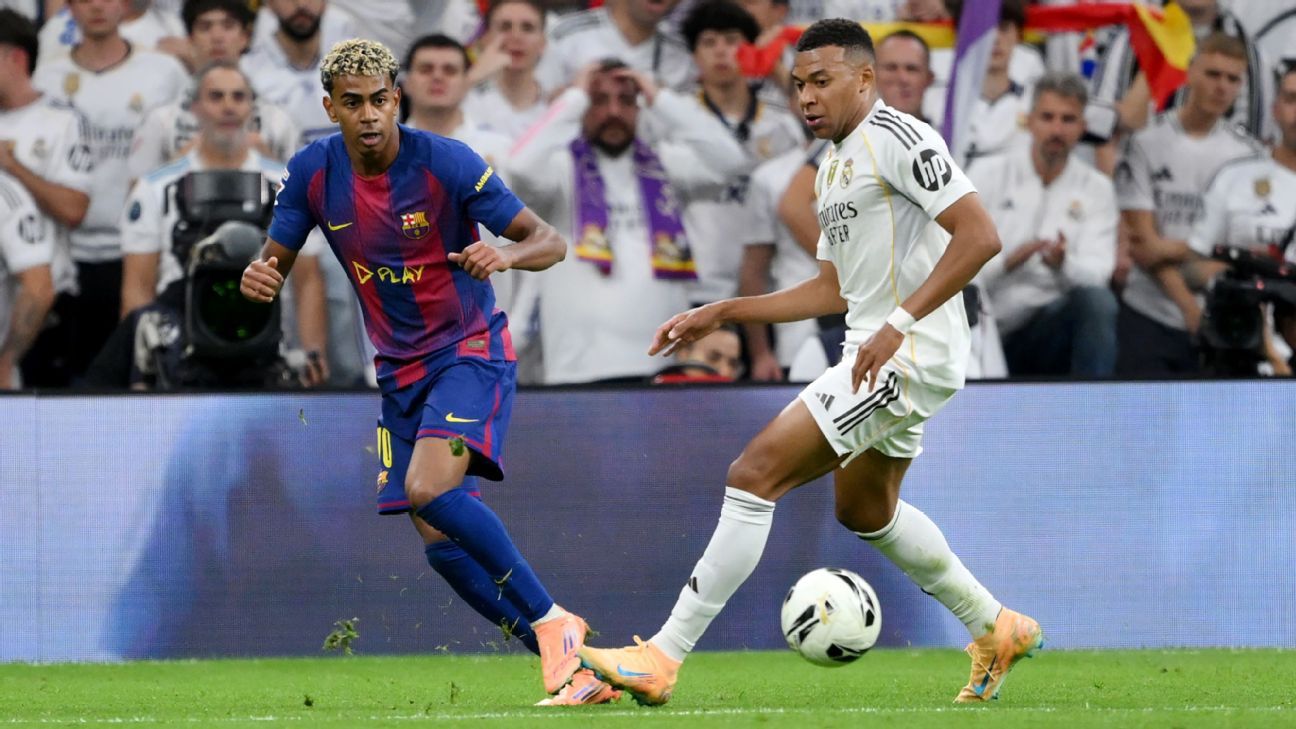
With every other major trophy now assigned, or forsaken, the battle for LaLiga resumes this week with the top two -- Barcelona and Real Madrid -- refocusing through their tears, licking salt from their wounds and worrying about how to solve their deficiencies.
Each was eliminated last week at a humiliating and financially damaging stage of the UEFA Champions League. Each unforgivably lost the key home leg of their quarterfinal, and then knocked out after hauling themselves back into a position to win. Galling.
Perhaps, however, Atlético Madrid and Bayern Munich have actually handed big favors to Madrid and Barça; inflicting pain and embarrassment to leave forensically clear where their Achilles' heels are located and what needs to be solved.
- Messi bought a club in Barcelona! Get to know UE Cornellà - After Champions League defeat, can Madrid's project be salvaged? - Despite Yamal's form, Atleti dump Barça out of Champions League
There was a global chorus of praise and appreciation for Atlético's 3-2 aggregate win over Barcelona and then Bayern's thrilling 6-4 ousting of Madrid because the quality and spectacle of those matches gave rare levels of entertainment -- but you can't cash that at the bank or swap it for the trophy.
In case this recent break for Champions League and Copa del Rey football distracted you, the Spanish league restarts Tuesday with Madrid hosting Alavés and Barça facing Celta Vigo at Camp Nou the next night (stream all LaLiga matches on ESPN+ in the U.S.).
With seven matchdays, including a Clásico at Camp Nou remaining, Hansi Flick's Barcelona have a nine-point lead and are well placed to achieve something Madrid have only managed once in the past 36 years: retain their title. The intimidating fact confronting Los Blancos is that no Liga-leaders have ever tossed away this sizeable a margin so late in a season.
Despite Barcelona facing inhospitable visits to Osasuna and Getafe (their least favorite stadium in Spain), plus that head-to-head with Álvaro Arbeloa's team on May 10, it's a decent assumption that the holders will be champions again.
For different reasons, though, each of the two behemoth clubs needs to start their internal review immediately.
Barça have genuinely threatened to close the gap on Madrid in recent years, despite Los Blancos keeping on achieving their holy grail of European domination -- but the Blaugrana have been weaker, less reliable, more vulnerable and won fewer trophies this season.
Madrid? They have an ultramodern, revenue-generating stadium, their turnover is huge, they remain the brand name in soccer. But they're in a bit of a mess.
Stewart Robson discusses Barcelona's approach to defending as Eric Garcia sees red vs. Atletico Madrid.
Barcelona are fun to watch. They are prodigious in how they promote and develop talent from their youth system. If properly handled, right now, they could be on the verge of a golden era.
But they're far short of being at a Champions League-winning level.
Firstly, there's Robert Lewandowski. It would be indefensible lunacy to extend his expiring contract. There's no questioning the Poland international's historic stats, trophy haul or that he has been an elite goal-grabber. But Barcelona's high defensive line -- the 4-2-3-1 system to which Flick seems manacled -- means that unless they press, intensely, brilliantly and consistently, they will regularly be cut open against good counterattacking sides playing from back-to-front through, rather than over, Barcelona.
It happened last season against Inter Milan, it has happened again at regular intervals this campaign, and it was the main cause of the goals that they conceded against Atleti while Los Colchoneros knocked them out of the Copa and Champions League.
At nearly 38, Lewandowski neither has the capacity nor the desire to press and harass -- the notorious defending from the front -- that the German coach's system requires. Nor, when Ferran Torres lost form, was Lewandowski able to supply a flow of crucial goals. I would argue that selecting Lewandowski and the dispensable Marcus Rashford in the first leg against Atlético in the Champions League quarterfinal allowed their rivals to build transition attacks at will.
A horrendous error. So: If there's no Lewandowski and Rashford next season then whom?
Barcelona have been fluttering their eyelashes at Julián Álvarez, but his Atlético teammate Alexander Sørloth looks like the smarter, easier, cheaper (his release clause is €35 million) and possibly higher-return investment. Either the Norwegian or Galatasaray striker Victor Osimhen.
Meanwhile, at the back, it will be a dereliction of duty if Barcelona do not bring their coach a brilliant, quick, aggressive, left-footed, international-quality center back. Transferring Frenkie de Jong to fund these two acquisitions, plus adding better fullback competition would be shrewd.
If they do those jobs, and somehow grapple LaLiga's Financial Fair Play restrictions into submission, Barcelona can consider themselves to have had an excellent summer.
Given how overreliant Barcelona are on Pedri, Raphinha and Lamine Yamal, they also need a medical, physiotherapy and fitness system which leaves these three key players well-tuned, fresh and in prime form more often than they've managed this season.
Madrid's situation is far more complex and far less easy to solve.
Examining squad deficiencies and imbalances, and linking them to whether Arbeloa stays in charge, is all a little bit pointless until there is clarity about how well the club is being run from its highest echelon.
I get a distinct end-of-era impression. Perhaps decay would be too strong a word, but decline wouldn't.
I don't think players or staff currently behave or perform as if there is the same level of trust, respect -- even fear -- from them toward the president Florentino Pérez. Everybody, no matter who it is, eventually ages, slows down, burns out and declines in performance. Whether that's your star striker, your coach or your club president, the process is inevitable.
The best eras in the past quarter century at Real Madrid have been when the president is energetic and driven. It's when his talented vice president José Ángel Sánchez is being an extremely good consiglieri, and when club legends -- such as Pedja Mijatovic or Zinedine Zidane -- are selecting the talent and recommending it to the president.
Right now I'm not sure any of the above is sufficiently true at Real Madrid.
It won't be easy to disassemble this squad, and rebuild it, if that process is being handled by a 79-year-old president, no director of football and the clutch of self-interested agents who smell big bonuses.
What's crystal clear is that following the haemorrhage of leadership represented by the departures of Toni Kroos, Luka Modric, Nacho, Lucas Vazquez and Joselu -- plus the fact that those in power seem determined to push Dani Carvajal out, come what may -- is bad news.
The squad energy, intensity and discipline, Madrid's training regime and the the resolve with which their burned-out, underprepared squad is willing to "attack" the challenges of next season are all important issues to address. As is transforming Madrid's porous fullback play, signing some midfielders that can control matches (such as Manchester City's Rodri or Paris Saint-Germain's Fabián Ruiz) and finding a way to make Vinícius Júnior and Kylian Mbappé press properly (or shift one of them out).
Whether the new coach is Mauricio Pochettino or José Mourinho (two of the preferred candidates), Madrid require to match their obligatory work in the transfer market with the type of soccer the new guy (assuming Arbeloa is scapegoated) will want to play. It's called joined-up thinking. Otherwise you start the rebuild at a major disadvantage.
And I'll tell you what: It's just as vital for Barcelona that Madrid succeed in this tough array of tasks.
Right now the Camp Nou club is in the ascendancy, but are they coasting a little? Feeling like they have a bigger margin for error and relaxation because they don't believe their biggest rivals are adequately reinstating their snarl?