 Image source, Getty ImagesImage caption,
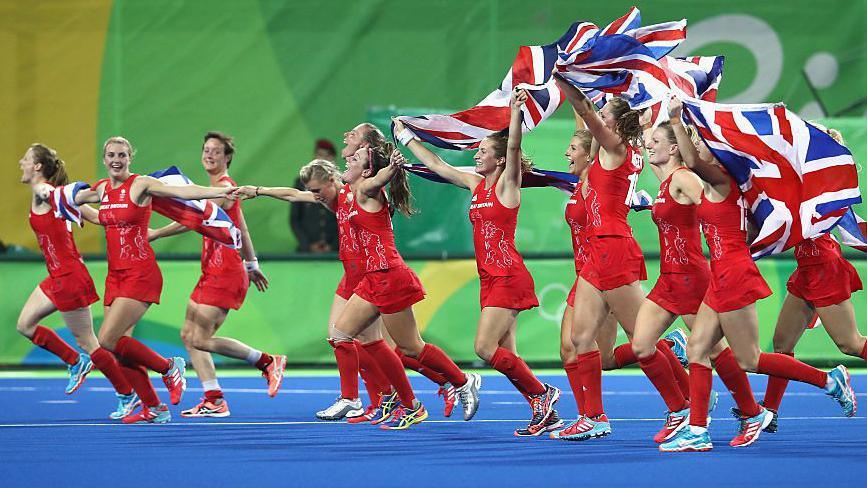
 Team GB players celebrate victory over the Netherlands in the Rio 2016 Olympic hockey final
ByKatie Falkingham, BBC Sport Senior Journalist and Katie Gornall, BBC Sport correspondent- Published17 minutes ago
It is getting tense.
The date is 19 August 2016, and Great Britain's women hockey players are on the cusp of history. Penalties are under way against the Netherlands in the Olympic final in Rio de Janeiro.
Back home in Britain, nine million people are watching on the BBC. Many through their hands, families are glued to the screen.
It was the same for the family gathered at Balmoral.
Nobody - nobody - could avoid the tension.
"I was sitting at dinner thinking 'what's going on?' Somebody who was helping at the table kept whispering the score to me," says Sophie, Duchess of Edinburgh.
"Eventually Her Majesty said, 'oh for goodness sake, just go'. So I ran through to the library and I was watching it."
Speaking on a special BBC Radio 5 Live programme to commemorate the anniversary of the gold medal, the Duchess, a patron of England Hockey, continues: "It was getting to the point when I was leaping up and screaming.
"The drawing room is right next door and I suddenly was conscious of this presence.
"Her Majesty had come through and she was standing in the doorway.
"She was watching the penalties - she couldn't cope with the pressure, she had to take herself away again. She couldn't cope with it."
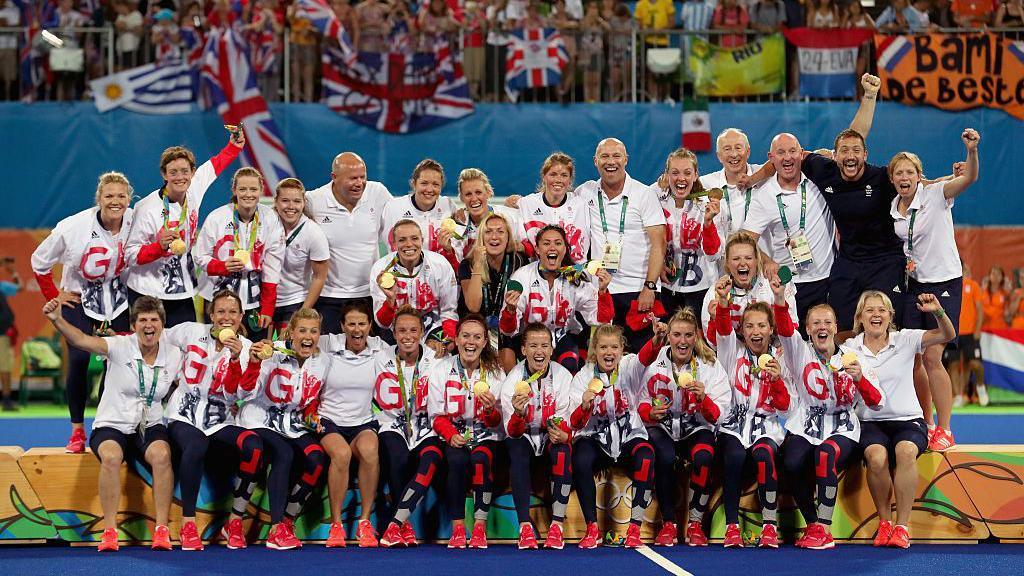 Image source, Getty Images
Wednesday marks 10 years since that historic gold, sealed by penalty strikes from Helen Richardson-Walsh and Hollie Pearne-Webb after an enthralling final had finished 3-3 at full-time.
But on paper, this was a match Team GB were not supposed to win.
They were the top scorers with 21 goals and won all eight of their matches in Rio, but in the Netherlands they were facing a side that represented - and still do - the gold standard of women's hockey.
The Dutch were the Olympic champions in 2008 and 2012 and going for their third title in a row. They were the world's number one side and reigning world champions.
But throughout the GB squad - including captain Kate Richardson-Walsh and head coach Danny Kerry - there was an unspoken feeling that this was their time.
Superstitions were rife. Everyone sat in the same seat on the bus, Kerry wore the same - washed - pants for every match and Sophie Bray did not clean her kit throughout the tournament.
Helen Richardson-Walsh knew Olympic gold was theirs while observing the Dutch players' behaviour in the tunnel before the game.
"They were all cheering and jeering, doing things that they would never normally do," she says.
"We were just looking straight ahead, steely-eyed. I remember thinking, 'oh, we've got this'."
Victory sealed the women's team's first Olympic gold in the sport, and Britain's first since the men's victory in 1988.
"Sometimes it feels like a dream and you have to ask yourself, 'did it really happen?'" says Kate Richardson-Walsh.
"But we're still very much in touch with each other, and every single year on the 19th of August we all message each other and say congratulations again.
"Our vision was to be the difference, create history and inspire the future.
"I think that meant something very special to each of us, and I think we continue to try to live in that way."
Listen to Team GB Women's Hockey: 10 Years On, featuring HRH The Duchess of Edinburgh, on BBC Radio 5 Live and BBC Sounds on Wednesday, 19 August at 21:00 BST
Was hockey ready for Olympic gold?
A decade on, all but one - Lily Owsley - of that golden team has retired from playing internationally.
Team GB would go on to win bronze at the Tokyo Olympics, but from Paris in 2024 they left empty-handed, the first Games since 2008 the British women's squad had not won an Olympic medal.
Since 2021, GB or England - as they play outside the Olympics and FIH Pro League - have not won a medal at a major tournament, with the exception of Commonwealth gold in 2022.
In the annual Pro League, they have not finished higher than seventh - in a nine-team tournament - in each of the past three editions.
Conversely, the men's team have thrice finished among the Pro League medals since 2022, and won European silver in 2023.
At the ongoing World Cup in Belgium and the Netherlands, England's men have won both their pool matches so far, while the women beat South Africa but lost to China.
"We do have peaks and troughs in performance. Most nations do if you look at it," England Hockey chief executive Rich Beer told BBC Sport.
"But when we look at the underlying data and the wider information available to us, we're confident we can see progress being made."
But one former GB women's international, who asked to remain anonymous to protect relationships within the sport, told BBC Sport that hockey missed a major opportunity to capitalise on its landmark moment.
England Hockey "wasn't ready to win" in 2016, she said, arguing that the organisation lacked the commercial, marketing and participation infrastructure needed to convert Olympic success into long-term growth.
"We weren't proactive enough," she added.
Beer, who was appointed chief executive in 2025, says the governing body did make efforts to build on the success, pointing to the 2018 Women's World Cup in London and growth in junior club participation. England will also host next year's European Championships.
"We did our best, don't get me wrong," he says.
"We went on to host a Women's World Cup in 2018, where we had more than 100,000 fans at Lee Valley.
"But I think consistent visibility is one of the biggest challenges facing Olympic sports."
Beer says England Hockey has changed its approach over the past two years in an effort to raise the sport's profile, including reacquiring broadcast rights and moving matches away from behind a paywall.
"We've done more around the international game to try to raise the profile," he says. "That has really driven greater viewership of the sport."
A mixed picture at grassroots
At the other end of the sport, the picture is mixed as to how the 2016 Olympic win affected grassroots hockey.
Sport England figures show that participation among women is now higher than it was at the time of the Rio Games. In 2024-25, 84,200 women played hockey regularly, up 7,000 from 2016.
But growth has been modest at a time when women's sport has boomed more broadly.
Since 2016, women's football has attracted more than 80,000 additional regular players, participation in women's rugby union has more than doubled, and more than 285,000 women now play netball at least twice a month.
The trend among children, however, is more concerning.
Sport England data shows weekly participation among under-16s falling from 452,800 in 2017-18 to 288,000 in 2024-25.
"We've been really proactive in trying to get hockey sticks into people's hands in state schools, but resources are finite for a governing body and for a sport of our size," says Beer.
Another longstanding challenge for hockey is the perception that it remains disproportionately a sport of private schools and affluent families.
"I'm very concerned. I think there's perception and reality," says Beer.
"We won Olympic gold and some papers still put 'jolly hockey sticks' in the headline. That's so far from reality and so far removed from what the sport is about."
England Hockey says it invests in community clubs, state-school programmes and free teacher training to widen access, and has launched Project 2011, a scheme designed to help talented young players from state-school backgrounds access high-quality coaching and development opportunities.
But Beer accepts, however, that hockey cannot match the resources available to wealthier professional sports.
"Because we don't have the sort of money that commercial sports have, we're not going to be able to offer fully funded professional academies in the way football can.
"We're not there yet."