After a slew of promotions, Kade Anderson emerges as the top prospect to stash
 By Scott White May 13, 2026 at 9:52 am ET • 10 min read
Last week was the most fruitful yet for the Five on the Verge, with Robby Snelling, A.J. Ewing and Ryan Waldschmidt all moving up to the big leagues. All are poised to get a serious look from their respective clubs, too, which has made them priority pickups off the waiver wire. Turns out stashing them ahead of time would have saved you some heartache, not to mention some FAAB dollars.
Snelling probably has the most widespread appeal just because everyone could use another starting pitcher (whether they recognize it or not). Walks were an issue in his first start, as they were at times in the minors, but he showed a fuller arsenal than I expected and missed bats at a reasonable enough clip.
Between Ewing and Waldschmidt, Ewing probably has the higher floor as a legitimate speed demon with a plus hit tool, but Waldschmidt has the higher ceiling, being the one with some over-the-fence power. Both are disciplined hitters with excellent on-base skills.
Their removal from the Five on the Verge clears the way for some new stash targets, though with as many prospect promotions as we've seen lately, it stands to reason that you might have to wait a little longer for the next round to pay off.
FIVE ON THE VERGE
(Here are the prospects most worth stashing in redraft leagues.)
Kade Anderson, SP, Mariners
2026 minors: 3-0, 0.60 ERA, 0.67 WHIP, 30 IP, 5 BB, 47 K
Kade Anderson first appeared in the Five on the Verge a week ago and now climbs to the top of the list, leapfrogging Noelvi Marte in the process. Another dominant outing in which he allowed one earned run on two hits with one walk and nine strikeouts in 5 2/3 innings (which actually raised his ERA) has a little something to do with it. I made the comparison to Chase Burns last week, and I'm going to stick with it here. Burns was mowing down minor league hitters so effortlessly last year that he needed just 13 starts to ascend to the majors, with only the final two coming at Triple-A. I'm not sure how the Mariners would make room for Anderson if they decided he was ready, seeing as they're about to be overloaded with the return of Bryce Miller, but life finds a way. That's particularly true when the only obstacle is pitcher health. Add Anderson now and thank me later.
Noelvi Marte, OF, Reds
2025 majors: .263 BA (339 AB), 14 HR, 10 SB, .748 OPS, 16 BB, 85 K 2026 majors: .138 BA (29 AB), 0 HR, 1 SB, .331 OPS, 2 BB, 10 K 2026 minors: .370 BA (92 AB), 3 HR, 8 SB, .970 OPS, 10 BB, 18 K
You might think that JJ Bleday's emergence has complicated Noelvi Marte's return to the majors, but Will Benson and his .188 batting average are still getting an awful lot of at-bats. For that matter, TJ Friedl and his .186 batting average shouldn't be feeling so secure either. Of course, Marte may not be pushing as hard to return as his .370 batting average would have you believe. GM Brad Meador made clear last week that Marte's return is tied less to performance than process, and his performance has only worsened since then. His 1-to-1 strikeout-to-walk ratio has gone away, too, with him striking out eight times while drawing no walks in his past seven games. And then there's the question of defense. Marte continues to spend half his time in center field, possibly as a way to give him more chances or to see cleaner angles off the bat, but it's a long shot to think he'll be able to handle that position in the majors.
All of this is my convoluted way of explaining why I've moved Marte behind Anderson in the stash rankings, but for all the nitpicking, it still wouldn't take much for the Reds to bring him back, particularly since he's spent so much time in the majors already. (Yes, I realize he's not technically a prospect anymore.)
Cole Carrigg, OF, Rockies
2025 minors: .237 BA (477 AB), 15 HR, 46 SB, .710 OPS, 45 BB, 145 K 2026 minors: .369 BA (149 AB), 4 HR, 24 SB, .980 OPS, 12 BB, 23 K
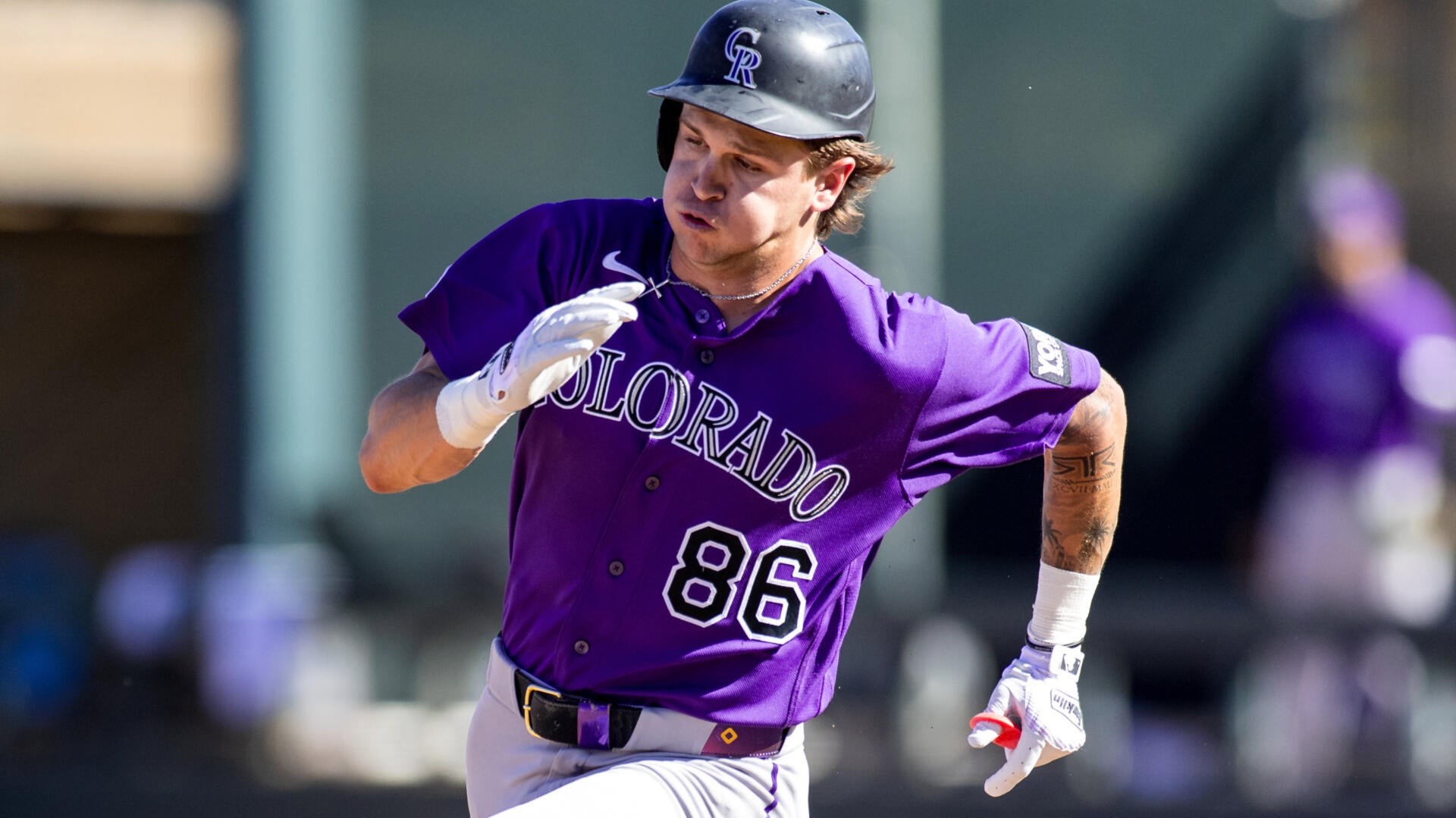
Bummed that you missed out on A.J. Ewing? Hoping to find another outfielder who could dominate steals while helping out in batting average? Well, check out what Cole Carrigg is doing. In his past 11 games, he's batting .460 (23 for 50) with three homers and nine steals, bringing him to a .369 batting average and 24 steals for the season. Those numbers are, of course, absurd and would seem to meet president of baseball operations Paul DePodesta's criteria for calling up a player, which he laid out a couple weeks ago.
"We want to call players up when they are banging down the door, where we have to make room for them because they're just playing so well, and they have the underlying foundation in place to be successful up here," DePodesta said. "Not just to survive, but to be successful."
If Carrigg isn't "banging down the door" with his performance so far, I don't know what more he could do. In addition to the top-line numbers, he's cut his strikeout rate nearly in half, saying it only ballooned last year because he "got into some bad habits." The exit velocities are a bit lacking, which could limit his over-the-fence power, but Coors Field has a way of making up for those kinds of shortcomings. He's a capable center fielder who could step in for Brenton Doyle or Jordan Beck already, and he's also gotten some exposure to shortstop.
Colt Emerson, SS, Mariners
2025 minors: .285 BA (506 AB), 16 HR, 14 SB, .841 OPS, 71 BB, 105 K 2026 minors: .252 BA (131 AB), 6 HR, 9 SB, .798 OPS, 15 BB, 41 K
The Colt Emerson stash, like the Kade Anderson stash, is more with an eye on the next few weeks than the next few days. Only recently has he begun to show signs of life, batting .357 (10 for 28) with two homers and two steals in his past six games, and the return of Brendan Donovan from a groin injury leaves him without a path to playing time. But Emerson is being paid like a major leaguer already, having signed an eight-year, $95 million deal at the end of March, which is normally a move that launches a player's major league career by removing all service time considerations. So if anything, the Mariners should be finding excuses to bring up Emerson sooner than later, but so far, president of baseball operations, Jerry Dipoto, has been unwilling to do that.
"Our belief in Colt and the reasons for signing that contract were more about the long term than it was about his promotion now," Dipoto recently said. "And that continues to be the case. We'll do the right thing for his development."
Still, if either of J.P. Crawford, who's in the last year of his contract, or Cole Young flounder while Emerson is surging, the timeline could change quickly.
Braden Montgomery, OF, White Sox
2025 minors: .270 BA (448 AB), 12 HR, 14 SB, .804 OPS, 57 BB, 130 K 2026 minors: .299 BA (127 AB), 6 HR, 2 SB, .954 OPS, 24 BB, 42 K
Braden Montgomery only moved up to Triple-A a week ago, but A.J. Ewing played just 12 games there before moving on to the big club. The White Sox's outfield need might be just as urgent as the Mets', what with Jarred Kelenic getting serious run out there, and they haven't been shy about promoting players this year. If Montgomery hits the ground running at Triple-A -- and he's performed reasonably well so far -- he could be in for a short stay there. The switch-hitter's strikeout rate is a bit elevated, but he hits the ball with authority, takes his walks and has run high line-drive rates at every stop. I'd say he's a distant fifth here because the Fantasy impact would be questionable even if he gets the call, but there does need to be a fifth.
FIVE ON THE PERIPHERY
(Here are some other prospects doing something of note.)
Edwin Arroyo, SS, Reds
2025 minors: .284 BA (464 AB), 3 HR, 12 SB, .716 OPS, 40 BB, 88 K 2026 minors: .342 BA (161 AB), 8 HR, 5 SB, .998 OPS, 17 BB, 29 K
The above numbers pretty much tell the story. Edwin Arroyo's improvement from one year to the next is stark, particularly in the home run category. Though he was a prospect of some stature even prior to this season, it was mostly for his defense. Now, though, it's his bat that has him knocking on the door to the majors, particularly with second baseman Matt McLain and third baseman Ke'Bryan Hayes struggling to pull their weight offensively. So why not include Arroyo in my Five on the Verge? His peak exit velocities are a bit on the low side, and his chase rate is a bit on the high side. I may be grading harshly because of his mediocre track record, and if you need infield help more than outfield help, you could certainly stash him over Braden Montgomery. Arroyo clearly showed enough juice on this 428-foot home run Tuesday:
107.5 mph | 428 ft on Edwin Arroyo's latest Triple-A homer 🔥 The @Reds' No. 6 prospect has seven extra-base hits and 10 RBIs in his past five games for the @LouisvilleBats: pic.twitter.com/Hcp3kYTl8Q
— MLB Pipeline (@MLBPipeline) May 12, 2026
Cooper Ingle, C, Guardians
2025 minors: .260 BA (415 AB), 10 HR, 36 2B, .808 OPS, 86 BB, 85 K 2026 minors: .351 BA (57 AB), 5 HR, 2 2B, 1.192 OPS, 23 BB, 18 K
Cooper Ingle has reached base at a .543 clip so far at Triple-A, which pretty much tells the story. He's always been a good on-base guy, but his batting eye is almost superhuman right now, accounting for a chase rate of only 10 percent. His tools are fairly muted otherwise, but he so rarely puts the ball on the ground, hitting line drives and fly balls in almost equal measure, that his bat plays beyond his exit velocities. The problem is the organization he plays for. Few emphasize catcher defense more than the Guardians, who have passed on several offensive-minded catcher prospects over the years and just traded for defensive standout Patrick Bailey, creating a clear roadblock for Ingle. Ingle, 24, got plenty of exposure to the outfield in college, but the Guardians have had him play catcher exclusively. We'll see if they begin experimenting to speed up his arrival.
Devin Fitz-Gerald, SS, Nationals
2025 minors: .302 BA (139 AB), 6 HR, 8 SB, .910 OPS, 28 BB, 24 K 2026 minors: .325 BA (117 AB), 8 HR, 10 SB, 1.101 OPS, 23 BB, 22 K
The hyphenated wonder was one of the pieces the Rangers sent to the Nationals in the MacKenzie Gore trade, and with the way his first year has gone in his new organization, he may turn out to be the biggest one. He was already demonstrating impressive speed and plate discipline at High-A, and now the power has begun to show up. With two more home runs Tuesday, Fitz-Gerald is up to five in his past six games. The switch-hitter has been far more productive from the left side than the right side, which is so often how these things go, but he has such a wide range of talents that I have to imagine he'll be surging up midseason rank lists.
Eric Hartman, OF, Braves
2025 minors: .240 BA (338 AB), 5 HR, 48 SB, .699 OPS, 42 BB, 92 K 2026 minors: .328 BA (128 AB), 12 HR, 13 SB, 1.107 OPS, 17 BB, 31 K
If you were inclined to dismiss Eric Hartman's three-homer game April 21 on account of him sounding made up, he kindly demanded you respect his "authoritah" with a 9-for-15 performance at Asheville over the weekend -- one that included three doubles and three homers. His standout tool is speed (no big bones here), which was apparent from his 48 steals last year, but a big spike in exit velocity, along with an optimal pull-air rate, has contributed to his power breakthrough. At only 19, he offers plenty to dream on, and there are no immediate plate discipline concerns. I will also point out that Eric Hartman was born in Canada, which is somehow just perfect.
Karson Milbrandt, SP, Marlins
2025 minors: 3-5, 3.00 ERA, 1.28 WHIP, 90 IP, 48 BB, 113 K 2026 minors: 2-1, 1.48 ERA, 0.99 WHIP, 30 1/3 IP, 12 BB, 40 K
After making a big leap last year, Karson Milbrandt is soaring to even higher heights this year on the strength of one of the goofier-looking windups in all the minors.
PROSPECT WATCH 26 Karson Milbrandt AA Pensacola MIA 6’2” RHP 22yo 5.9vRocketCity 6 IP 2H 0R 2BB 9K 22whiffs/89pitches Funky, unconventional, awkward windup…yet effective FF 96max Many breakers in the dirt tho 26: 31.2 IP 34.2K% 10.3BB% 18SwK% 63strike% pic.twitter.com/3CuAMSUcDT
— YGM Fantasy Baseball (@YGMfantasy) May 12, 2026
Hey, it works. In addition to the 1.48 ERA and 11.9 K/9, he has the sort of swinging-strike rate (18 percent) that you basically never see from a starting pitcher in the majors. And he's almost certainly going to be a starting pitcher, boasting a five-pitch arsenal and taking on a true starter's workload. His past three outings at Double-A have all lasted six innings.
Join the Conversation comments