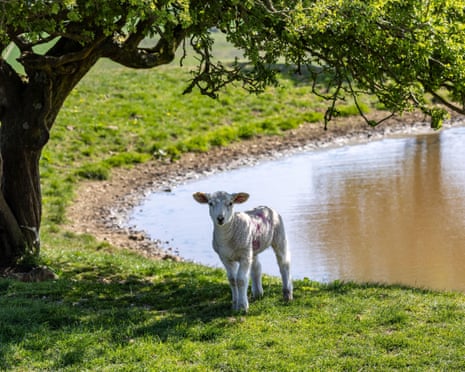
 A lamb on Ditchling Beacon in the South Downs. Grass growth has ‘completely stalled’, says the NFU. Photograph: lemanieh/AlamyA lamb on Ditchling Beacon in the South Downs. Grass growth has ‘completely stalled’, says the NFU. Photograph: lemanieh/AlamyExplainerHow England’s brutal summer heat is affecting farm animals and crops
 There are parched fields, overheating sheep and potentially the worst cereal harvest since detailed records began – but it’s a good year for cider apples
As parts of the UK swelter through a fifth successive climate crisis-driven heatwave and nearly three-quarters of England remains in drought, how are six homegrown products faring?
Livestock
On her farm in Durham on Monday where she was vaccinating sheep, Clare Wise stopped and stood still. For the first time in weeks, it had begun to rain. “We didn’t think of taking cover, we just stayed out and enjoyed it!” she says.
Farmers farther south were less lucky, and the continuing drought, as well as causing distress for animals in danger of overheating, is storing up problems for livestock farmers this winter. Grass growth has been about half of what it should be by this time of year and mowing excess grass in summer is where most get their winter feed.
“This would be the peak season for collecting winter forage, but we have not been able to do that,” says Wise, who is also the acting livestock board chief for the National Farmers’ Union. “Grass growth has completely stalled.”
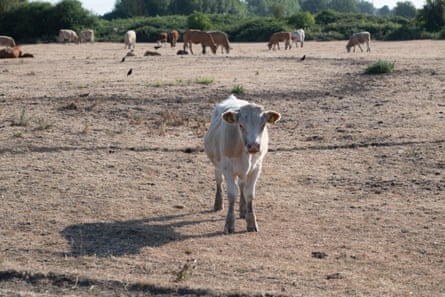 Cattle on Dorney Common, Buckinghamshire, try to graze in the extreme heat. Photograph: Maureen McLean/Shutterstock
Some farmers have been forced to dip into their winter feed stores; others will need to supplement their scant supplies with bought-in feed.
Milk production is down, but so far only slightly – by about 1%, according to the Agriculture and Horticulture Development Board (AHDB), as cows have less to eat and are discouraged by the heat. Sheep shearers have been in short supply, making it difficult for farmers to make their flocks comfortable.
For future years, farmers can grow trees and higher hedges to provide shade for their beasts, says Tom Cantillon, an analyst at the Energy and Climate Intelligence Unit (ECIU) thinktank. Some with bigger herds might consider air conditioning in their sheds and milking parlours.
But for many livestock farmers, the fear is that this year is just the beginning.
Fruit
For aficionados of soft fruit, this is turning out to be a glorious summer. Berries are smaller but sweeter as the sunniest July on record in the UK has concentrated flavours. Strawberries and raspberries have done particularly well; stone fruit such as peaches, greengages and plums have ripened quickly, and cherries and blueberries have been cheap and plentiful.
Cider drinkers can also rejoice at the smaller and sweeter apples. Supermarkets tend to choose apples based on size, notes Cantillon, so if fewer of them make the grade, shoppers may be disappointed but drinkers will see the benefits. “It could be a bumper year for cider-making,” he says.
The picture is “genuinely mixed” for other produce, says Martin Emmett, the horticulture and potatoes board chair at the NFU.
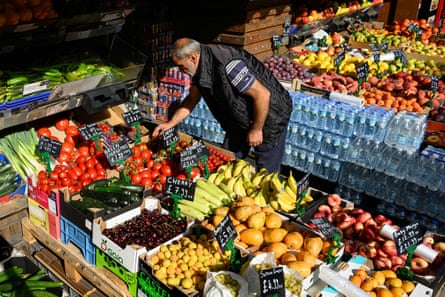 A grocery shop in London. The hot and dry summer has produced mixed results for fruit growers. Photograph: Leon Neal/Getty
Most fruit in the UK is grown covered on substrate, so a lack of rainfall in the fields has been less of an issue. But horticulturalists are worried about their water supplies. About half of the UK’s potato crop, for instance, is irrigated, often using groundwater from boreholes or abstracted from rivers. Many farmers would find it easier to store more of their own water on the farm, but constructing on-farm reservoirs requires complex planning permission.
Tougher crops and beaver dams: how UK farmers are tackling droughtRead moreCereals
Britain could be in for its worst cereal harvest in four decades, with wheat, spring barley and oats all substantially down on their 10-year average, according to estimates from the AHDB analysed by the ECIU. This year’s cereal and oilseed harvest is forecast to be 18.5m tonnes, which would make 2026 the worst since detailed records began in 1984.
After a wet start to the year that affected late planting for spring wheat, a dry April hit winter wheat at a crucial growing stage. The record heatwave in May also deprived grains of the moisture they need to plump out.
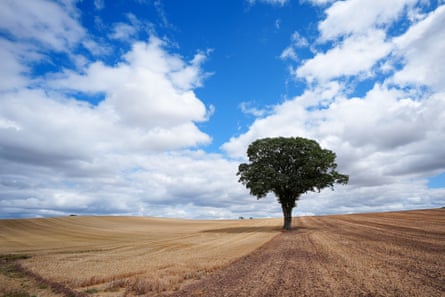 Sun bleached stubble covers a field after harvesting in Shropshire. Photograph: Christopher Furlong/Getty
Further heatwaves in June and July added heat stress, while the drought continued to stunt the grains. Since mid-June, there has been no rainfall or none of significance across much of England. July was the driest month ever recorded in southern England.
Yields on wheat are normally about 7.9 tonnes per hectare in the UK; that is forecast to be down by more than a tonne per hectare, at about 6.7 tonnes this year.
Estimates taken in early August, with about half the harvest gathered, showed that the loss of about 2.5m tonnes compared to early estimates would amount to about £390m in lost revenue for farmers.
Tom Lancaster, an analyst for land, food and farming at ECIU, says: “From the wettest winter on record in 2024, to the hottest summer in 2025, and now unprecedented heat and drought this year, we are in danger of UK farming entering a climate doom loop, as repeated impacts undermine the capacity of farmers to drill next year’s crop.”
Martin Lines, the chief executive of the Nature Friendly Farming Network, who farms in Cambridgeshire, says this year has been “brutal”, especially coming on top of two previous consecutive poor harvests. “Harvest this year has been a real kick in the teeth,” he says. “I’ve never known it this dry and hot on our farm. Even farmers I know who were sceptical of climate change are now saying they’re really worried.”
Europe is not faring much better, with heatwaves and fires contributing to a forecast of €2bn (£1.7bn) in lost revenue.
Wine
While traditional British crops are suffering, many vineyards are thriving. WineGB, the trade association representing the UK’s wine producers, says it is optimistic about the size and quality of the 2026 harvest. Producers are reporting healthy vineyards, clean fruit and encouraging ripening after stable summer conditions.
Nicola Bates, the chief executive of the trade body WineGB, said: “Whilst it’s too early to definitively say the overall impact on this year’s UK harvest – and what happens over the next few weeks will be crucial – the vineyards look strong and we’re optimistic.
“That said, seasonal conditions remain variable and producers continue to adapt, so building long-term resilience plans is essential for protecting our vineyards and to future-proof English and Welsh wine.”
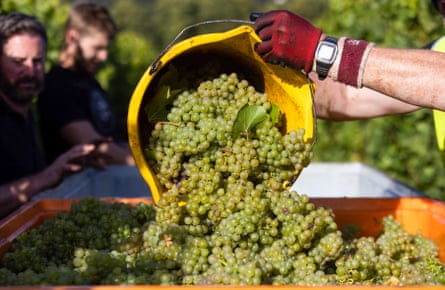 Freshly picked grapes are emptied into storage crates at a Chapel Down vineyard in Maidstone. Photograph: Bloomberg/Getty
Although some growers in Kent, the heartland of the British wine industry, suffered from late frosts most have managed to maintain fruit health.
Tim Spakouskas, a grower with 7 hectares (17.5 acres) of vineyard in North Yorkshire, says his farm has had very little rain for at least two months but his long-established vines are doing well as they have deep roots able to tap into moisture well below the sun-baked surface.
He is acutely aware that his wider family, who farm a variety of other crops, are “struggling a bit” in the hot dry weather which is not Yorkshire’s usual fare. Spakouskas says some of his newer vines planted last year are also showing signs of stress and he fears he may lose some if the weather does not change.
Salad
We may like to eat salad in the heat but lettuce is not a big fan of very hot weather. Its ideal growing temperature is about 20C, according to farmers, and it starts to get stressed at 24C. Over 35C, it won’t be suitable for sale, so the recent bouts of hot weather have been tricky for growers.
Ben Andrews, a salad farmer based in Herefordshire, posted on Instagram on Thursday: “There is still no rain and the veg is really struggling.” He said lettuce heads were likely to be smaller and it would probably take two to make up a portion, hitting takings.
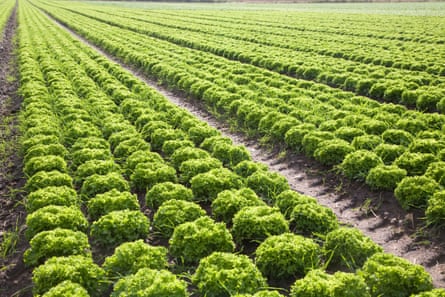 Lettuces grow near Hollesley in Suffolk. Crops start to get stressed at 24C. Photograph: Geography Photos/Universal Images Group/Getty
Other leafy vegetables such as spinach and pak choi have also entered “thermal dormancy”, where they stop growing in the intense heat, according to Oddbox, which sells boxes of imperfect or surplus fruit and vegetables.
Even those growing in the controlled environments of greenhouses and polytunnels are struggling with the heat which topped 30C in parts of the UK again on Thursday.
Jan Bentley, the managing director of WS Bentley, which supplies salad cress, microgreens and pea shoots to restaurants and supermarkets grown in hydroponic systems, said yields had been reduced by “heat stress and some poor germination and crops destroyed when extremely hot”.
Oddbox also said the quality of cucumbers had been affected as “plants are stressed in the extreme heat, which causes them to misshape”.
Fish
It is not just people, animals and crops that have sweltered this summer: the water around Britain’s coast is also hotter.
Cornwall’s coastal waters are experiencing marine heatwave conditions for the third consecutive year, registering temperatures 3-4C warmer than at this time of year a decade ago, bringing challenges and opportunities for Britain’s fishers as Mediterranean species of fish and shellfish move into UK waters, while cod and haddock are migrating farther north.
 Increasing octopus numbers off Cornwall have led to record catches. Photograph: A Martin UW Photography/Getty
Britain’s southernmost county is experiencing its largest octopus bloom in 75 years, according to the Marine Biological Association, thought to be linked to the warming seas.
As the octopus population has exploded, a record 130,000 tonnes has landed at Newlyn’s fish market so far this year. In previous years, less than 100 tonnes of octopus would have been brought ashore at the market, says Chris Ranford, the chief executive of the Cornish Fish Producers’ Organisation.
The fishing industry is “split down the middle whether it’s an opportunity or a problem”, says Ranford. “The volume has got to the level where it is a really solid export market, and the price has held up fairly well.”
Octopus is popular in countries including Spain, but there is little domestic appetite. UK fishers are also finding octopus have broken into their shellfish pots and eaten the crab and lobster inside, reducing catches of these species that are more popular with British diners.
Ranford, who is also the current chair of the National Organisation of Fishermen’s Federations, says there are concerns that a very cold winter or drop in water quality could suddenly cut octopus numbers, leaving fishers with little to catch as crab, lobster and scallop populations take time to recover.
Explore more on these topicsShareReuse this content