Breaking space news, the latest updates on rocket launches, skywatching events and more!
Contact me with news and offers from other Future brands Receive email from us on behalf of our trusted partners or sponsors By submitting your information you agree to the Terms & Conditions and Privacy Policy and are aged 16 or over.You are now subscribed
Your newsletter sign-up was successful
Want to add more newsletters?
An account already exists for this email address, please log in. Subscribe to our newsletter NASA celebrates Hubble's 36th anniversary with a new image of the Trifid Nebula, a star-forming region it first captured in 1997. (Image credit: NASA, ESA, STScI; Image Processing: Joseph DePasquale (STScI))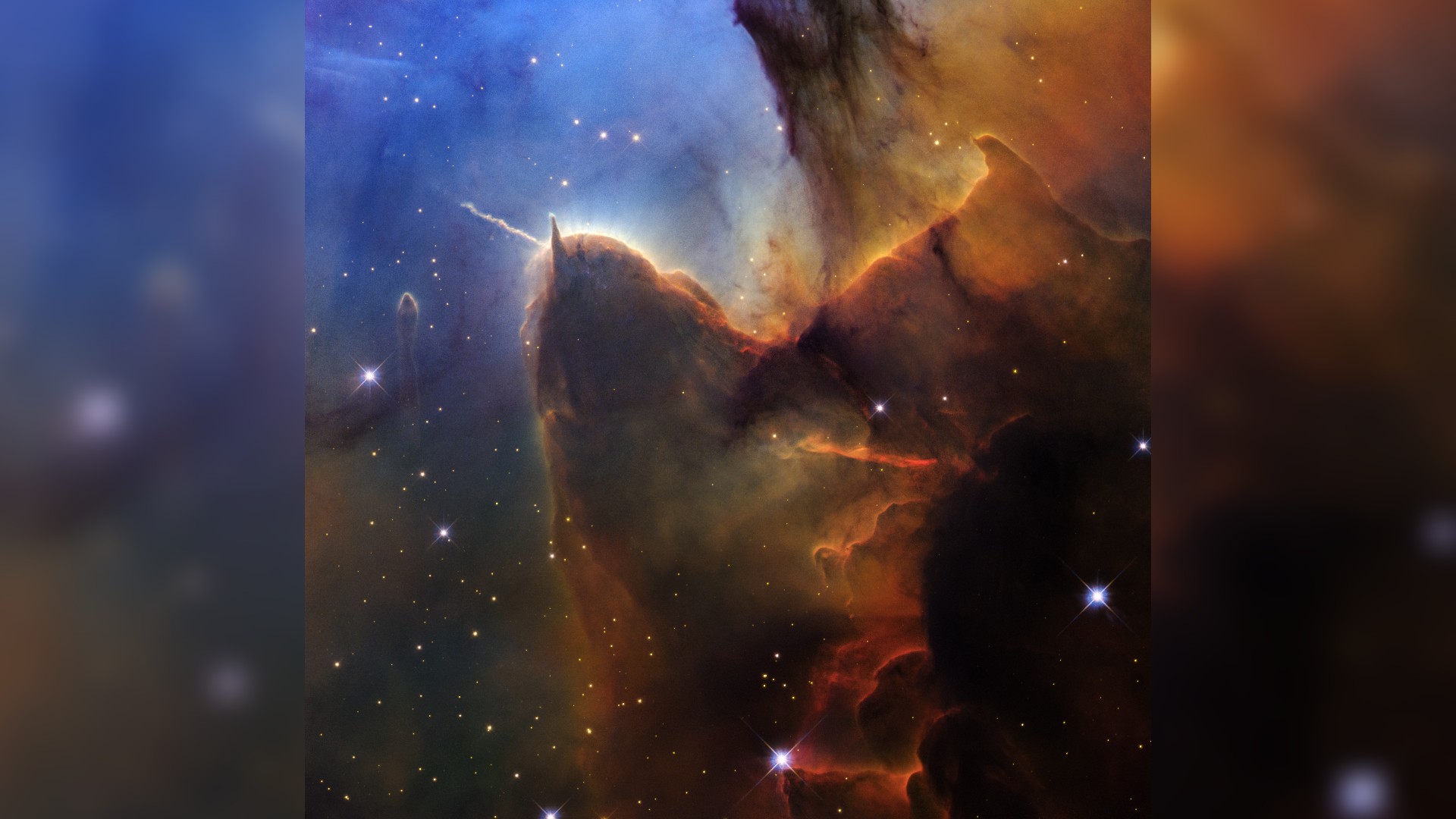
The Hubble Space Telescope is celebrating its 36th anniversary in space this week with a glimpse into the heart of a major star-forming region, presented in prismatic color.
Hubble's anniversary image presents what is just a small section of the Trifid, at the end of one of the four large dust lanes that extend from the central region of the nebula. Towering columns and sweeping walls of gas and dust dominate the scene. The center point is perhaps what looks like a gigantic mountain with two 'spikes' protruding from its peak, like the antennae on an insect. Yet despite their appearances, these spikes are two completely different phenomena.
The spike pointing straight up is a pillar of denser gas and dust that has not yet been eroded by the barrage of ultraviolet light and powerful particle winds from nearby newborn massive stars that are just beyond the edges of this image. At the tip of the pillar, we can see a star that has formed. Although it is still embedded in the nebula and not clearly visible, we can see what looks a little like the tip of a fingernail around it. This, it seems, is a circumstellar disk that one day will form planets.
The other spike pointing towards the left is very different, with a more cloudy and uneven appearance than the thick pillar. This spike is a Herbig–Haro object (HH 399, specifically) — a jet of material launched by a growing protostar accreting too much matter and ejecting the excess along its rotational axis. The jet bursts out through the clouds of the nebula and extends light-years into space.
Between Hubble's first image of the Trifid taken in 1997 and this new image, astronomers have been able to measure the speed of the jet and see how its size and structure have changed during the intervening 29 years. From this information, they aim to learn in greater detail how young stars interact with their environment, which potentially can impact upon how those young stars mature.
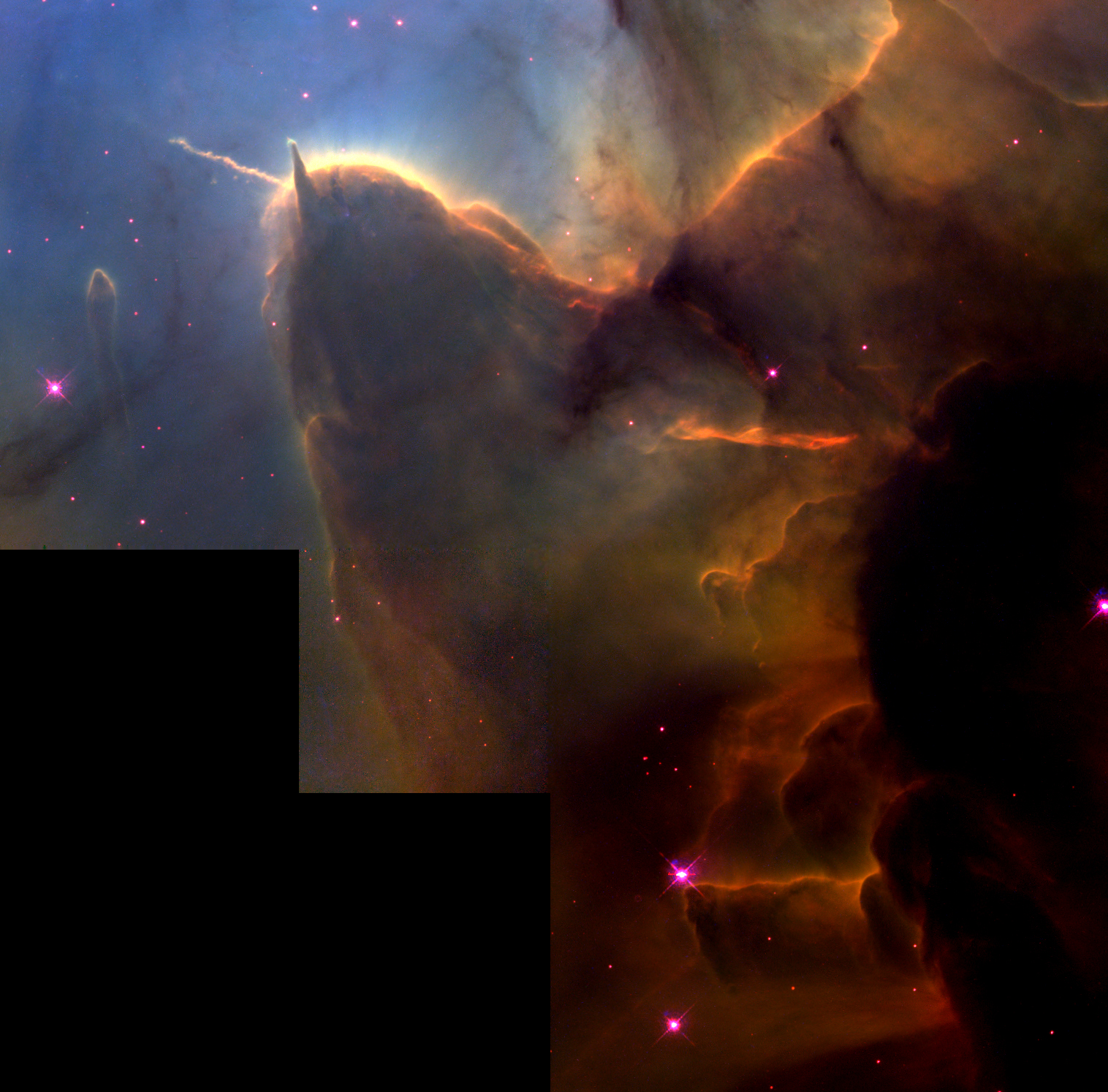
To the left of the 'space slug' we can see a lone tendril of gas separated from the rest. This tadpole-like object is a clump of denser nebulosity that hasn't been completely photo-dissociated by the Trifid's radiation field yet.
Get the Space.com NewsletterContact me with news and offers from other Future brandsReceive email from us on behalf of our trusted partners or sponsorsMeanwhile, the top left and bottom right corners of the new Hubble image are in stark contrast to one another. You might at first think that it is the bottom right corner that is the clearest region in the image, because it is black.
However, the black that you see is not space — it has barely any stars. Instead it is a supremely dense patch of dusty gas that may be forming stars from within, but from without still appears impenetrable.
It's actually the top left corner that is clearest. The pretty blue hue is produced by ionized gas as ultraviolet light begins to clear away the nebula. We can see this process in action — the yellow glow around the head of the slug looks like the nebula is fraying, and this is where the denser gas is being eroded by the radiation. Indeed, in star-forming regions such as the Trifid, the radiation sculpts the nebulosity in a way that is somewhat analogous to how wind sculpts rocks in the desert.
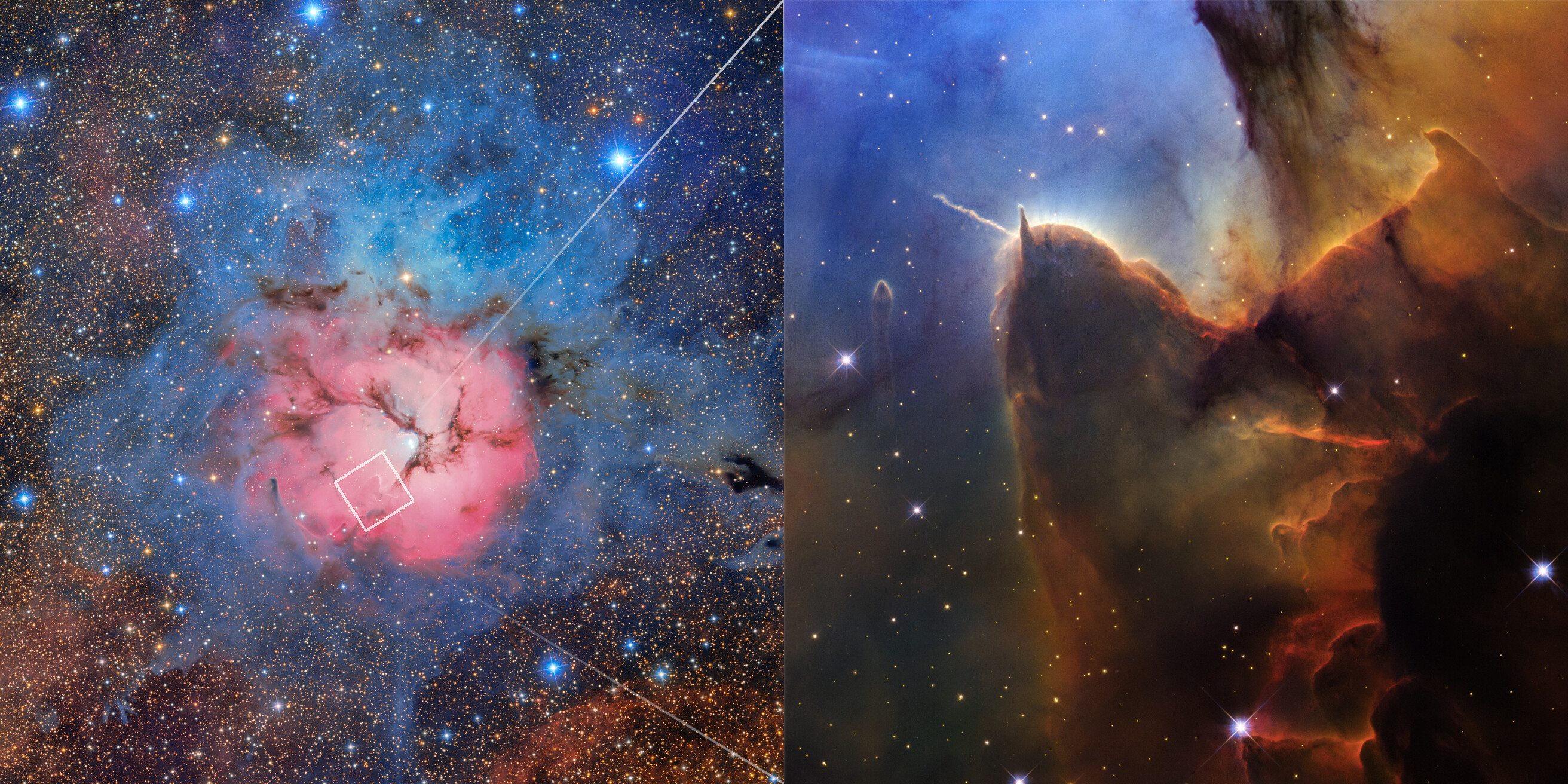
The name of the Trifid, which is over 4,000 light-years away, refers to an object that has three lobes. The nebula was given this name by the nineteenth century British astronomer John Herschel, who saw three lobes divided by dust lanes through his telescope. In actuality, the nebula has four lobes — Herschel's telescope was unable to resolve the fourth dust lane.
This latest image from Hubble forms just one of more than 1.7 million observations that the space telescope has made over the past 36 years since it launched on April 24, 1990. Those observations have spawned about 23,000 research papers written by nearly 29,000 astronomers in total worldwide, and about 1,100 of those papers were written in 2025 alone.
Hubble may be getting old, but it is far too soon to be talking about its legacy — it is still accomplishing an extraordinary amount of work in the here and now.
 Keith CooperContributing writer
Keith Cooper is a freelance science journalist and editor in the United Kingdom, and has a degree in physics and astrophysics from the University of Manchester. He's the author of "The Contact Paradox: Challenging Our Assumptions in the Search for Extraterrestrial Intelligence" (Bloomsbury Sigma, 2020) and has written articles on astronomy, space, physics and astrobiology for a multitude of magazines and websites.
View MoreYou must confirm your public display name before commenting
Please logout and then login again, you will then be prompted to enter your display name.
Logout MORE FROM SPACE... 1Sun unleashes 2 colossal X-flares within 7 hours of each other, knocking out radio signals on Earth
- 2Ted Cruz pushes back on NASA budget cuts: 'I don't want to wake up one day and look up at the moon and realize the Chinese have beat us there'
- 3Could 'The Mandalorian and Grogu' restore the 'Star Wars' spark? Watch the electrifying final trailer and decide if this is the way
- 4What will happen when our sun starts dying? These 'stellar archaeologists' may have found a clue
- 5These 'interstellar glaciers' could give water to young star systems. Could they support alien life, too?