Breaking space news, the latest updates on rocket launches, skywatching events and more!
Contact me with news and offers from other Future brands Receive email from us on behalf of our trusted partners or sponsors By submitting your information you agree to the Terms & Conditions and Privacy Policy and are aged 16 or over.You are now subscribed
Your newsletter sign-up was successful
Want to add more newsletters?
An account already exists for this email address, please log in. Subscribe to our newsletter This image from the HiRISE camera aboard NASA's Mars Reconnaissance Orbiter shows Chasma Borealis at Mars' northern ice cap. (Image credit: NASA/JPL-Caltech/University of Arizona)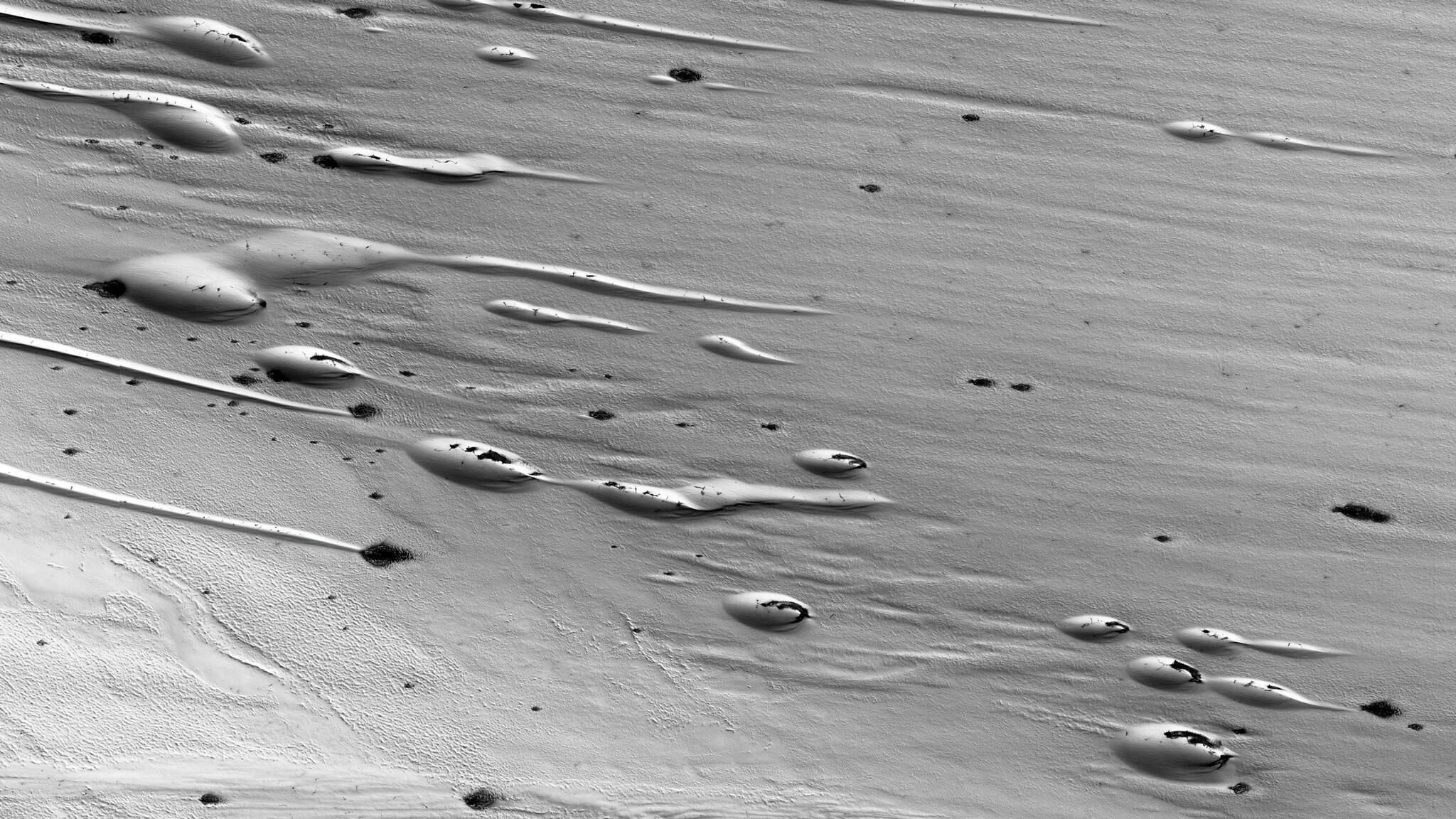
Springtime has arrived on Mars as ice melts on the planet's northern ice cap.
What is it?
This new image from HiRISE, which stands for High Resolution Imaging Science Experiment, shows the surface of Chasma Boreale, a large valley in Mars' northern ice cap. Here, ice melts and recedes in the springtime, some evidence of which can be seen in this image.
Article continues belowIn this image, you can also see dunes streaking across the Martian surface. They hold information about the winds on the planet, as you can tell the direction of the wind based on the direction of the dunes' sharp tips.
Why is it incredible?
Chasma Boreale is a valley with walls rising up 4,600 feet (1,400 meters) from its flat floor. Hundreds of millions of miles away from Earth, this barren landscape lies at the planet's northern ice cap.
And yet, however icy cold, desolate, or far away this planet is, it feels the change of springtime just as we do here on Earth.
This image is a visual reminder of the similarities worlds share across the solar system, however different they may be.
Get the Space.com NewsletterContact me with news and offers from other Future brandsReceive email from us on behalf of our trusted partners or sponsors Chelsea GohdContent Manager
Chelsea Gohd served as a Senior Writer for Space.com from 2018 to 2022 before returning in 2026, covering everything from climate change to planetary science and human spaceflight in both articles and on-camera in videos. With a M.S. in Biology, Chelsea has written and worked for institutions including NASA JPL, the American Museum of Natural History, Scientific American, Discover Magazine Blog, Astronomy Magazine, and Live Science. When not writing, editing or filming something space-y, Gohd is writing music and performing as Foxanne, even launching a song to space in 2021 with Inspiration4. You can follow her online @chelsea.gohd and @foxanne.music
View MoreYou must confirm your public display name before commenting
Please logout and then login again, you will then be prompted to enter your display name.
Logout MORE FROM SPACE... 1A bright star will disappear for up to an hour on April 25 — here's what's happening
- 2Hubble Telescope celebrates 36th anniversary with gorgeous new image of famous Trifid Nebula
- 3Sun unleashes 2 colossal X-flares within 7 hours of each other, knocking out radio signals on Earth
- 4Ted Cruz pushes back on NASA budget cuts: 'I don't want to wake up one day and look up at the moon and realize the Chinese have beat us there'
- 5Could 'The Mandalorian and Grogu' restore the 'Star Wars' spark? Watch the electrifying final trailer and decide if this is the way