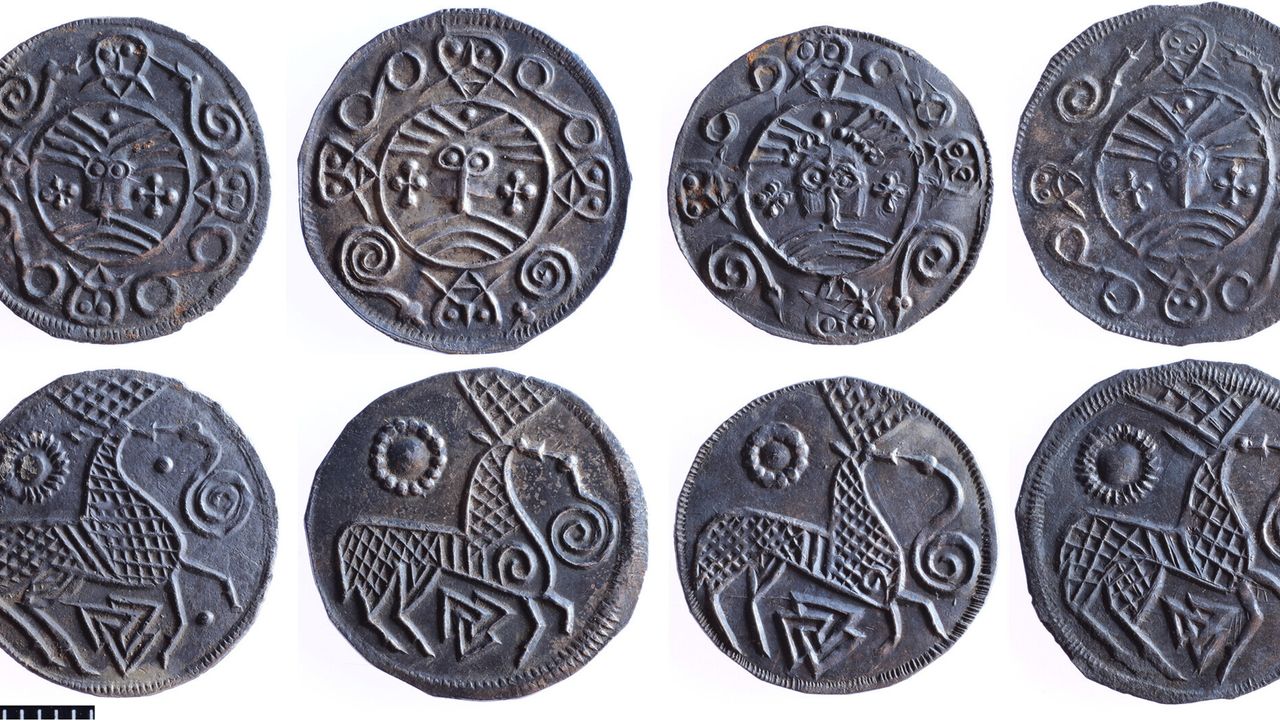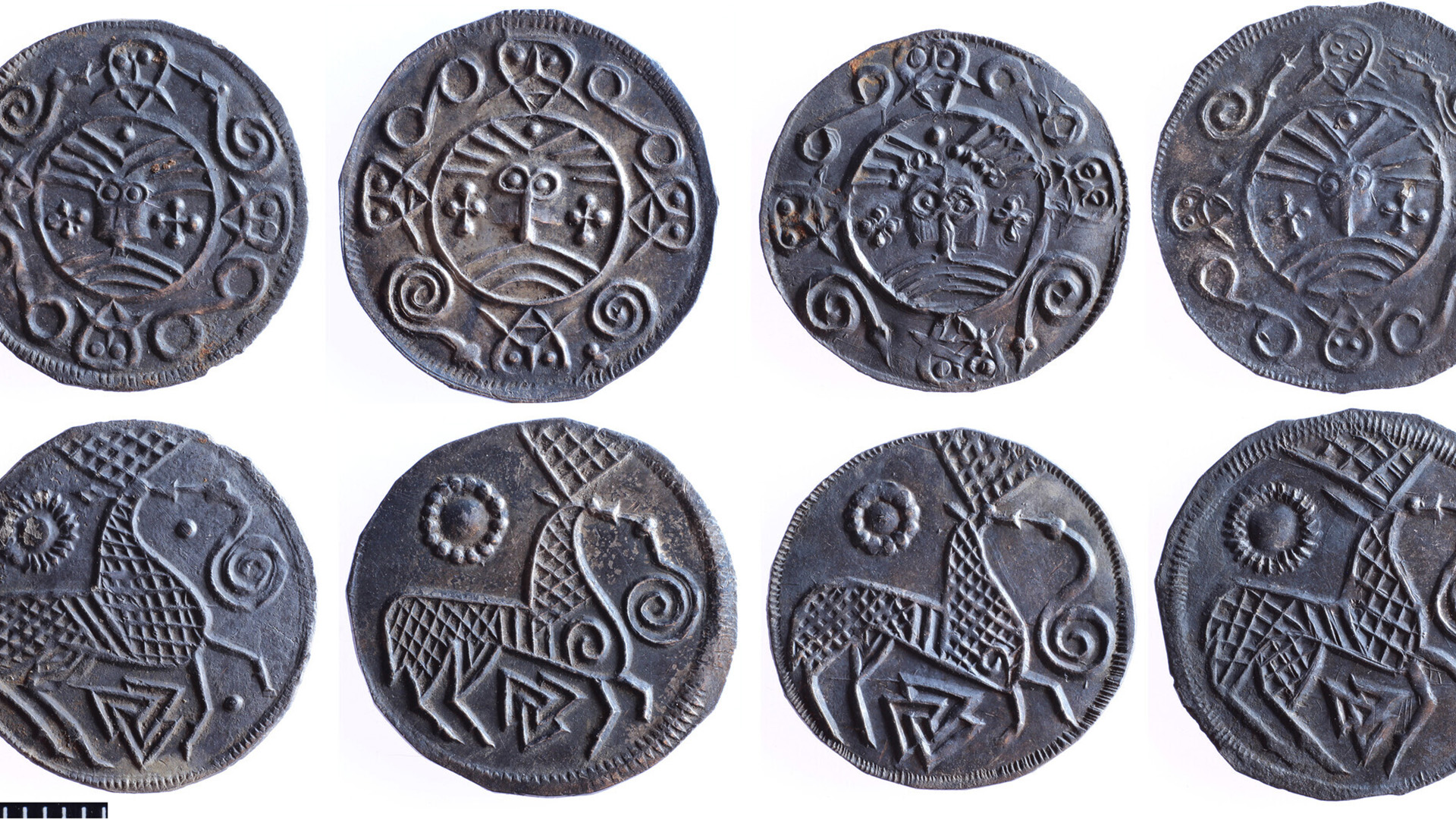
One side of the coins portrays a stylized face said to represent the Norse god Odin, and the other side portrays a stag. The dies used to stamp the sides of the coins were replaced with similar dies as they wore out. (Image credit: Claus Feveile/Birch et al. Archeometry 2026)
Share this article Join the conversation
Follow us Add us as a preferred source on Google Newsletter Subscribe to our newsletter
Some of the earliest Viking "pennies" were made with silver that contained melted-down coins from the Islamic world, a new study reports. The finding confirms the relationship between early Viking and Islamic silver, which was likely the result of long-distance trade.
The silver coins make up the Damhus hoard, a trove of 226 Viking Age pennies found near the town of Ribe on Denmark's Jutland Peninsula in 2018. The trove dates to between A.D. 830 and 850, which makes the silver pieces some of the earliest Viking coins ever discovered, according to the study, which was published June 5 in the journal Archaeometry.
Although the coins are formally called pennies, their weight in silver alone means they were much more valuable than modern pennies when they were made in the ninth century, study first author Thomas Birch, an archaeologist at the National Museum of Denmark, told Live Science. "The word comes from the Old English word 'pening'," he said – similar to "pfennig" in High German. A single pening was enough to buy ale, bread or simple tools.
The ancient coins are also remarkably well preserved after more than 1,000 years in the ground, Birch said. One side shows a face said to represent Wodan or Odin, the chief Norse god, while the other side portrays a stag.
Viking treasure
Crucially, the dies used to stamp the sides of the coins were replaced by similar dies as they wore out, resulting in tiny changes that modern scientists can identify, Birch said.
As a result, Birch and his colleagues saw that at least 30 dies had been used, and they estimate that hundreds of thousands of this type of silver Viking penny were produced by the single mint at Ribe, which was a major settlement at the time.
Early medieval Denmark was a center of the Norse world, and raiders from the coasts of Scandinavia were known as Vikings after the Old Norse word "vikingr," which meant something like "pirate."
Sign up for the Live Science daily newsletter now
Get the world’s most fascinating discoveries delivered straight to your inbox.
Contact me with news and offers from other Future brandsReceive email from us on behalf of our trusted partners or sponsors
The Vikings became notorious in 793 when they raided Christian monks on the English island of Lindisfarne. This event sparked the Viking Age, which ended in 1066 when a Viking army was defeated at Stamford Bridge in England only a few weeks before the Norman Conquest.
Ancient silver
Birch said the Damhus hoard came from a time when Denmark was divided among pagan Norse kingdoms, more than 100 years before their unification and Christianization under Harald Bluetooth.
Examination of 25 of the coins with X-ray fluorescence and other analytical techniques looked at the different isotopes — elements with different numbers of neutrons in their nuclei — of the trace elements mixed in with the silver. The results indicated that, in some cases, more than half of the precious metal had come from Islamic silver coins called "dirhams," he said.
The Viking coins were probably minted from ingots of silver produced outside Scandinavia, in part by melting down Islamic coins in bulk, Birch said, and these ingots had likely been traded to the ancient mint at Ribe.
Related stories
"This silver has already had a life cycle; it's not coming straight from a mine," he said. "[The silver] has been made into dirhams and then been melted in a pot somewhere."
The coins in the Damhus hoard came from the precise time when silver from the Islamic world was becoming common in the Viking world, he noted; Islamic jewelry from that time has also been discovered in Scandinavia.
"We're right at the juncture of when we can see Islamic silver coming in," Birch said. "If these coins are being minted in the hundreds of thousands, that's a huge quantity of Islamic silver."
Article Sources
Birch, T., Horsnæs, H., Andreasen, R., Feveile, C., Merkel, S., Kershaw, J., Sarah, G., Naismith, R., & Moesgaard, J. C. (2026). The Damhus Hoard: New insights into some of the earliest Viking silver coinage. Archaeometry. https://doi.org/10.1111/arcm.70168
See how much you know about ancient norsemen with our Viking quiz!
Tom MetcalfeLive Science Contributor
Tom Metcalfe is a freelance journalist and regular Live Science contributor who is based in London in the United Kingdom. Tom writes mainly about science, space, archaeology, the Earth and the oceans. He has also written for the BBC, NBC News, National Geographic, Scientific American, Air & Space, and many others.
View More
You must confirm your public display name before commenting
Please logout and then login again, you will then be prompted to enter your display name.
Logout