Image caption,
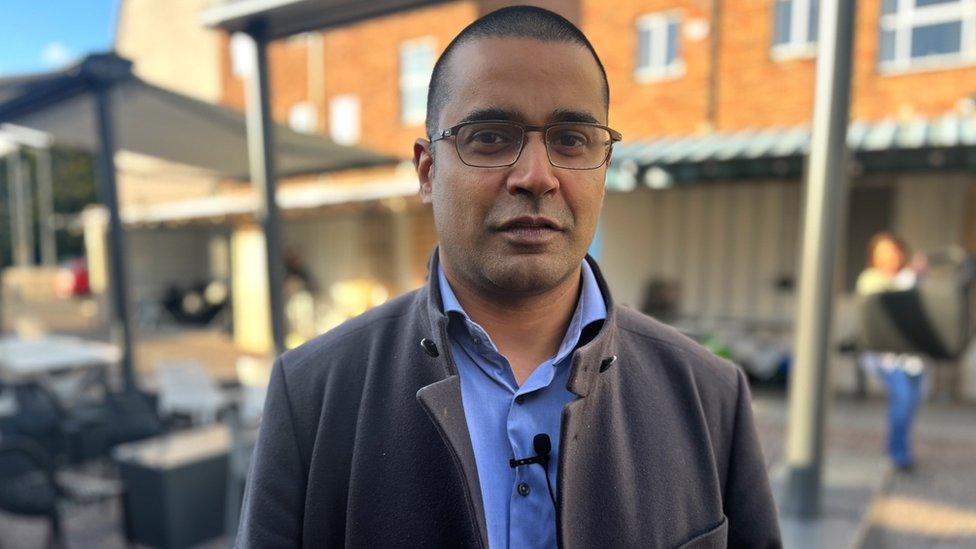
Michael says he did "a lot of practising" for his stand-up debut
ByBernie AllenBBC News NI- Published18 minutes ago
Stepping onto the stage for the first time, Michael Hart is "flying" with adrenaline.
He didn't think he had it in him, but he's about to tell his own jokes to a room full of strangers.
He stutters at first but soon gets his first laugh from the crowd and the nerves he's feeling are washed away by a wave of elation.
Now he's on a roll...
Michael is part of a group of people who have struggled with mental ill-health and are now giving stand-up a go to build up their self-belief and connect with others.
Through the Finding Our Funny workshops run by the charity Inspire, they're turning their experiences into comedy material - and then taking it on the road for three gigs across Northern Ireland this month.
 Image source, InspireImage caption,
The comics have performed gigs in Enniskillen, Londonderry and Belfast
Michael has sought help for his mental health over the past few years and has struggled with his confidence.
Given those circumstances, throwing himself into stand-up is a daunting prospect - but he's embraced the challenge.
"The first thing I said was: 'What's the worst that can go wrong?
"I did stutter at the start, I sort of froze - but I came back in again. Just a joy to get up there. I think I kept it together well.
"My wee trick was I done a lot of practising."
He's now performed three gigs, using all his own material.
"It's all true, I didn't make any of this stuff up."
Carla Sloan says she's had mental health issues for most of her adult life and had never imagined trying her hand at stand-up until now.
"I've done lots of mental health courses on emotional resilience and stuff but this was something completely different.
"The first day I drove into the car park and then I was like: 'No.'
"I turned the car around and I drove back down the road and then I thought: 'Ah, I'm here, I might as well go in and see what it's about'."
 Image caption,
Carla says her stand-up experience has boosted her self-esteem
As a mum of teenagers, Carla's jokes are about her real-life experiences of parenting.
"All my material is based on teenage girls and the fun you have raising them but also when they do something that they aren't meant to do," she smiles.
Tim McGarry is a veteran of the Northern Ireland comedy scene, best known for playing Da in the long-running BBC sitcom Give My Head Peace.
For decades he's given audiences the giggles with his own stand-up shows, so who better to mentor this bunch of budding comics?
For McGarry, the approach to comedy should be a simple one.
 Image caption,
Tim McGarry shared some of his tricks of the trade, such as comic timing and dealing with a crowd
"I just sat down with them and said, well, what makes you laugh? What's something funny in your life?
"Most of them went off and wrote stuff themselves and I tweaked a bit and helped a wee bit - but it's coming from entirely the participants themselves."
While some comic techniques can be taught, McGarry says, much of his work as a mentor involved building their self-belief.
'My family is very proud of me'
Getting "out of their comfort zone" and taking that first step onto the stage is the hard part, says McGarry - but the payoff is worth it.
"There is no better feeling than coming off stage and going: 'You know what? I made people laugh'."
Michael certainly felt that buzz.
 Image source, Inspire WellbeingImage caption,
Michael is keen to keep his stand-up career going
"When I looked back at my videos I couldn't believe how well I'd done. My family is very proud of me," he says.
"My goal is to get back into work - and this has raised my confidence even more."
The experience has given Carla a fresh belief in herself too.
"I've learnt not to underestimate myself - and that was a big one for me as I do tend to underestimate what I'm capable of.
"Maybe I need to look at myself a bit more and be aware of just how much I can do.
"I might have to take things slower than other people - but I can still do it."
 Image caption,
Kerry Anthony says the workshops helped the group to build resilience and confidence
Inspire chief executive Kerry Anthony says the project is something very different to what the charity would normally do.
Much of its work involves helping people who are dealing with mental ill-health, homelessness or addiction - but Kerry says that talking about those "heavy" topics through humour has been "wonderful" for those in the stand-up workshops.
"People who use our services... have worked with us over the years to use their voice around very serious issues to do with mental ill-health.
"This was a time that they could use their voice in a totally different way.
"Comedy isn't a treatment for mental ill health - but comedy is important for everybody."
Related topics
Annual 'craic pilgrimage' crosses the border
- Published23 May 2025

'Some of these guys wouldn't be here' if not for football chats
- Published17 August
'I'm a doctor - but I want to be a stand-up'
- Published4 May 2024