The cold blob is an unusual patch of cooling in a world that is heating up through global warming. This picture of the ocean is for illustrative purposes only. (Image credit: Feifei Cui-Paoluzzo via Getty Images)
Share this article Join the conversation
Follow us Add us as a preferred source on Google Newsletter Subscribe to our newsletter
A mysterious "cold blob" in the Atlantic Ocean is a sign that key ocean currents are weakening, a new study has found, with potentially devastating long-term impacts on our climate and weather.
The cold blob, or North Atlantic Warming Hole, is an area south of Greenland and Iceland where average sea surface temperatures have actually been going down. Researchers have been working to understand the blob for years, given that it bucks the global trend of Earth getting warmer.
The new research, published May 28 in the journal Geophysical Research Letters, supports previous interpretations that the blob's existence points to a weakening of ocean currents known as the Atlantic Meridional Overturning Circulation (AMOC).
The AMOC maintains Europe's relatively mild temperatures, particularly in winter, and helps regulate climate across Europe, Africa and America. Researchers have warned that a weakening AMOC has serious environmental consequences, with its collapse considered a major potential tipping point, or key threshold within Earth's systems, beyond which substantial and irreversible environmental change will occur.
Scientists are uncertain about the rate at which the AMOC is weakening, with one recent study projecting that it will slow down by around 50% by 2100. If the AMOC were to collapse completely, temperatures in parts of the Northern Hemisphere could plummet by some 18 to 27 degrees Fahrenheit (10 to 15 degrees Celsius), extreme droughts would be unleashed in southern Europe, and the sea level would rise along the northeastern coastline of North America.
"Given the well-established existence of a tipping point of the AMOC, as well as recent studies finding a range of different "early warning signals" of the ocean circulation approaching such a tipping point, the strong evidence for a weakening AMOC is a serious concern for society and policy," the authors of the new study wrote in the study.
The AMOC acts like a conveyor belt, carrying water, nutrients, and absorbed carbon dioxide from the tropics northward. This warm water heats up the atmosphere, with westerly winds then carrying the resulting warm air towards land, keeping Europe relatively mild.
Sign up for the Live Science daily newsletter now
Get the world’s most fascinating discoveries delivered straight to your inbox.
Contact me with news and offers from other Future brandsReceive email from us on behalf of our trusted partners or sponsors
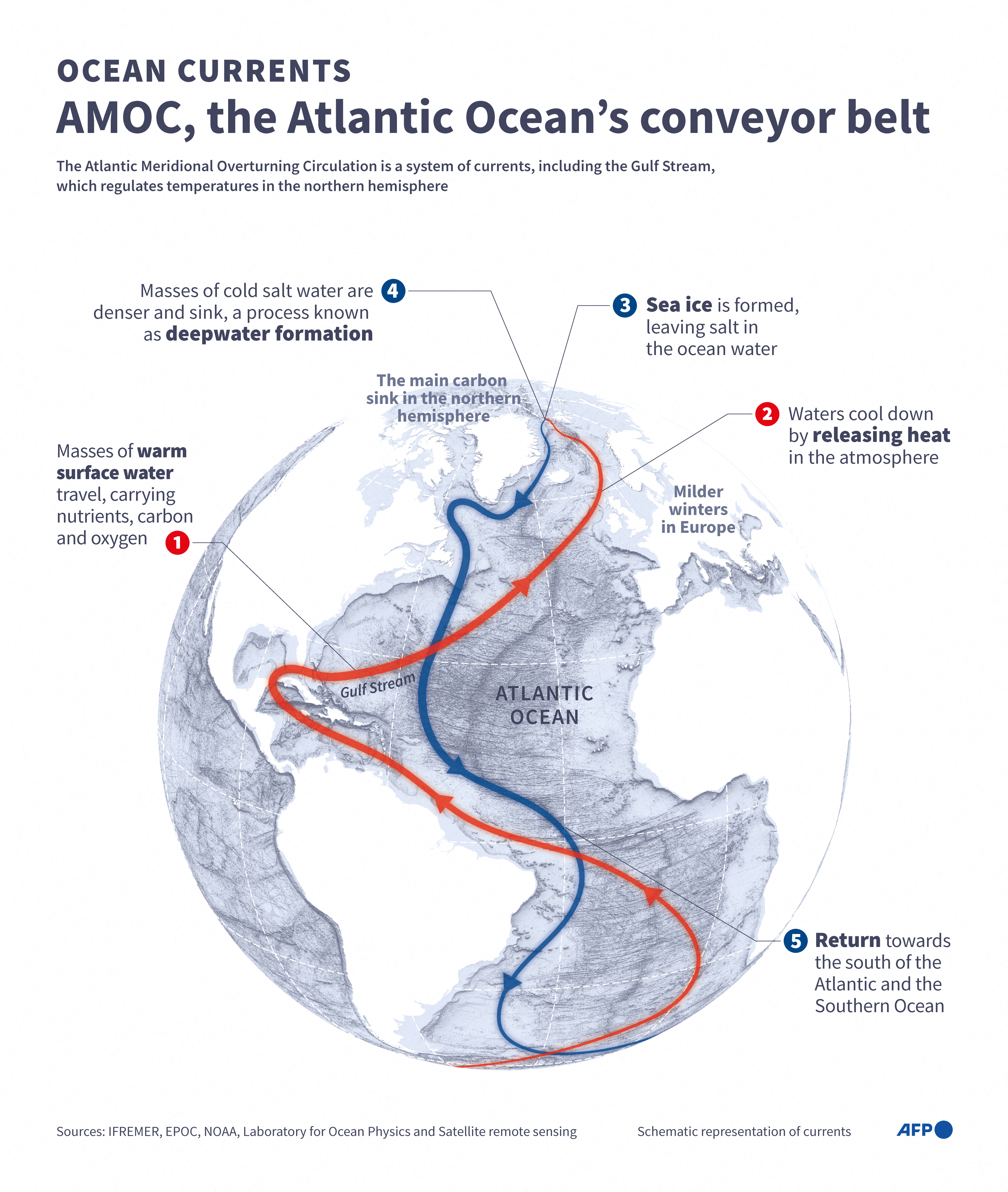
The AMOC is a conveyor belt of ocean currents.
(Image credit: Graphic by Nalini LEPETIT-CHELLA and Sabrina BLANCHARD / AFP via Getty Images)
Many researchers have posited that cooling in the blob is due to reduced ocean heat transport. In other words, slowing ocean currents are delivering less heat to that region, leading to a patch of cooling. However, some researchers have also suggested that the blob could be the result of increased heat loss at the ocean surface, according to the study.
RELATED STORIES
The authors of the study analyzed measurements of ocean heat content and surface flux changes in the blob region, based on data collected by Copernicus satellites and other sources. They concluded that the blob was a deep-reaching loss of ocean heat content and thus couldn't be explained by heat changes at the surface. Rather, their findings support the theory that the blob is caused by changes in ocean heat transport and the AMOC, a conclusion backed by a previous study published in 2025 in the journal Communications Earth & Environment.
"Our analysis supports the interpretation of the observed "cold blob" as a sign of a weakening AMOC," the authors wrote.
There are still uncertainties surrounding the cold blob and the weakening AMOC, with work ongoing to better understand these phenomena. Meanwhile, the Trump administration is set to remove 900 deep-sea monitoring instruments from the Atlantic and Pacific Oceans, which include sensors that would have kept tabs on the AMOC.
 Patrick Pester
Trending News Writer
Patrick Pester is the trending news writer at Live Science. His work has appeared on other science websites, such as BBC Science Focus and Scientific American. Patrick retrained as a journalist after spending his early career working in zoos and wildlife conservation. He was awarded the Master's Excellence Scholarship to study at Cardiff University where he completed a master's degree in international journalism. He also has a second master's degree in biodiversity, evolution and conservation in action from Middlesex University London. When he isn't writing news, Patrick investigates the sale of human remains.
View More
You must confirm your public display name before commenting
Please logout and then login again, you will then be prompted to enter your display name.
Logout