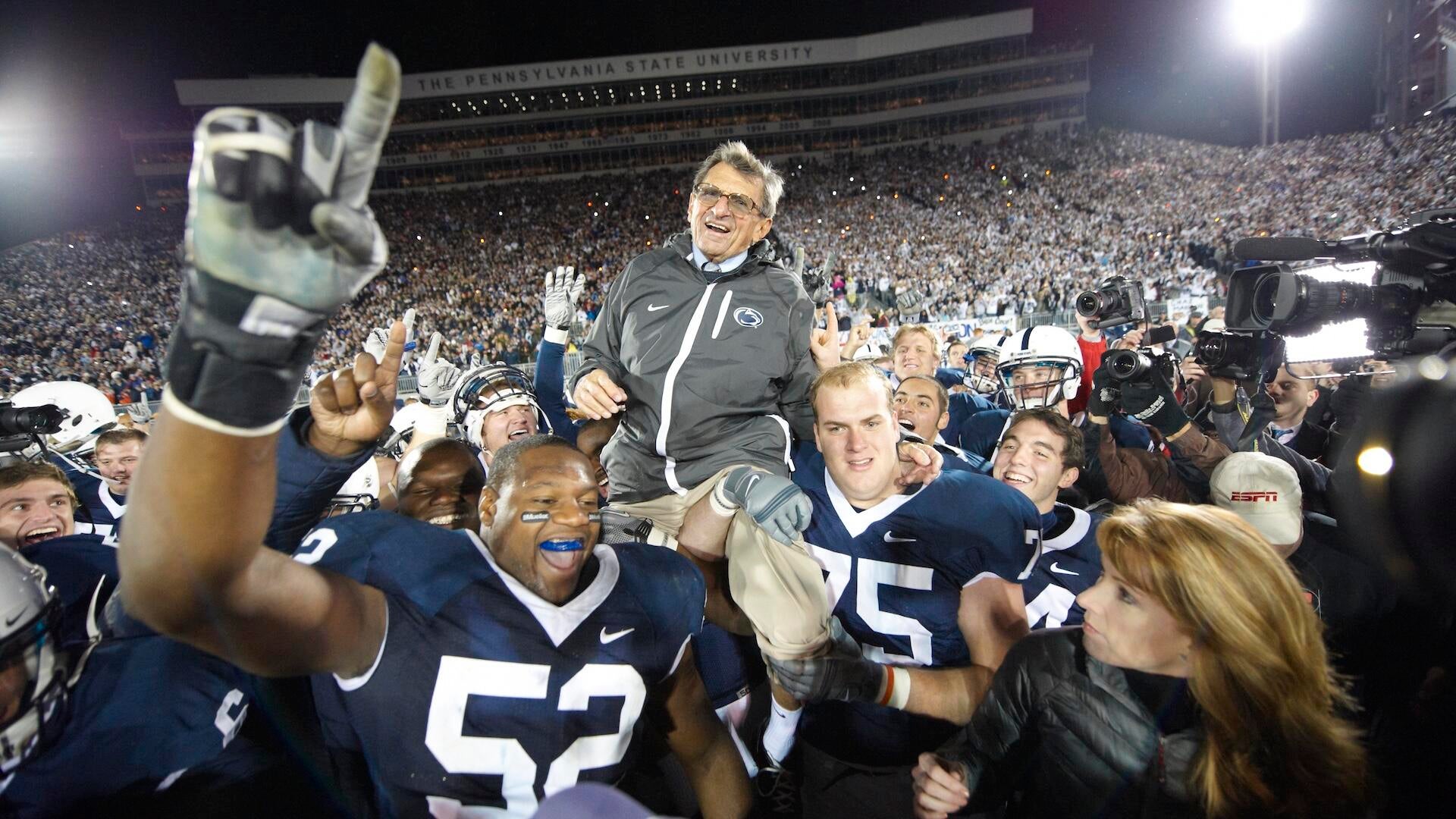
For years, Joe Paterno has been a live wire for Penn State's football program. But times have changed, and the surest sign of a new era in State College has been the incremental official reintegration of Paterno in increasingly more prominent ways.
New coach Matt Campbell's playbook is clear, with several not-so-subtle homages to Paterno. Campbell continually states that he's honoring the past and just trying to focus on football. He's been inviting back former Nittany Lions players from decades past over his first few months on the job, a common tactic by new coaches. But acknowledging Penn State's significant football history is impossible to do without directly acknowledging Paterno, and that is difficult without acknowledging how his tenure ended.
Paterno was fired in 2011 in the wake of the Jerry Sandusky child sexual abuse scandal after 62 total seasons coaching at Penn State. An independent investigation in 2012 overseen by a former FBI director found that Paterno knew as early as 1998 that there were concerns about Sandusky's conduct with children and that administrators, as well as Paterno, "failed to protect against a child sexual predator harming children for over a decade."
What came after
Bill O'Brien took over in 2012, and under heavy sanctions, including scholarship reduction and postseason bans, coached the Nittany Lions for two seasons and then left in a blaze of glory with blunt frustration regarding part of the Penn State fanbase he felt was still loyal to Paterno (specifically, O'Brien was responding to criticism he had fired one of Paterno's last remaining holdover assistant coaches):
"You can print this: You can print that I don't really give a [expletive] what the 'Paterno people' think about what I do with this program. I've done everything I can to show respect to Coach Paterno. Everything in my power. So I could really care less about what the Paterno faction of people, or whatever you call them, think about what I do with the program. I'm tired of it.
"For any 'Paterno person' to have any objection to what I'm doing, it makes me wanna put my fist through this windshield right now."
James Franklin largely held that faction at arm's length as he went about the work of modernizing the program and leading it to the ceiling of success he never truly was able to break through, and eventually got him ousted from the job at the end of 2025. In some ways, he was able to do so because he had so much success, but eventually, his rope ran out.
But as Terry Smith campaigned for the permanent job after being named interim late last season, direct associations with Paterno became more blatant. Smith wore a 409 pin to honor Paterno, whom he played for at Penn State. It signified the number of wins Paterno won while in charge, which was an NCAA record that the organization stripped from Paterno, then posthumously restored, and is a catch-all rallying cry for Paterno supporters. It was a clear appeal to some of those so-called Paterno people in order to lobby support to get the permanent job.
What Campbell has changed at PSU
Instead, Matt Campbell was hired, and with him arrived the most visible school associations to Paterno yet (Campbell retained Smith on staff).
It starts with the last thing the Nittany Lions see before they take the field at home.
For years under Franklin, Penn State ran out of the tunnel at Beaver Stadium under a blue banner with a clear message: "1-0." That has changed under Campbell, and the sign now reads "success with honor," a famous core philosophy of Paterno. Campbell addressed it this week.
"I'm not a big slogan guy, I don't have a lot of great slogans, but one thing I know is to continue to pay honor to what's come before us," Campbell told reporters. "When you talk to these former players and the guys that have come through here, what that value system has meant to this program, that I just felt in absolute alignment with that value, and I think it means exactly what it should mean here at Penn State."
In Penn State's season-opening win over Marshall, Campbell wore black shoes with white laces. To many, it may seem innocuous, but it matters at Penn State -- it was another Paterno calling card. Campbell was asked about it on his radio show days later.
"I don't know if I selected them, but I think somebody said, 'What do you think of these?' Obviously, I know the history of this place and what those white laces mean," he said.
And high above Campbell, the sign for Beaver Stadium's section 409 was highlighted in blue anew.
Coinciding with all of this is the opening of a Paterno family experience room inside Penn State's all-sports museum, which is itself inside Beaver Stadium. The project, which was in the works for two years before Campbell's arrival, was largely funded by an anonymous donor who, in a school press release, said he gave a gift "supporting the creation and naming" of the room. It features, among other things, an exhibit immortalizing Paterno's desk with personal artifacts.
Paterno's specter is inescapable for Penn State, and the school has tried to toe the line before.
There was a petition signed by over 15,000 Penn State fans that hung in downtown State College by a local organization in 2014 in support of restoring Paterno's wins to him. In 2014, a one-second shot of Paterno returned to the Beaver Stadium pregame hype video. In 2022, displays of his black shoes returned to Beaver Stadium.
The night Paterno had the wins restored in 2015, the hockey team wore 409 decals on their helmets, leading then-AD Sandy Barbour to apologize on social media, writing that the helmet decals were "inappropriate and insensitive." Plans for the men's basketball team to do something similar were quickly scrapped.
Joe's widow, Sue, still lives minutes from campus in State College. She recently spoke to the team during preseason camp. Their son, Jay, has been on the board of trustees since 2017 and is a backer of his father's legacy. Keepsakes can be found at Paterno's gravesite in a local cemetery. "409" bumper stickers can be seen on cars around town.
Eventually, Penn State will have to address the largest unresolved Paterno legacy issue: When and if it will return the life-sized bronze statue of Paterno that stood outside Beaver Stadium for over a decade. It was removed weeks after Louis J. Freeh's report was released in 2012. It's currently at a "secure location," but one wonders if the incremental restoration of Paterno's legacy by official channels will culminate with putting the statue back somewhere, if even just in the new exhibit that bears his family name.
The distance of time does increase the palatability of Paterno's legacy restoration for some. The vast majority of Penn State students, for instance, were in elementary school when Paterno's career and life ended.
Campbell, like Smith before him, will attempt to invoke Paterno by trying to stick to the understandable desire to honor the history of a storied football program. The tension will always lie between those two things. What his teams did was often legendary, and what one of his assistants did was deeply monstrous. Paterno's culpability will always be the subject of deep debate.
To acknowledge Paterno as a football coach is to decide how much cognitive dissonance one can muster. Some will justifiably always feel that blackballing him is the right thing to do in support of the victims of Sandusky's crimes, committed by a man who many feel was at the very least enabled by Paterno. Others will feel that there's a time-served element to slowly reintegrating him.
Some want to see football as just a sport that ends when you cross the white lines, while others, including Paterno himself, saw its holistic impact on society via a kingdom built in a central Pennsylvania town. For decades, he ruled it. Fourteen years later, Penn State is still reckoning with how to honor him.
Add CBS Sports on Google Join the Conversation comments