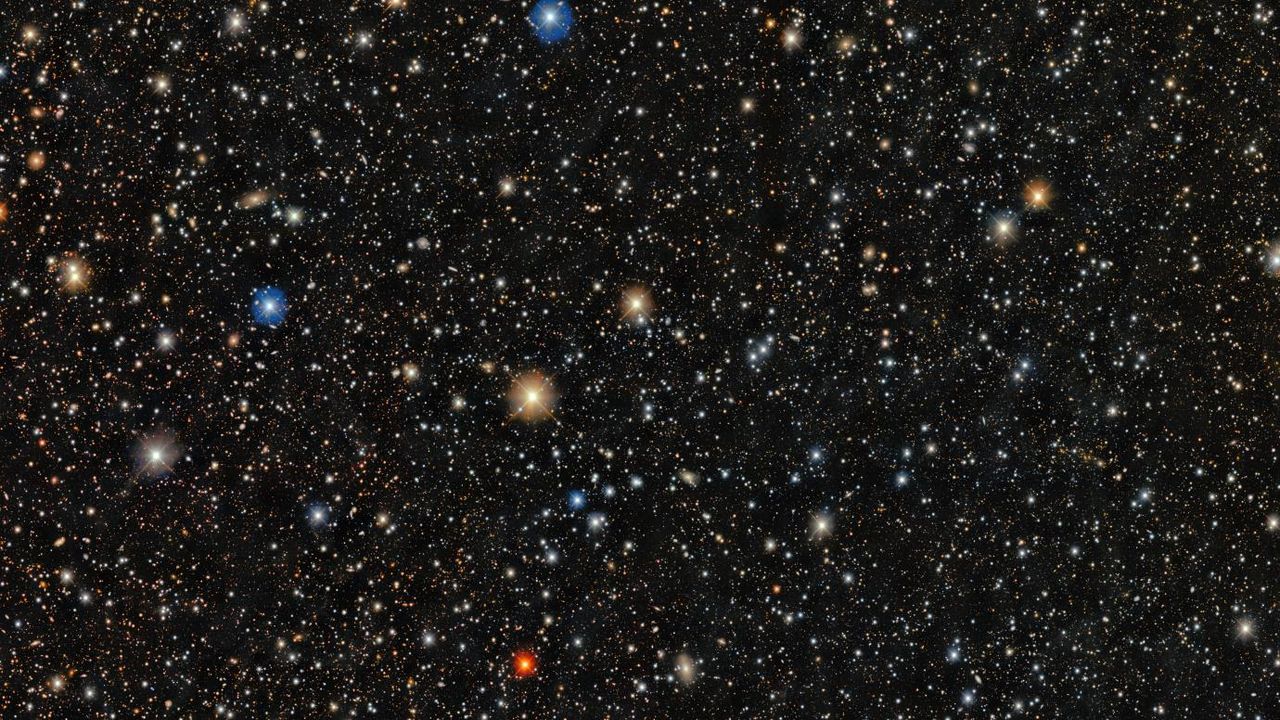
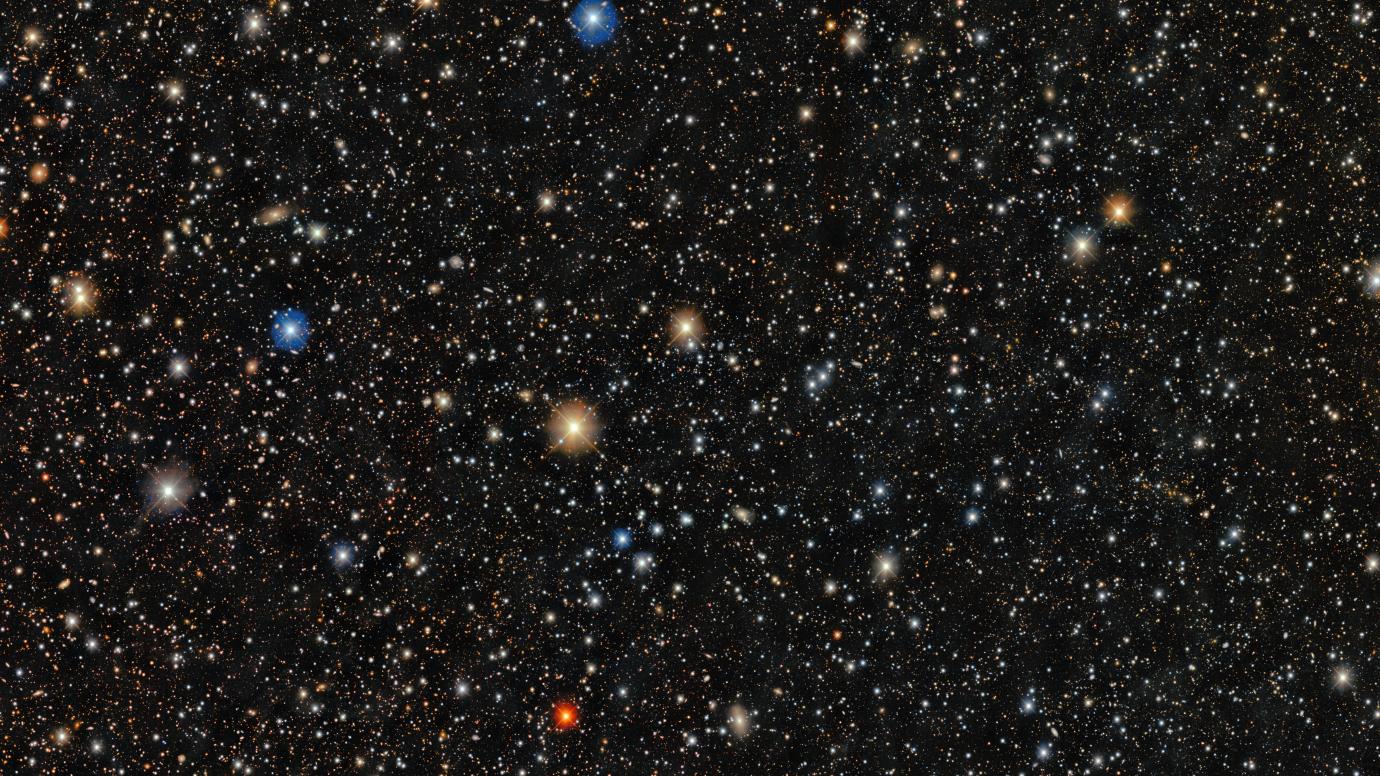
 Stars in the dwarf galaxy Pictor II, which is more than 10 billion years old. (Image credit: CTIO/NOIRLab/DOE/NSF/AURA) Share this article 0 Join the conversation Follow us Add us as a preferred source on Google Newsletter Get the Live Science Newsletter
 Get the world’s most fascinating discoveries delivered straight to your inbox.
Become a Member in Seconds
Unlock instant access to exclusive member features.
Contact me with news and offers from other Future brands Receive email from us on behalf of our trusted partners or sponsors By submitting your information you agree to the Terms & Conditions and Privacy Policy and are aged 16 or over.You are now subscribed
Your newsletter sign-up was successful
Want to add more newsletters?
Join the club
Get full access to premium articles, exclusive features and a growing list of member rewards.
Explore An account already exists for this email address, please log in. Subscribe to our newsletter Quick FactsWhat it is: Star PicII-503 inside the Pictor II dwarf galaxy
Where it is: 150,000 light-years from Earth in the Pictor constellation
When it was shared: March 16, 2026
This gorgeous snap, taken by the Dark Energy Camera (DECam) mounted atop the Víctor M. Blanco 4-meter (13 feet) Telescope in Chile, shows a glistening field of stars inside the dwarf galaxy Pictor II, which is more than 10 billion years old.
Population II stars formed when the cosmos was young and stars had yet to fuse heavier elements into existence, meaning they are composed primarily of hydrogen and helium. This means that PicII-503 has roughly only 1-40,000th of the iron contained within our much younger sun.
Article continues belowBut what the star lacks in iron it makes up for in carbon. Like many Pop II stars, PicII-503 is unusually rich in the stuff, having a carbon-to-iron ratio that's more than 1,500 times the ratio in the sun, researchers said in a statement.
PicII-503's location inside Pictor II (Image credit: CTIO/NOIRLab/DOE/NSF/AURA Image processing: Image Processing: T.A. Rector (University of Alaska Anchorage/NSF NOIRLab), M. Zamani & D. de Martin (NSF NOIRLab) Acknowledgment: PI: Anirudh Chiti, Alex Drlica-Wagner)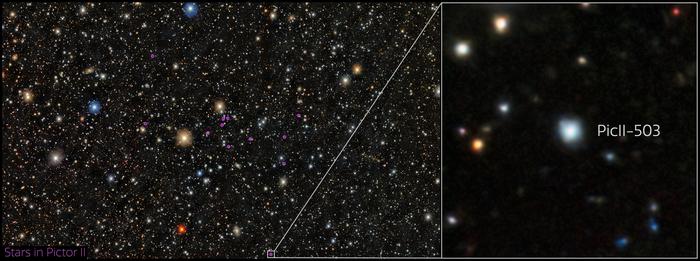
Astronomers have proposed many theories why this may be the case but because many Pop II stars are spotted after they've migrated away from their birthplaces, these suggestions have been hard to verify.
But PicII-503 is still located within its primordial dwarf galaxy, so astronomers acted as "stellar archeologists," using the star’s composition to test their theories. The star’s carbon-rich makeup lends credence to an idea that, during the violent supernova explosion at the end of a star’s life, lightweight carbon in the star’s outer shell is flung farther away than other elements.
That could also explain why carbon ends up everywhere in the universe, making it an extremely suitable element to act as the key building block for life.
Sign up for the Live Science daily newsletter nowContact me with news and offers from other Future brandsReceive email from us on behalf of our trusted partners or sponsorsSee more Space Photos of the Week
 Hubble sees Egg Nebula 'hatch'
The closest baby nebula to Earth was caught spitting up its stardust.
 Hidden structure in 1st Vera Rubin image
First-light images from the Vera C. Rubin Observatory reveal a 163,000-light-year stream of stars emanating from a nearby galaxy.
 JWST peeps the 'Eye of God'
A spectacular James Webb telescope image reveals intricate structures inside the Helix Nebula.
TOPICS Ben TurnerActing Trending News Editor
Ben Turner is a U.K. based writer and editor at Live Science. He covers physics and astronomy, tech and climate change. He graduated from University College London with a degree in particle physics before training as a journalist. When he's not writing, Ben enjoys reading literature, playing the guitar and embarrassing himself with chess.
View MoreYou must confirm your public display name before commenting
Please logout and then login again, you will then be prompted to enter your display name.
Logout LATEST ARTICLES 1Why do animals have different pupil shapes?
- 2Physicists created an electron 'catapult' that moves particles at 'extraordinary' speed
- 3Computing quiz: Can you match these 'ancient' devices to their pictures?
- 4Super El Niño looms, an Acropolis fragment resurfaces, a promising cure for Alzheimer's appears, and a hexagonal diamond is made
- 5'That's why there's 9 billion of us and not 9 billion of some other primate': Why our ability to adapt is humanity's 'superpower'