

 Shari VahlScam Secrets presenter
 BBC
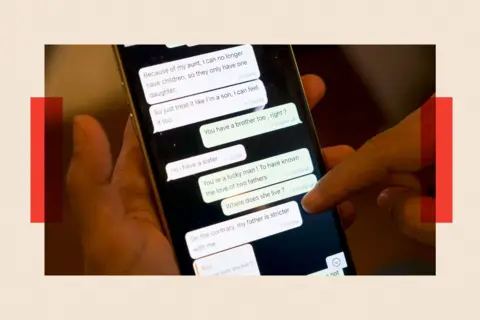
BBCIn 2024, Kirsty, a woman in her 40s living in North Yorkshire, met a man on a dating website who said he was an English businessman working in Turkey.
He shared a picture that he claimed was of himself showing his chiselled abs on the beach and claimed to be financially secure. He even used a banking website to persuade her he had $600,000 (£443,600) in savings.
But after two weeks of chatting, he said he'd been mugged and his phone and computer had been stolen, and he asked her to buy him a phone and to pay some bills for him with her money. What happened next perfectly illustrates the international web that scammers weave.
Kirsty bought a phone in the UK and posted it to a block of flats in northern Cyprus, where the man told her he was visiting for work, and bit by bit over a period of two months she transferred £80,000 from her bank account. She'd borrowed £50,000 of it from her family, in the belief the man she loved was in trouble. All on his promise he'd pay her back as soon as he could get back into his bank account.
But in fact the phone ended up in Lagos, Nigeria, and the £80,000 went to people with Nigerian, Romanian and other European names via money transfer services. The man was not British, but Nigerian, using a voice disguiser to deceive his target.
Even the banking website he had shown Kirsty shortly after meeting her turned out to be a very sophisticated fake registered in the US city of Baltimore.
 Thousands of people are duped into handing over personal information and money in the UK every year
Kirsty is just one victim of what experts say has been a surge in scams since the Covid lockdowns of the early 2020s. Global fraud losses are now over half a trillion dollars a year, according to the Global Anti-Scam Alliance.
Reports of romance scams such as Kirsty's rose by 20% in the first quarter year on year between 2024 and 2025, according to Barclays, with City of London police saying £106m was lost in the UK in 2024 alone to scams like the one Kirsty fell prey to.
Kirsty's story is also an example of the increasingly internationalised nature of scamming and with the costs adding up, governments and companies are pushing for international cooperation to stop the scammers.
For the first time, a joint agreement has been signed between nations to combat scamming. But criminal techniques are becoming increasingly sophisticated and they often originate from parts of the world where the authorities struggle to operate.
And so the question is whether there is really much countries can do to turn the tables on the scammers and prevent many more people like Kirsty being conned out of their savings?
The Covid boom
Scams are usually defined as an attempt by an individual, be it by text, on the phone or email, to get you to do something which will ultimately see you losing money, or your data. I've spent two decades investigating fraud for the BBC and while scams come in every flavour, ultimately they're all the same – someone lying to you to get you to send money.
Fraud is the most common crime in the UK, accounting for more than 40% of crimes against individuals. The UK government says 70% of scams come from overseas, and they're usually through criminal gangs.
As governments across the world restricted the movements of their citizens during Covid lockdowns from 2020, people spent more time online. We bought more online and socialised more online, and this brought us closer to the people who want to scam us. At the same time, realistic video impersonations, voices, websites, and texts became more commonplace, and scammers increased their use of social media including WhatsApp.
Meanwhile, global layoffs created a new labour force that could be recruited by criminal networks, says Ilias Chatzis, acting head of the UN Office on Drugs and Crime. The criminal networks are very hard to crack.
"Some of these scams are in almost lawless areas or in areas which are controlled by armed gangs… that the governments may have very little control over."
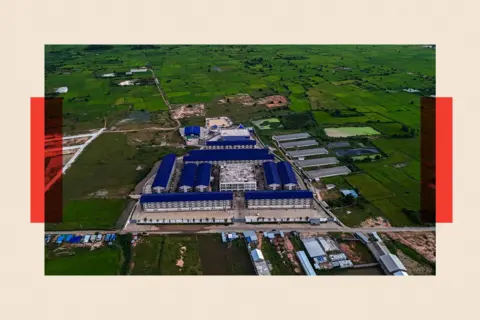 ReutersThis scam compound in Cambodia is one of a number that have been identified in South East Asia
Myanmar is one country that has become notorious for its scam centres. These have their roots in the 1990s, when illegal casinos were set up. These were cracked down on, but during the pandemic these buildings were increasingly used as the operational hubs for scams. When the military junta seized power in 2021, the civil war that ensued helped criminals capitalise on the chaos within the country and scam centres flourished.
Victims creating victims
There's also another complicating factor - that the scammer could be a victim too. Bogus job adverts lure people overseas who can't find work in their home country. They are trafficked to scamming centres, where they are trapped and forced to steal people's money for their criminal bosses.
The BBC recently visited a massive vacated scam compound in a Cambodian town that people had fled after being shelled during a border dispute between Thailand and Cambodia.
The scam centre revealed desperate living and working conditions. The walls of one of the rooms in the centre were painted with motivational messages, such as "Money Coming From Everywhere" in Chinese letters.
Records showing when 'employees' went to the lavatory and how long they took were found, along with fake police uniforms and counterfeit police summons, which were designed to scare people into handing over their money.
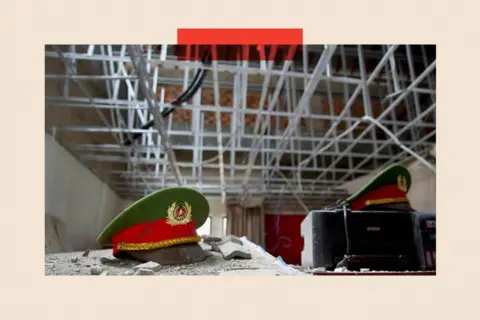 LULU LUO/BBCBogus police uniforms were found in the scam compound the BBC visited
Conning people into going to the scam centres is a scam in itself. The victim will be met at the airport, convinced they are on their way to a new job as a teacher or a customer service agent. "Everything looks normal - until they are in the compound, and they're totally in the hands of the traffickers," Chatzis says. "From then on, the nightmare starts. Passports are taken away."
The people inside these scam compounds are forced to work long, hard shifts, with targets to bring in a certain amount of money from defrauding victims around the world. Failure to hit these targets can mean solitary confinement, beatings or the threat of being moved to a different compound where conditions are even worse.
Chatzis points out that for every victim in the UK, "there may be another victim on the other side that has been forced to commit this scam".
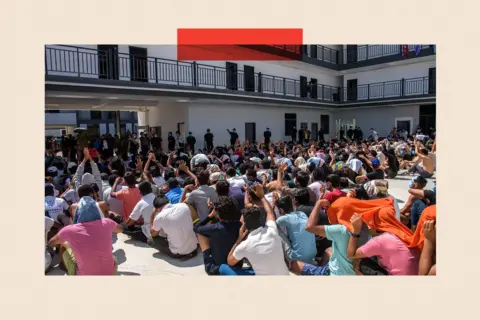 ReutersTrafficked scam centre victims in Myanmar are stuck in limbo after being freed
It isn't only South East Asia - scam centres also flourishing in countries such as India and the UAE.
Some scam farms act as legitimate businesses during the day and scam centres by night. For example, in north-east India, legal call centres become scam centres by night, with the scammers taking advantage of the time difference to target people in the UK, the US and Australia, because the common language is English.
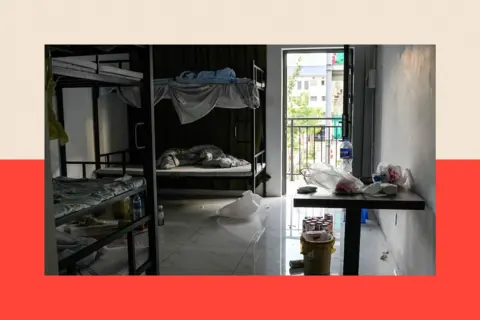 ReutersThe living conditions in the scam centres are often very bad
Nick Court, a former City of London police officer who is now the head of Interpol's financial crime and anti-corruption centre, says people from wealthy nations need to understand the reality overseas.
He describes them as "lawless areas where law enforcement officers cannot enter, except with huge military escorts, where the pay is low and the benefits of being involved in fraud are incredibly high."
Tackling the scammers
At the Global Fraud Summit in Vienna, organised by the United Nations and Interpol last month, there were 1,400 guests including governments, from the UK to China, and the biggest tech companies in the world.
Gatherings like this have been taking place since 2024, but I could see this was clearly much bigger. Government ministers, tech giants and law enforcement were all there and for the first time a joint agreement was signed between some nations at the end.
The summit saw 44 countries out of 120 represented signing a pledge committing to "disrupting fraud at the source and enhancing victim support". While it's hoped more will sign later, there are still many nations that have not committed to cooperation.
Wealthier nations in attendance – European nations, South Korea, Australia – are often the victims, and they have a greater interest in solving this matter.
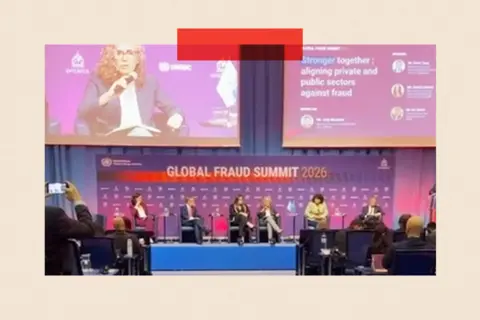 Much of the discussion at the Global Fraud Summit was about how to encourage better collaboration
Meanwhile developing nations, where many of the scam operations are based – especially Myanmar, West Africa and South Asia – are being asked to do more, often without the resources to do so.
It is a stark reminder of the imbalance: of criminals exploiting impoverished communities with opportunities to make money that they wouldn't otherwise have. And for some countries tackling things that are much more elemental to their own population's existence have to take precedence over worrying about financial crimes in wealthier countries.
What really caught my ear was Xolisile Khanyile, a financial crimes prosecutor from South Africa, outlining this tension. She argued that two-way collaboration was critical: if developing nations are to help destroy fraud networks, wealthier countries need to share their technical expertise and resources too.
She said in her experience, developed nations will complain about a lack of resources without understanding that fighting industrialised fraud needs "fit-for-purpose skills like your forensic accountants, experts on crypto, experts in open source investigations, so that we will be able to make a difference."
When I spoke to the UK's Fraud Minister, Lord Hanson of Flint, he told me punishing countries for refusing or failing to cooperate on tackling scams could be counterproductive. Instead, he said, the focus should be on "soft power".
"What I can do is try to get international cooperation to ensure that we have outcomes which support the making of fraud harder for criminals, make their costs harder, bring them to account, and if we can freeze any assets they're making from those fraudulent activities."
There is also the question of whether the authorities and big tech are working closely enough together. "It's long been my opinion that the big tech companies and social media giants need to be far more involved and at a far more operational level," says Steve Head, who is now retired but was previously the UK's first National Coordinator for Economic Crime. In 2014 he helped break up the so-called boiler room scams operating from Spain that tricked British people into investing in non-existent shares.
"It's these multifaceted international relationships with big business that we really need to be strengthening far more than we have," he adds.
Digital firms including Amazon and Meta were at the summit, signed the joint statement, and have stepped up their anti-scam protections. Dating platform Match.com has cracked down on fake accounts, and says it now removes 50 every minute.
Head says he learned laying the groundwork for successful action took time before any operational activity took place, and the same applies to cooperating with tech firms. "That's still about creating and demonstrating that mutual benefit, and it's about building trust between the partners and mutual respect."
Show me the money
It's not all doom and gloom. There were plenty of examples of successful operations at the Vienna summit.
Alex Wood, former fraudster and part of the BBC Scam Secrets team, heard a successful example of collaboration on a very small scale that could give inspiration for future operations.
"I was listening to someone from the German police in one of the sessions and he was explaining how a victim in Germany was defrauded and the money ended up in Hong Kong," he said. "He happened to have the mobile phone number for somebody at Interpol, phoned that person, the person at Interpol happened to have the mobile phone number for someone in Hong Kong, and they managed to stop the payments and get the money back."
More from InDepthWhy cheap power could matter more than clean power in the push for net zero
The surprising reality of how teenage girls still define themselves
China is winning one AI race, the US another - but either might pull ahead
Another example from Vienna was a Google representative saying it had worked with the Singaporean government to prevent 2.8 million "malicious apps" from being downloaded. Criminals were persuading people to "sideload" things like fake banking apps – downloading them from the internet rather than the official Android store.
Though many remain hopeful about the future of fighting scams, it's victims like Kirsty who resonate with me. As well as the money she transferred, she lost her faith in people.
With scammers increasingly fleet of foot, cross-border attempts to crack down on them will need to be swift too.
Top image credit: Getty Images

BBC InDepth is the home on the website and app for the best analysis, with fresh perspectives that challenge assumptions and deep reporting on the biggest issues of the day. Emma Barnett and John Simpson bring their pick of the most thought-provoking deep reads and analysis, every Saturday. Sign up for the newsletter here
MoneyCrimeUnited Nations