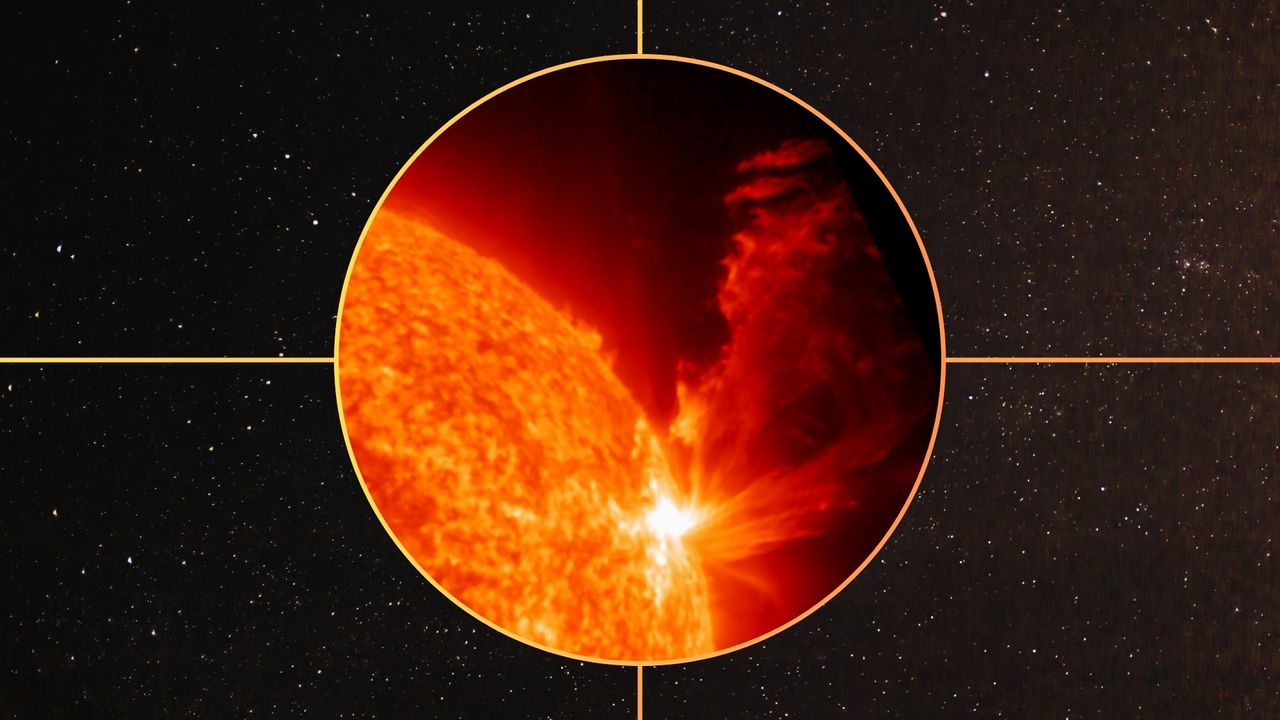
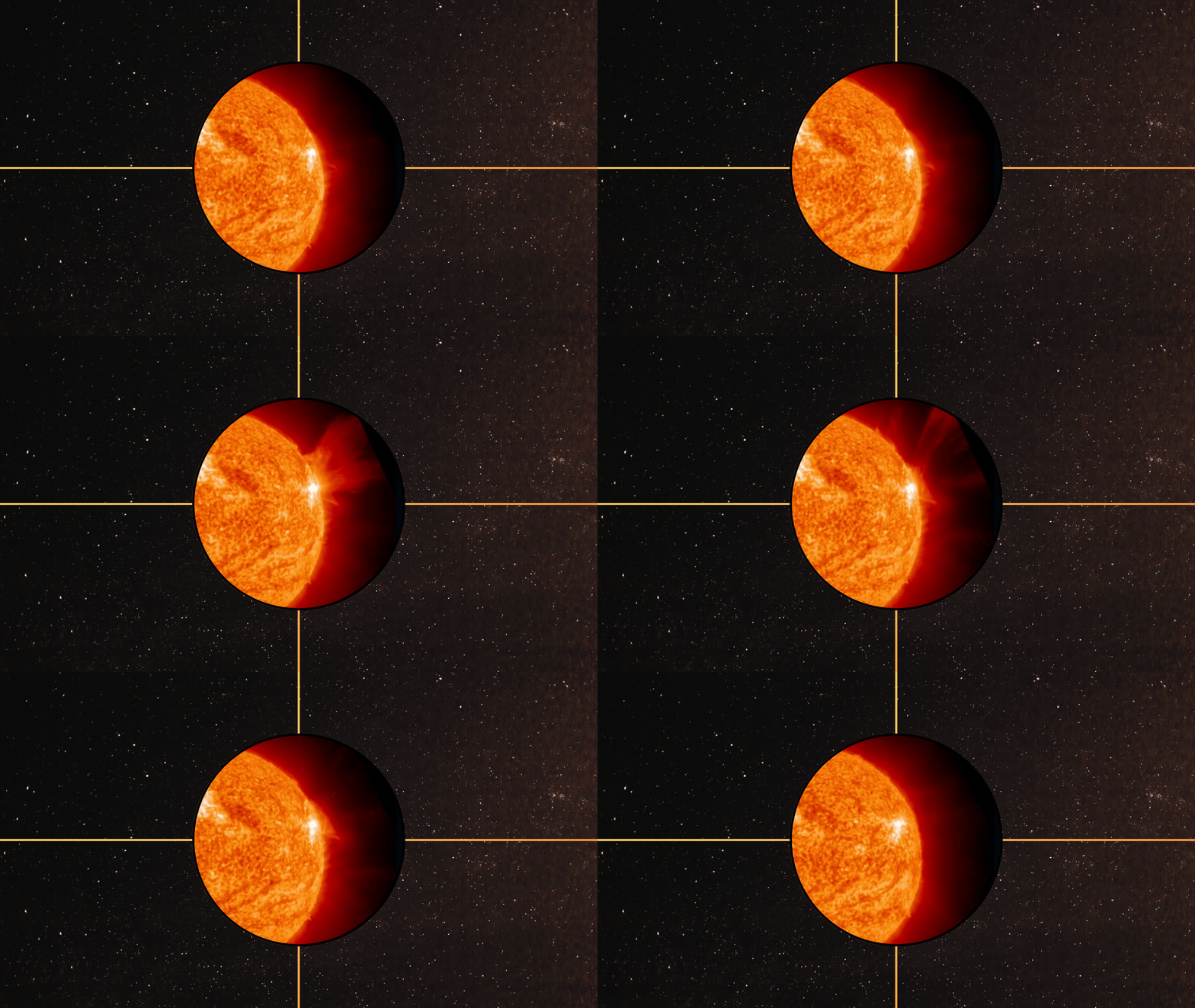
 The twin eruptions briefly disrupted radio signals across the dayside of Earth. (Image credit: Inset: NOAA GOES 19, graphic created in Canva Pro) Share this article 0 Join the conversation Follow us Add us as a preferred source on Google Newsletter Get the Space.com Newsletter
 Breaking space news, the latest updates on rocket launches, skywatching events and more!
Contact me with news and offers from other Future brands Receive email from us on behalf of our trusted partners or sponsors By submitting your information you agree to the Terms & Conditions and Privacy Policy and are aged 16 or over.You are now subscribed
Your newsletter sign-up was successful
Want to add more newsletters?
An account already exists for this email address, please log in. Subscribe to our newsletter The first X-flare peaked at 9:07 p.m. EDT on April 23 (0107 GMT April 24) (Image credit: NOAA GOES-19)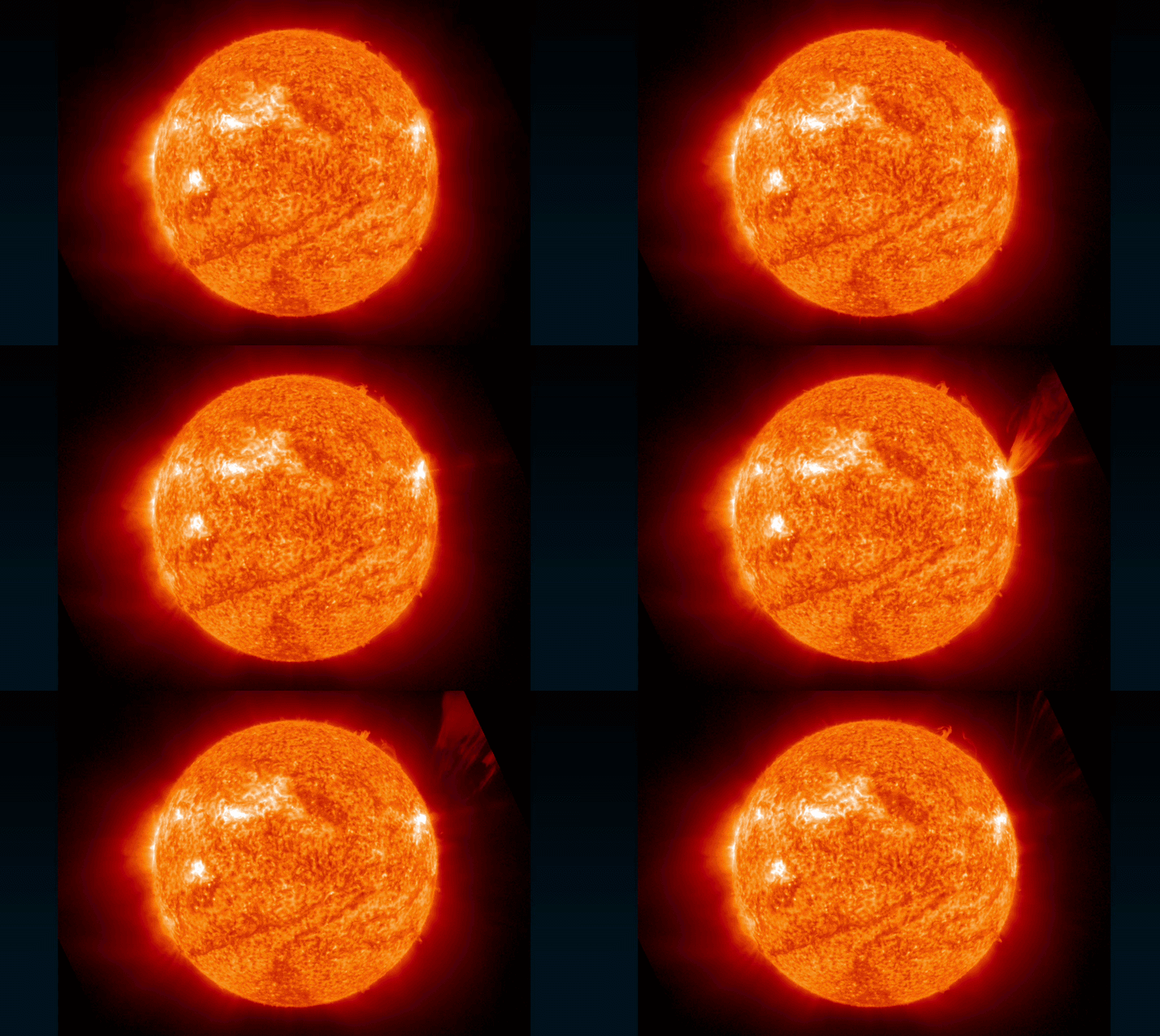
The sun has certainly woken up! It has fired off not one but two powerful X2.5 solar flares within just 7 hours.
The bursts of radiation from the flares triggered strong radio blackouts on the sunlit side of Earth — the first affecting parts of the Pacific Ocean and Australia and the second impacting East Asia.
The active sunspot region is putting on quite the show before it rotates out of view. The X-flares were preceded by a flurry of M-class solar flares on April 23, along with a rare "sympathetic flare" where eruptions occurred in two separate sunspot regions on opposite sides of the sun.
The second X-flare peaked at 4:14 a.m. EDT (0814 GMT). (Image credit: NOAA GOES-19)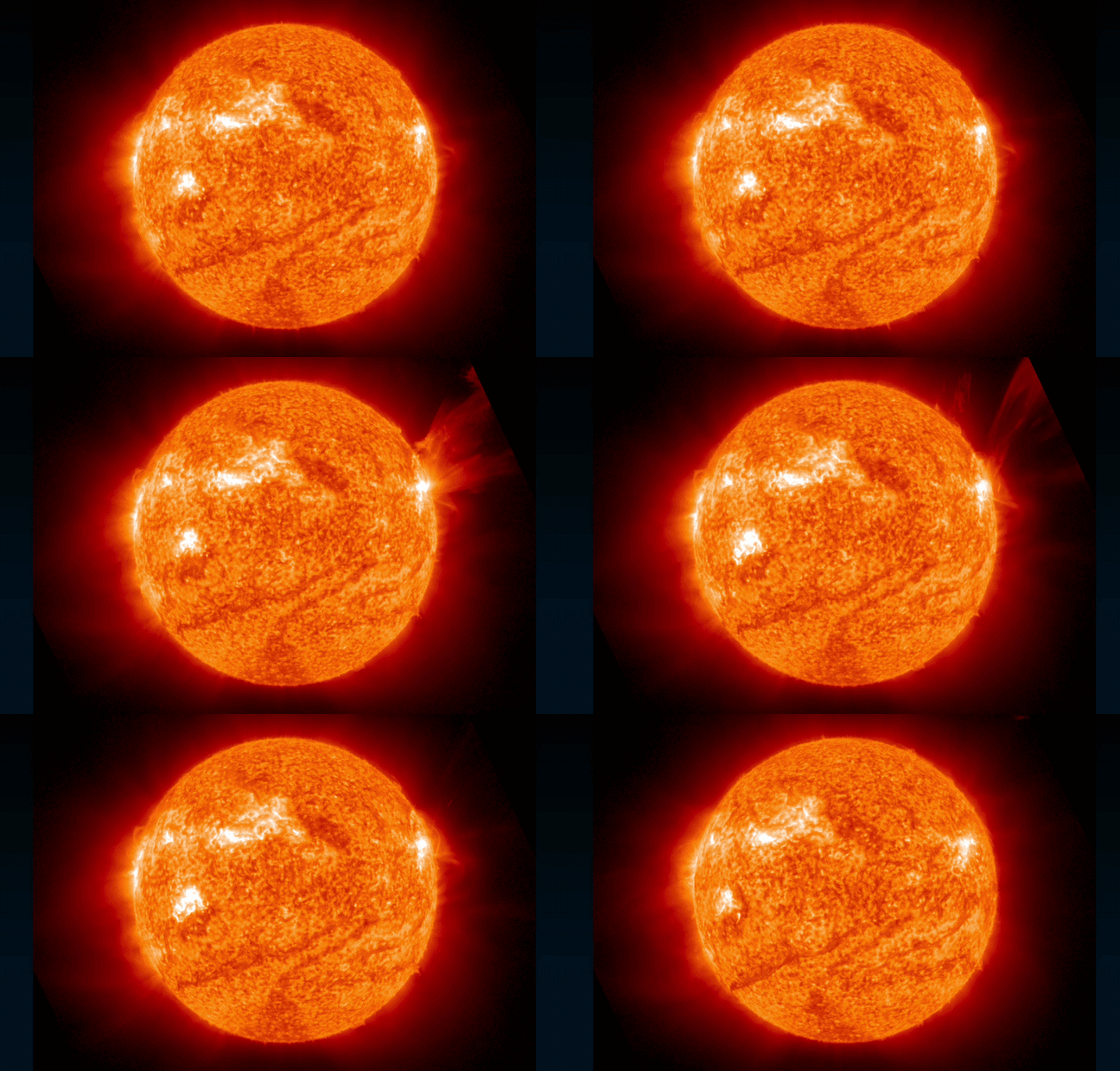
The X-flares appear to have been accompanied by coronal mass ejections (CMEs) — large expulsions of plasma and magnetic field from the sun. However, because the sunspot is positioned on the sun's western edge, it's unlikely these CMEs are heading directly toward Earth. That said, forecasters are still modelling their paths and a glancing blow remains possible. If that happens, it could trigger geomagnetic storm conditions and spark vivid aurora displays.
What are solar flares?
Solar flares are powerful explosions from the sun that release intense bursts of electromagnetic radiation at the speed of light, including X-rays and ultraviolet light.
They are classified by strength into five categories, A, B, C, M, and X, each letter representing a 10-fold increase in intensity, with X-flares being the most powerful.
How do they cause radio blackouts?
Image 1 of 2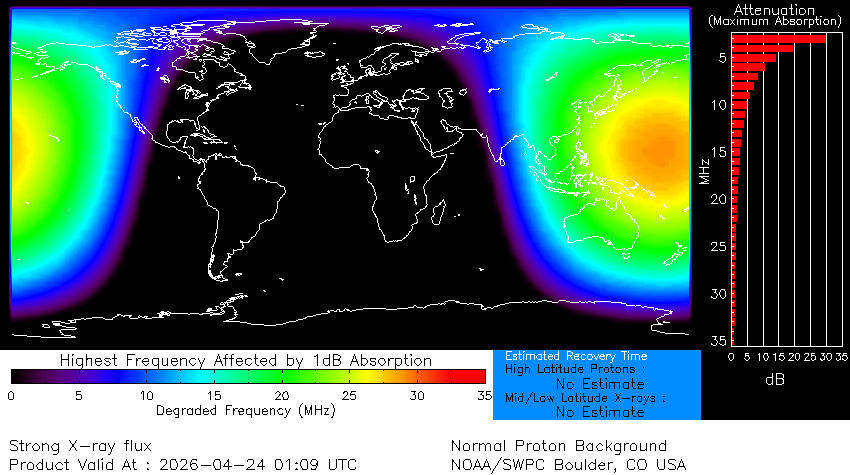 High-frequency radio blackouts from the first X-flare.(Image credit: NOAA Space Weather Prediction Center)
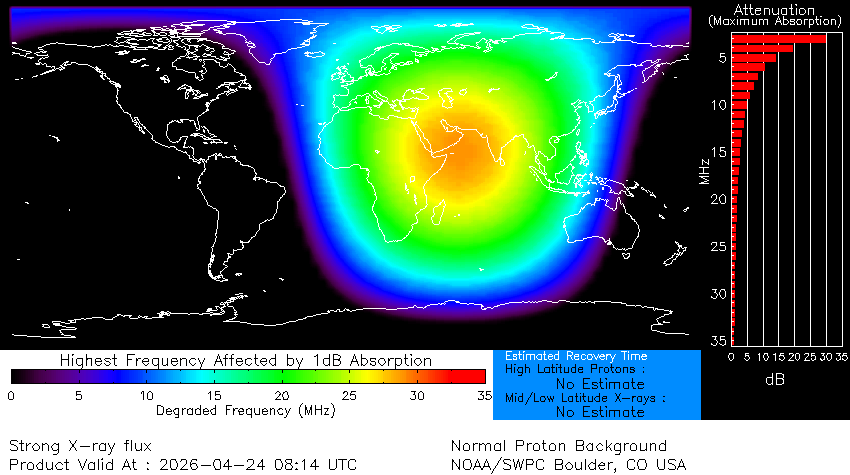 High-frequency radio blackouts from the second X-flare.(Image credit: NOAA Space Weather Prediction Center)
When radiation from a solar flare reaches Earth, it ionizes the upper atmosphere known as the ionosphere, which can disrupt shortwave radio communications.
Under normal conditions, high-frequency radio waves can travel long distances by bouncing off the upper layers in the ionosphere. But during a strong solar flare, the lower layers become much more ionized than usual.
This creates a denser environment where radio waves are more likely to collide with charged particles and lose energy. As a result, signals can weaken, become distorted or be completely absorbed, leading to shortwave radio blackouts according to NOAA.
 Daisy DobrijevicSkywatching Editor
Daisy Dobrijevic joined Space.com in February 2022, having previously worked as a staff writer for All About Space magazine. She completed an editorial internship with BBC Sky at Night Magazine and worked at the National Space Centre, communicating space science to the public.
Daisy holds a PhD in plant physiology and a Master's in Environmental Science. Based in Nottingham, U.K., she covers all things space, with a special focus on solar activity and space weather. She also has a keen interest in astrotourism and is always on the lookout for the next northern lights adventure.
She will be a guest speaker aboard HX's Solar Eclipse Expedition in August 2026 and will join Hurtigruten as an onboard astronomer for a northern lights sailing in January 2027.
View MoreYou must confirm your public display name before commenting
Please logout and then login again, you will then be prompted to enter your display name.
Logout MORE FROM SPACE...!["We'll keep [politics] out of your way so you can do your job."](https://cdn.mos.cms.futurecdn.net/sFddUtYAnAsDrcBoWVSb7Y.jpg) 1Ted Cruz pushes back on NASA budget cuts: 'I don't want to wake up one day and look up at the moon and realize the Chinese have beat us there'
1Ted Cruz pushes back on NASA budget cuts: 'I don't want to wake up one day and look up at the moon and realize the Chinese have beat us there'- 2Could 'The Mandalorian and Grogu' restore the 'Star Wars' spark? Watch the electrifying final trailer and decide if this is the way
- 3What will happen when our sun starts dying? These 'stellar archaeologists' may have found a clue
- 4These 'interstellar glaciers' could give water to young star systems. Could they support alien life, too?
- 5Ancient volcanic ash seen blowing across Mars in new spacecraft images