 Image source, Getty ImagesImage caption,
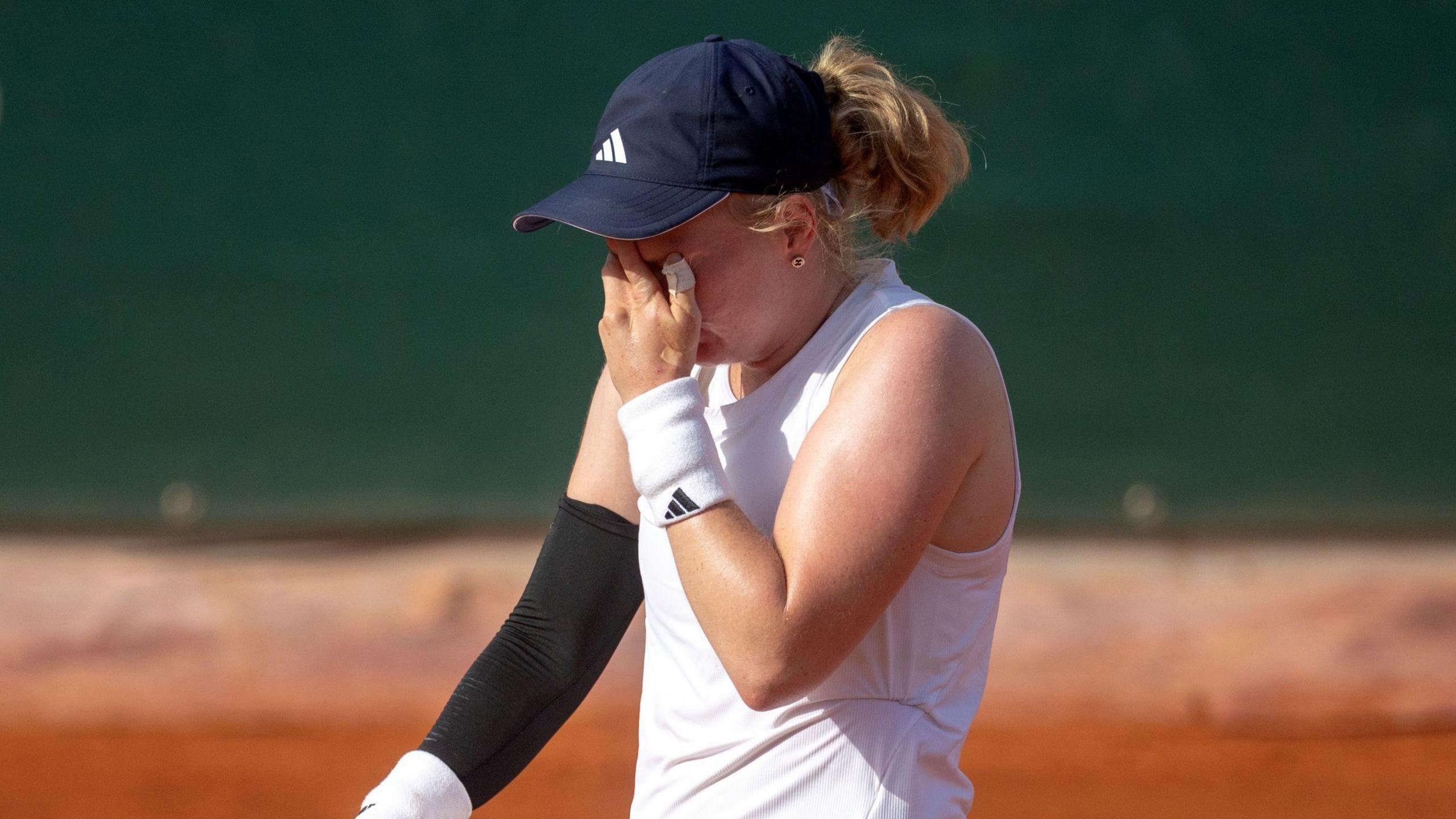
 Britain's Francesca Jones earned the biggest pay day of her career by winning a Grand Slam main-draw match for the first time in Paris
ByJonathan JurejkoBBC Sport tennis news reporter- Published48 minutes ago
Solo travelling, sleeping in a transit van and sharing rooms are all money-saving tricks used by lower-ranked players over the years.
It is one of the reasons tennis' top players say they protested about pay at the French Open - to drive change for the good of the game.
A group of top-10 players - including Aryna Sabalenka, Coco Gauff and Jannik Sinner - are demanding the four Grand Slams give a larger chunk of their revenue in prize money.
Sabalenka insists the aim is not to make themselves wealthier but to "stand up and fight" for lower-ranked players.
"There's not enough money for players on tour," said Britain's world number 105 Francesca Jones.
"Where that funding should come from is not for me to say. But we don't earn enough.
"You don't break even unless you're in the top 75 and even then it is tight."
Anna-Lena Friedsam, who reached the top 50 in singles in 2016 but has spent most of the past three seasons outside the top 100, agrees.
"It is a tough industry. Our whole year is based on how much money we make in the Grand Slams," the German told BBC Sport.
"I'm glad the top players are speaking and taking care of this important issue. Us lower-ranked players don't have the same platform."
How are French Open stars coping with Paris 'heat dome'?
- Published18 hours ago
'I need to win £300k a season to break even'
For most players, it is simple: more winnings means more support.
Britain's Toby Samuel earned £75,000 in Paris after coming through qualifying to reach a Grand Slam main draw for the first time. That is enough to fund the rest of his season.
"These events are where you make real money that can boost your career and pay for your team," Samuel said.
"As you do better at Grand Slams and get more money, everything off the court becomes a bit easier and helps you on the court."
Hiring a coach on a full-time basis, alongside a physiotherapist or fitness trainer, makes up the bulk of outgoings.
"It all costs a lot of money. I feel that a lot of people outside tennis don't really understand that," said Australia's Rinky Hijikata, who remembers not eating proper meals to save cash.
"To invest back into your own game takes a lot of money and effort."
Friedsam estimates that she needs to win about £300,000 a season to break even.
If she does not bring in enough cash, she will go to the next tournament without a coach.
The global nature of tennis means constant international travel, and for players coming from more remote areas, funding flights is even more difficult.
Bolivia's Juan Carlos Prado Angelo, who reached his first Grand Slam main draw at Roland Garros, says affording travel is "very difficult for every player" from South America.
The 21-year-old has an added complication. Coming from a country with a lack of tennis pedigree, he has had to go outside Bolivia to find the professional expertise he needs.
"I live in Bolivia and all my team - except for my coach - are from Argentina," Prado Angelo said.
"I train half in Buenos Aires and half in Bolivia, so I have to pay to take them to Bolivia and then I need to travel to Argentina. It's expensive."
Australia's Tristan Schoolkate, like many players of a similar singles ranking, usually travels economy on long-haul flights in order to save cash.
"The travel does cost a lot. I can't wrap my head around the prices to fly business," the world number 123 said.
"If there is a need, like I'm playing the next day, then it is a consideration. But it comes out of my own pocket and makes the expenses very high."
Finding somewhere to sleep - without paying a fortune - is another challenge when you are not consistently making the Slam main draws.
Samuel used to bunk up with his coach. Qualifying for the Roland Garros first round meant he was finally able to pay for separate rooms.
Another Briton, Billy Harris, travelled around the lower rungs of the circuit sleeping in his Transit van for three-and-a-half years.
"I had a bed in the back, was cooking on the roadside and parking up in McDonald's car parks," he told BBC Sport in 2023.
Jones reached a career-high of 65 in January and has £890,000 in career earnings, but says she still struggles to make ends meet.
The 25-year-old has a rare genetic condition and doctors said she would never play professionally. Jones acknowledges her physical struggles mean she spends more money than most players of a similar ranking because she needs a larger team around her.
Speaking before earning at least £75,000 by winning a Grand Slam main-draw match for the first time, Jones said: "I wouldn't say there's been a significant profit for me.
"Unless I get back to the ranking I was at the start of this year, breaking even is not going to happen."
Why tennis' stars want pay to rise
The current generation of players have decided now is the time to act on a disagreement that has festered for much of the past two decades.
Last year, the Professional Tennis Players' Association (PTPA) began legal action - which it said was "on behalf of the entire player population" - against the governing bodies.
It accused tennis' governing bodies in the US, the UK and the EU of "horizontal price-fixing" their prize money, saying what the players earn "lags far behind" other athletes.
Both the ATP and the WTA Tour have defended their position, pointing to the prize money and security they offer.
Last year, a group of top-10 players - represented by former WTA chief Larry Scott - opened talks with the Grand Slams to demand a greater share of prize money.
The Grand Slams have strongly defended what they stump up - around 15% of their revenue on average - and also point to the state-of-the-art facilities they provide.
The leading players want nearer 22% by 2030 and limited their pre-French Open media commitments to 15 minutes in protest at the money on offer.
Further talks will be held in Paris next week.
"We've been talking about this for how many years now? Nothing has moved," said 2018 US Open champion Sloane Stephens, a former long-time member of the WTA players' council, now ranked 363rd.
"We know we are fortunate to make a lot of money and travel the world, but I think compared to other sports it is unfair."
The money trickling down the Slam draws has increased significantly in recent years.
Hijikata says he feels more financially secure after spending a couple of seasons inside the top 100.
"I guess doing things to save a few bucks here and there is all part of the journey. These top players all had to go through that too," the 25-year-old added.
"If the next generation have it better then I guess that would be a great outcome for everyone."
Related topics
Live scores, results and order of play
Get tennis news sent straight to your phone
- Published16 August 2025