 The Emancipation Statue in Bridgetown, Barbados was crafted in 1985, 19 years after the island gained full independence from Britain. Photograph: Joe Raedle/Getty ImagesThe Emancipation Statue in Bridgetown, Barbados was crafted in 1985, 19 years after the island gained full independence from Britain. Photograph: Joe Raedle/Getty ImagesUK stole 25 million years of life and labour through slavery in Barbados, research finds
Experts estimate economic harm of US$2tn done by 200 years of chattel slavery but stress this is ‘not an invoice’
Britain stole 25 million years of life and labour through slavery in Barbados, according to new research by a team of international experts.
Their report concludes that Barbados’s population of African descent have suffered damages estimated at up to US$2tn (£1.5tn) from 200 years of chattel slavery.
The head of the research team, Coleman Bazelon, said the total reflected the magnitude of the damage done, but he emphasised that the figure was not a bill for damages but the factual foundation for dialogue.
“This research is not creating an invoice for anybody to pay,” said Bazelon. “It is an accounting of the harm that was done … a recognition of the harm that was done that is the starting point for reconciliation.”
Barbados was the first major British colony to force enslaved people to work on its plantations from the early 1600s. It is also a founding nation of the Caribbean Community (Caricom) which advocates for reparations.
Bazelon was the lead co-author of the 2023 Brattle analysis, which was included in the report on reparations for transatlantic chattel slavery in the Americas and the Caribbean. The analysis estimated that chattel slavery affected 19.9 million people, including those who were captured, those who lost their lives while being transported from Africa, and those who worked on plantations and their descendants.
After Britain abolished slavery on 1 August 1834, £20m was paid in compensation to enslavers for loss of their “property”. The enslaved people themselves received nothing.
Bazelon’s new research was conducted by the non-profit organisation Public Interest Experts. “What they asked me to focus on was: what was the value of the labour stolen through slavery in Barbados,” Bazelon said.
Speaking at an event in Barbados to preview the research earlier this month, Barbados’s minister for pan-African affairs and heritage, Trevor Prescod, said: “You can’t erase history … My job is to give an Afrocentric redress to the imbalances that occurred during the period of slavery.”
The minister said that the report will eventually go to the cabinet for ratification. “I feel the public must walk with us to our destination … Many areas of progress that we were denied will be at the heart of our call and claims for reparations and reparatory justice,” he said.
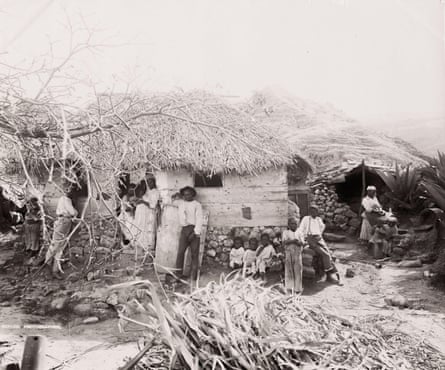 Workers on a sugar plantation in Barbados in the 19th century. Photograph: Chronicle/Alamy
Bazelon has given a detailed breakdown of the methodology and figures: “The value of the labour that was provided but not compensated, it’s somewhere betweenUS$500bn and US$700bn. But of course, an enslaved person working in Barbados had much of their life stolen from them as well. So, I think it’s very proper to include the short lifespan of people who were enslaved in Barbados. And the short lifespan estimate is anywhere from about US$1.1tn to US$1.3tn. So if you add them together you end up with a range of about US$1.6tn to US$2tn as the value of the labour and life directly stolen from people in enslaved Barbados.”
He added: “The important contextual point is that there were [about] 379,000 people who got off the boat from Africa in Barbados … There were another 78,000 people who got on the boats but didn’t get off, who died during the middle passage. And then we estimate another 335,000 people who were born into slavery in Barbados.”
The findings provide an understanding of the significant size of the harm done.
Prof Alan Lester, from the University of Sussex, a leading expert on the British empire, said: “It’s not surprising that – when you add up the value of lives appropriated to make money in Barbados, Britain’s oldest slave plantation colony – you get such an enormous figure.
“The inequalities entrenched by slavery have only been exacerbated since, as compensation was paid to slave owners rather than the enslaved and independence left Caribbean islands drained of capital and indebted to western institutions.”
The 2023 Brattle analysis estimated that the value of harms from transatlantic chattel slavery in 31 territories in the Americas and the Caribbean amounted to US$100–131tn in total, of which US$77-108tn represented harms during the period of enslavement, and US$77-108tn the continuing harms since.
The analysis was commissioned after an international symposium on reparations and international law concluded that transatlantic slavery was unlawful.
Last month 123 nations at the UN general assembly voted that chattel slavery was the gravest crime against humanity. The US, Israel and Argentina voted against the resolution, while 52 countries, including the UK and other many European countries abstained. Previously, the UK prime minister, Keir Starmer, has ruled out direct monetary payments for reparations.
David Lascelles, the co-founder of Heirs of Slavery, a group of descendants of British enslavers who encourage others to acknowledge and discuss reparative justice, said: “My distant ancestor Henry Lascelles made his fortune in Barbados in the 18th century. Now, 300 years later, it’s high time we all recognise there is a debt to pay, a debt that is of course about money, but not just about money.”
Alex Renton, another co-founder of the group, added that “addressing the legacies of this most terrible event in Britain’s modern history is the right thing for the nation to do, morally and practically”.
Explore more on these topicsShareReuse this content